Alchemy of the Void: Nonlocal Magic of Particle Birth ✛ ✎ ✦
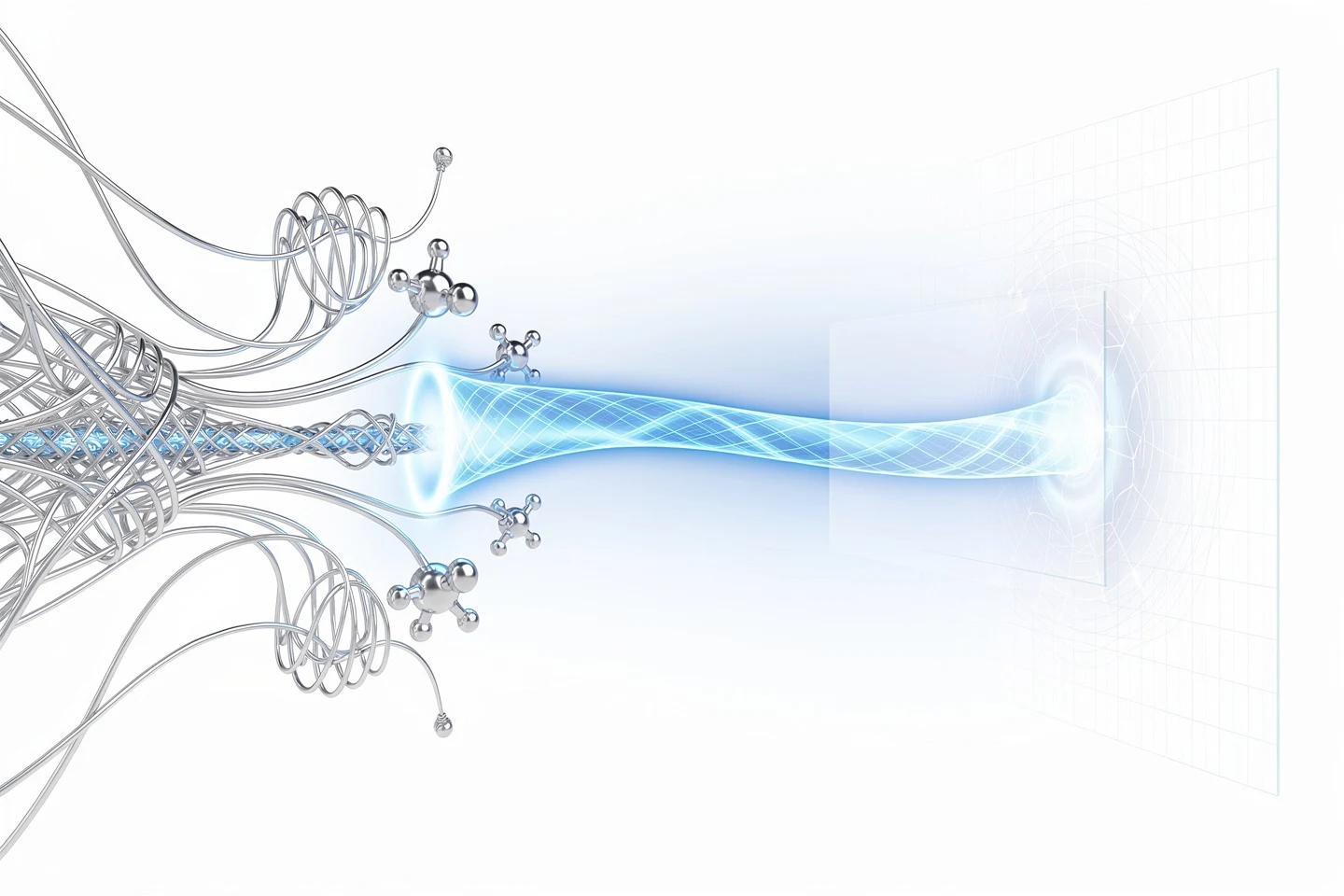
When an electric field reaches monstrous strength, emptiness ceases to be empty. Back in the mid-20th century, Julian Schwinger showed that the vacuum literally explodes with pairs of particle-antiparticle if the field is intense enough. This process, akin to the radiation of Stephen Hawking, long remained a theoretical curiosity. Today, with the development of ultra-powerful lasers and holographic methods, it becomes a window into the hidden structures of the quantum world.
The vacuum is like an alchemist's crucible, and the ultra-strong gauge field is the heat that draws from emptiness not gold, but something more precious. The product of the reaction is pairs of elementary particles, but hidden within them is a 'philosopher's stone': nonlocal magic, correlations that surpass ordinary entanglement.
In a new study, physicists used holographic duality to peek behind the curtain of standard entanglement. Holographic duality, discovered by Juan Maldacena, links gauge theories with string theory in a curved higher-dimensional space. Here, the born pair is modeled as an open string whose ends stretch in opposite directions, and its worldsheet turns out to be a two-dimensional spacetime with a horizon. The entanglement entropy of the pair is computed via the area of this horizon — an idea tracing back to John Wheeler's intuition about the inextricable link between information and geometry.
But the researchers went further. Using the Casini–Huerta–Myers method, they computed not just entropy, but its 'capacity'—a quantity showing how unevenly the probabilities are distributed in the entanglement spectrum. If entropy is the total weight of the mined metal, then capacity is the measure of its fineness: how much individual ingots differ in purity. The result is staggering: when the spacetime dimension is greater than two, the capacity is strictly positive and given by the formula $C_E$ = √λ·(d-2)/(d-1)³. In the familiar four-dimensional case, this is 2√λ/27. Remarkably, at d=2 (three-dimensional spacetime), the capacity vanishes — magic disappears, as if the two-dimensional world is too simple for nonlocal patterns. This contrast hints at why our Universe is three-dimensional for quantum complexity. Positive capacity is a precise signature of nonlocal magic: the born pair carries correlations that cannot be reduced to ordinary entanglement. They require for their description operations that go beyond the so-called stabilizer formalism. Simply put, each such act of creation endows particles with a hidden pattern that cannot be unraveled without a full quantum toolkit.
This work is not just an exercise in abstract mathematics. It sheds light on fundamental problems. The wormholes on the string worldsheet are linked to the geometrization of quantum complexity: perhaps gravity itself encodes such magic resources. Already Stephen Hawking showed how quantum effects near the event horizon give birth to particles, and now it becomes clear that these correlations may carry a magic structure. For physicists studying heavy-ion collisions, this means that in the fire of colliders, not just elementary building blocks are born, but states with nontrivial internal drama. And for quantum computer developers: that natural processes can serve as a source of valuable non-stabilizer states. Already today, related ideas are being tested in lattice simulations on prototypes of quantum processors.
The term 'magic' in quantum resource theory refers to states that cannot be efficiently simulated on a classical computer. Nonlocal magic is that part of magic that persists even after local unitary transformations, like an indelible watermark of correlations.
The idea that wormholes (in this case on the string worldsheet) are the geometric embodiment of quantum entanglement echoes the concept from 'Interstellar', where a wormhole connects distant points of spacetime — only here the bridge is built not of stars, but of the structure of string theory itself.