object

microparticle

A particle with dimensions on the order of micrometers, often used in materials science.
14 related articles

Description

Microparticles are tiny objects with sizes ranging from about one micrometer (a thousandth of a millimeter) to a few hundred micrometers. At this scale, materials behave differently than in bulk: surface forces, electrostatic interactions, and shape-dependent packing become dominant. In materials science, microparticles are the building blocks of powders, granular materials, and many industrial products, from pharmaceuticals to 3D printing powders.

History

The systematic study of microparticles emerged with the development of microscopy and colloid science in the 19th century, but the term 'microparticle' became standard in the 20th century with advances in aerosol science and powder technology.

How it works

The behavior of microparticles is governed by a balance of forces that are negligible for larger objects. Gravity becomes less important, while van der Waals forces, capillary forces from moisture, and electrostatic charges take over. Shape matters enormously: irregular or faceted particles interlock mechanically, making piles more stable than those of smooth spheres. This is why a heap of shaped particles can defy easy collapse, as explored in studies of granular jamming.

In practice

Microparticles are used in drug delivery systems, where they control the release of active ingredients, and in the fabrication of metamaterials and photonic crystals, where their precise arrangement determines optical properties.

Fun fact

Raindrops can eject microparticles of plastic from the ground into the atmosphere, where they travel thousands of kilometers before falling elsewhere.
Concept graph →

Related articles · 14

Optics2026-08-193 minarXiv:2608.19016
A Silicon Atom in the Dark: A Trap That Doesn't Glow
The laser beam in an optical tweezer is not just a spot of light but a force bag. A particle caught in it usually rolls toward the brightest point, like a ball into a dimple.
Exoplanets2026-08-151 minarXiv:2608.15068express
Laser Instead of Meteorite: How Melted Craters Are Born
On the surface of the Moon and asteroids, you can find pits smaller than a pinhead but with shiny, melted rims. Such marks are left by tiny meteorites, but the exact impact speed at which melting occurs remained unclear.
Optics2026-07-032 minarXiv:2607.03563express
Virus-Sized Laser Lights Up on a Gold Substrate
A typical laser is a cavity where light bounces between mirrors and gets amplified. But you can ditch the mirrors and make light circulate inside a tiny particle smaller than the light wave itself. That's how the new lasers work: nanoparticles of indium phosphide sitting on perfectly smooth gold.
Exoplanets2026-06-231 minarXiv:2606.24028express
Moon Dust May Reveal Alien Technologies
The Moon is a natural archive that has been collecting cosmic dust for billions of years. Among the microscopic grains that arrived from distant stars, there could be techno-specks — particles created by alien civilizations.
Quantum Physics2026-06-172 minarXiv:2606.19585express
Noise in the Trap: Dust Grains vs. Quantum
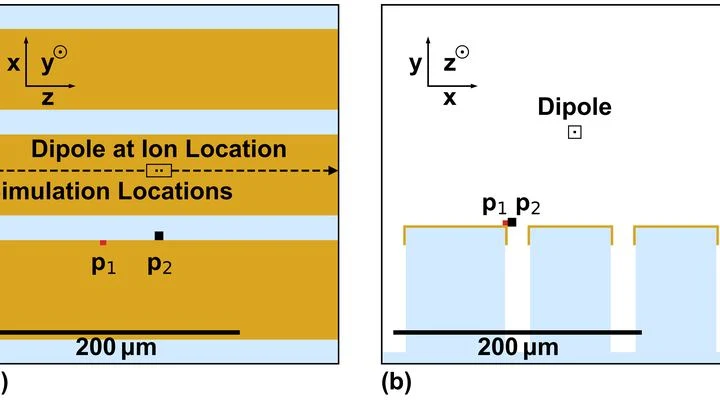
A quantum computer is like an orchestra where each ion is a musician and laser pulses are the conductor's baton. But if someone in the audience rustles, the delicate melody of quantum states goes off key.
Fluid Dynamics2026-06-141 minarXiv:2606.15885express
How Microbes Steer the Fate of Ocean Plastic
A microplastic particle drifts on the surface of a warm sea. Within days, invisible hitchhikers, bacteria and single-celled algae, cover it. This living film acts as ballast: the particle becomes heavier and starts to sink. In a new global model, oceanographers have for the first time tracked the fate of such "hitchhiking" plastic across the entire planet.
Optics2026-05-092 minarXiv:2605.08880express
A Flat Lens That Pretends to Be Thick Glass
Light needs space. A camera lens sits several centimeters from the sensor so the rays have room to focus. Now, that gap has been squeezed to the thickness of a sheet of paper, and light still behaves as if it had traveled its rightful centimeters. That's what 'spaceplates' do: flat elements that mimic free-space propagation.
Microdischarges: Sparks on the Tip of a Dust Grain
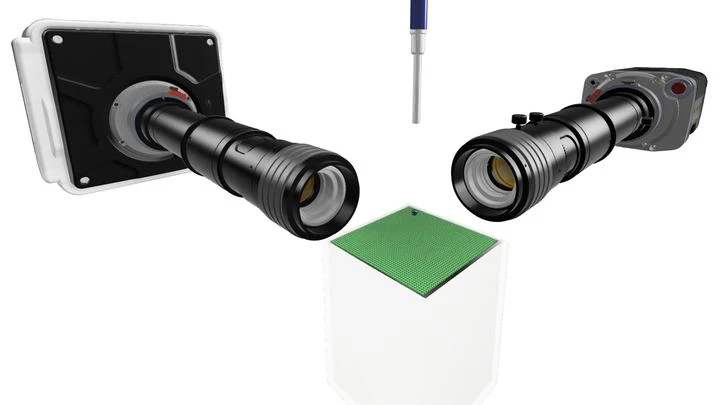
A dust grain hangs in the air, held by an invisible beam of light. Around it is ordinary air, but sometimes a tiny spark jumps across the grain. For the first time, scientists have observed such discharges up close and found that they are triggered not by the grain itself, but by invisible visitors from space and from the ground.
Materials2026-04-131 minarXiv:2604.11397express
How Metal Gets Stronger: The Dance of Defects
When you pull on a piece of metal, it changes shape and simultaneously becomes stronger. The secret lies in tiny defects in the crystal lattice called dislocations. They are like wrinkles in a rug: moving a wrinkle shifts the rug more easily than dragging the whole rug.
Fluid Dynamics2026-03-161 minarXiv:2603.15896express
How Rain Launches Microplastics into the Air
The Sun drives the water cycle, and rain returns it to the ground. But now, every drop is a tiny hammer striking the surface. Floating plastic particles (microplastics, mostly carbon) upon impact jump up like popcorn kernels on a hot skillet. But instead of popping, they get wrapped in a thin water film and turn into weightless beads.
Fidgety Molecules: How Internal Order Changes Behavior
A drop of ink in a glass of water spreads out on its own. But if the ink were made of tiny motors, they wouldn't just spread: they'd crawl, jostle, and cluster into swarms. Such self-propelled particles are called active. You can assemble them into molecules like beads on a bracelet. And here's the surprise: the order of beads on the bracelet changes everything.
Hunting Light Dark Matter with a Silicon Detector
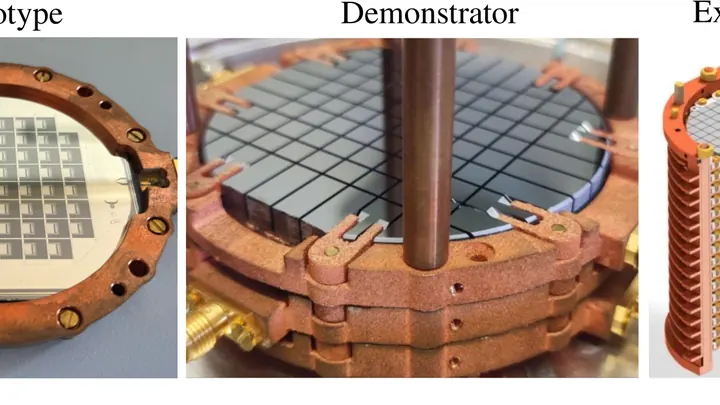
Dark matter is the invisible substance that holds galaxies together, yet it has so far escaped direct detection. The BULLKID-DM detector is designed to catch candidate particles with a mass around 1 GeV (roughly that of a proton) and an extremely weak interaction with ordinary matter — a…
Galaxies2026-01-191 minarXiv:2601.12728express
Cosmic Bullets in Cloud W44
In the dense, star-forming gas cloud W44, the ALMA telescope has spotted eight tiny clumps racing at enormous speeds. In position–velocity maps, each one looks like the letter V, just like the previously discovered 'Bullet'. This resemblance hints at a common origin.
Why a Pile of Odd-Shaped Particles Doesn't Collapse
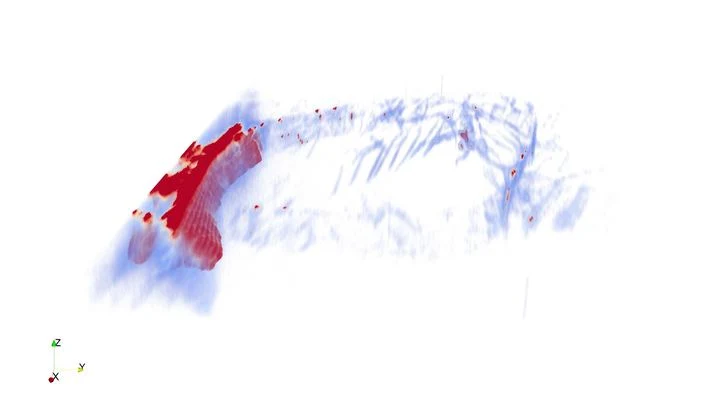
Pour a handful of dry sand: it will spread into a neat cone. Now grab a box of star-shaped pasta: the pile will stand almost vertical. Why? It's all about particle shape. Physicists built cylindrical piles from particles of different geometries — from smooth spheres to 'polypods' with several arms, like a sea star.