concept

string theory

String theory is a theoretical framework in physics where point-like particles are replaced by one-dimensional strings.
10 related articles · 1 formulas · 6 who worked here

Description

String theory is a model in which elementary particles are represented not as points, but as one-dimensional objects—strings. Different modes of string vibration correspond to each known particle: quarks, electrons, and even the hypothetical graviton. For internal consistency, the theory requires additional dimensions: superstrings exist in 10-dimensional spacetime. These dimensions are compactified (curled up) to scales of the Planck length—about 10⁻³⁵ m, which is why we do not observe them. There are variants: bosonic string, supersymmetric strings, and M-theory with membranes.

History

In 1968, Gabriele Veneziano discovered that Euler's beta function describes the scattering amplitude of mesons. This led to the dual resonance model, which Yoichiro Nambu, Holger Nielsen, and Leonard Susskind interpreted as a quantum theory of relativistic strings. In the 1970s, the bosonic string suffered from tachyons, but the addition of supersymmetry and fermions led to superstring theory (John Schwarz, Michael Green). In 1984–86, the 'first superstring revolution' showed that 10-dimensional superstrings are free of anomalies and can incorporate the Standard Model. The mid-1990s—the 'second superstring revolution'—revealed dualities and a unifying M-theory (Edward Witten).

How it works

The string action generalizes the action of a point relativistic particle: instead of a worldline—a worldsheet (two-dimensional surface) in spacetime. The quantum behavior of the string leads to the requirement of a conformal field theory on the worldsheet. The mass spectrum is discrete, and for a closed string, the massless spin-2 excitation corresponds to the graviton, automatically incorporating gravity. Interactions are described by Feynman diagrams, but with the topology of worldsheets—without ultraviolet divergences, yielding a finite quantum theory of gravity. Upon compactification, the extra dimensions determine the set of massless fields and symmetry groups of the effective theory. The superposition principle applies to string states.

In practice

There are no direct applications yet, but the mathematical apparatus of string theory is used for studying black holes and quantum entanglement, and in the future may become the basis of a unified 'theory of everything'.

Fun fact

If a string were the size of an atom, then the atom itself would have a diameter spanning an entire galaxy.

Concept graph →

Formulas

$$f_{\text{cut}} \propto \left(\frac{T}{G\mu}\right)^{1/2}$$
The cutoff frequency scales with temperature and string tension.
What is in the formula
f_cutvariableCutoff frequency for string formation — frequency hertz
TvariableTemperature of the system — temperature kelvin
GvariableNewton's gravitational constant — gravitational constant cubic metre per kilogram per second squared
μvariableString tension (mass per unit length) — string tension kilogram per metre
f_{{cut}}\approx8.67*10^{-3}{hz}(\frac{t_{{qcd}}}{{gev}})(\frac{10^{-11}}{gμ_0(v_x)})^{1/2} · 2606.05320v1

Related articles · 73

HEP Theory2026-08-062 minarXiv:2608.06016express
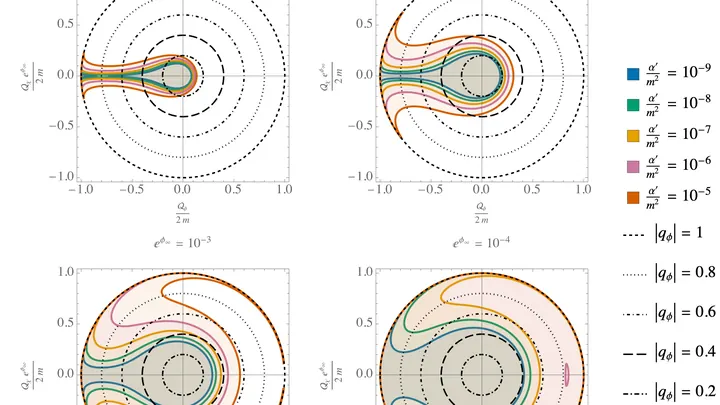
Hairy Black Holes and Strings
A black hole is not just a dark sphere. In string theory, it can grow 'hair'—extra scalar fields such as the axion and the dilaton. These fields gently alter the geometry of space around the hole.
Black Holes Sound Different in a Curved World
A black hole rings like a bell after being struck. This ring is the gravitational waves that detectors pick up. But what changes if the space around the hole is curved not only by its mass but also by an additional quantum correction?
HEP Theory2026-08-042 minarXiv:2608.03864express
Cosmic String Without a Singularity
The universe sometimes resembles an old fabric: after rapid cooling, wrinkles could have remained — thin, almost invisible threads of monstrous density. They are called cosmic strings. Usually, at the center of such a string hides a singularity — a point where the laws of physics lose their meaning.
Mesoscale2026-08-032 minarXiv:2608.02431express
Quantum Waves in the Macroworld: A Hair-Thin Wire
A thin silver thread nearly as long as a hair's width, and inside it, pristine quantum laws hold sway. Physicists built a conductor where electrons can only move forward or backward, like on a perfectly straight single-lane road with no shoulders. On such a road, any pothole or pebble would normally destroy the fragile quantum state.
General Relativity2026-08-032 minarXiv:2608.02742express
How Quanta Carry Away Spin from Stellar Pairs
Two stars circle each other, gradually drawing closer. Their dance loses energy, and that energy escapes into space — in the form of gravitational waves, and sometimes other fields.
HEP Theory2026-07-292 minarXiv:2607.27318express
The Universe Puts String Theory to the Test
Light from the very beginning of the cosmos has been traveling toward us for 13.8 billion years. During that time, its polarization, the direction of its oscillations, might have been twisted, like a compass needle that someone quietly nudged. Physicists call this phenomenon cosmic birefringence.
Cosmology2026-07-282 minarXiv:2607.25317express
Current-Carrying Cosmic Strings and Their Gravitational Imprint
Right after the Big Bang, space cooled unevenly. In some places, folds could have formed — threads of energy as thin as a hair but incredibly dense. Physicists call them cosmic strings. They oscillate, collide, and emit gravitational waves — ripples in the fabric of space itself.
HEP Theory2026-07-282 minarXiv:2607.26124express
Cosmic Strings: Echoes of the Universe's Birth
In the first fractions of a second after the Big Bang, the universe was a stage of rapid change. A stretched rubber sheet that cools quickly becomes covered with microscopic cracks. A similar process on a cosmic scale could have given rise to cosmic strings — ultra-thin but super-dense threads of energy stretching across the entire universe. These strings are not just defects in space.
When the Universe Freezes: Gravitational Waves from Cosmic Strings
The early Universe was like a rapidly cooling ocean. At colossal temperatures, everything was one — quarks, electrons, forces all blended into a symmetric 'steam.' But as it expanded and cooled, this steam condensed, phase transitions cascading one after another like water turning to ice.
HEP Theory2026-07-172 minarXiv:2607.16120express
The String That Refuses to Go Quiet
Pluck a guitar string, and it will vibrate and quickly fade. Now imagine a cosmic string: an ultra-thin filament of pure energy left over from the Big Bang, trillions of times thinner than an atom and denser than a neutron star. Strike it, and it might sing for billions of years.
HEP Theory2026-07-172 minarXiv:2607.16134express
A Black String in Imaginary Time
Quantum gravity is a lot like bookkeeping: every possible trajectory is an entry in the ledger, and to tally the accounts you have to sum them all up.
Topology by Aroma: How One Spin Gives Away the Quantum Phase
For a long time, identifying quantum phases was like interrogating a witness: you had to reach every corner of the system to uncover its secret. In the era of Landau, order was tied to symmetry breaking and a local parameter — everything plain as day.
Cosmology2026-07-064 minarXiv:2607.04893
The Universe's Dance Floor: When Dark Matter Breaks into a Quantum Rhythm
Ever since Fritz Zwicky noticed that galaxy clusters were moving too fast, and Vera Rubin measured the rotation of spiral arms, dark matter has remained cosmology's greatest mystery.
Strongly Correlated2026-07-032 minarXiv:2607.03534express
Spacetime Bricks: How Tensor Networks Catch an Elusive Field Theory
In quantum physics, there are theories where everything follows clear proportions, like a musical rhythm that always returns to the beginning of the bar. But there are also 'irrational' theories where the rhythm breaks and predicting the next beat is nearly impossible. One such theory is the compactified boson: a particle lives on a circle, and its behavior depends on the radius of that circle.
Brane Shadows: Searching for Hidden Dimensions on the Canvas of the Universe
The universe as painted in Einstein’s textbooks is a smooth four-dimensional canvas. But string theory adds a frame of extra dimensions — invisible, yet tangible to gravity. Imagine our universe as a membrane that trembles under the pressure of hidden layers.
Cosmology2026-06-233 minarXiv:2606.24886
HEP Theory2026-06-161 minarXiv:2606.17602express
Strings Before the Birth of Gravity
Superstring theory tries to describe everything in the world as vibrations of unimaginably tiny threads. But even these threads have their own bookkeeping. When physicists calculate the energy of empty space, they have to go through all possible string states, like a cashier who must scan every item in a huge hypermarket. Some items are later returned, but first they must be accounted for.
HEP Theory2026-06-141 minarXiv:2606.15988express
Why Particles Refuse to Live Alone
In the microcosm, long-range forces, gravity or electricity, do not switch off even at enormous distances. Therefore, any particle drags behind it a trail of soft (i.e., very low-energy) photons or gravitons. This trail is called the "dress"; without it, calculations fall apart and infinities appear.
General Relativity2026-06-122 minarXiv:2606.14549express
Gravity in Five Dimensions: What the Waves Say
When a distant galaxy sends us light, it dims with distance, and from that dimming, we can tell how far away it is. Gravitational waves work in much the same way: the farther their source, the weaker the ripple in space that detectors on Earth pick up.
General Relativity2026-06-122 minarXiv:2606.14815express
Quantum Corrections to a Black Hole in a Dark Web
A black hole is not just a cosmic vacuum cleaner. It is a region with such strong gravity that even light cannot escape it. But place it in a perfect fluid of dark matter and add a cloud of strings, thin filaments stretched across all of space, and the picture gets more complicated.
General Relativity2026-06-102 minarXiv:2606.12698express
A Black Hole of Loops and Shadows
Drop a pebble into a pond, and ripples spread across the water. A black hole 'sounds' much the same when matter falls into it or when its spacetime gets a gentle jolt. These fading oscillations are called quasinormal modes, like the tolling of a bell that gradually fades away.
Quantum Physics2026-06-092 minarXiv:2606.10318express
String and Light: How to Tune Their Dance
A guitar string is stretched between two mirrors. A beam of light bounces back and forth between them, and the string shudders at every touch. Sometimes the light loses energy — the string takes it and dissipates it as heat, like a fading sound. Other times, the string shifts the pitch of the light itself, changing its color but barely dimming it.
HEP Theory2026-06-092 minarXiv:2606.10924express
Reading Gravity in the Alphabet of Particles
An orchestra plays out of tune, and the sound seems like chaos. But if you record all the notes and analyze them mathematically, you can reconstruct the shape of the concert hall — where the walls are, how high the ceiling is. Roughly in this way, physicists propose to derive gravity from quantum theory. In everyday life, space and time are the stage on which events unfold.
HEP Theory2026-06-072 minarXiv:2606.08767express
Strings After the Bang: Dark Radiation Under Control
The early universe resembled a tightly stretched rubber band. In some theories, this band is not just space but enormous oscillating strings whose tension made the world expand at an unimaginable rate. When the band snapped (that is, when inflation ended) the strings collapsed and annihilated like popping bubbles in a boiling pot.
math.AG2026-06-061 minarXiv:2606.07960express
How Strings Recount Worlds
An intricate carpet with a pattern that is invisible to the eye but strictly defined. Every thread in it follows rules that can be written as equations. In mathematics, the role of such a carpet is played by Calabi-Yau spaces — multidimensional shapes important for string theory. The curvature of spacetime in them resembles folds in fabric.
The Snapping Cable of Reality: How Finite String Thickness Accelerates Quantum Decay and Reshapes the Gravitational Hum
Immediately after the Big Bang, in the seething cauldron of the cooling Universe, much like in unevenly hardening glass, stresses appeared — hairline cracks in reality, cosmic strings. Picture a tightrope walker balancing on an invisible cable stretched across the abyss of warped spacetime.
HEP Theory2026-05-301 minarXiv:2606.00617express
Neutrinos on a Twisted Path
Two pebbles drop into water, and the ripples on the surface intersect, blending their patterns. Neutrinos behave much the same way: light particles that pierce us by the billions every second. They can transform from one type to another, like an actor changing masks. Physicists call this dance oscillations.
General Relativity2026-05-262 minarXiv:2605.27514express
How to Tell a Quantum Crystal from a Foam
Spacetime is often pictured as a smooth fabric. But at the very microscopic level, this fabric might not be continuous; instead, it could consist of individual 'atoms'—events linked by causality. This picture of the world is called causal set theory.
General Relativity2026-05-241 minarXiv:2605.24967express
Spacetime turns grainy when measured
You can zoom into a high-resolution photo for a long time — until suddenly a smooth face dissolves into individual pixels. Something similar, according to a new study, happens to spacetime itself. The authors propose that tiny intervals of length are not pre-existing 'parts' of the universe but results of measurements.
General Relativity2026-05-232 minarXiv:2605.24704express
A Black Hole Listens: How Sound Emerges from Disturbance
Strike a bell, and it rings. But the sound isn't arbitrary: the bell itself picks out the notes to which its metal is tuned. It turns out a black hole behaves the same way. When something falls into it, or its spacetime gets warped, it starts to oscillate.
Cosmology2026-05-211 minarXiv:2605.22944express
Strings of the Cosmos: How to Catch the Universe's Tremors
A fundamental string plucked at the moment of the Big Bang doesn't just hum a single note — waves run along it, and occasionally tiny loops peel off. These loops, like tuning forks, begin to ring at their own frequency, producing a very high-pitched sound.
Cosmology2026-05-191 minarXiv:2605.19953express
Hidden Dimensions in Ancient Light
Ancient light, traveling 14 billion years, reaches us from all directions. At first glance, it looks perfectly smooth, but if you look closely, tiny fluctuations appear, like ripples on a still pond. Those ripples aren't random noise; they're an encoded history of the universe.
HEP Theory2026-05-192 minarXiv:2605.20324express
Strings Out of Tune: When Measurements Aren't Precise Enough
Unlike the Standard Model, where fundamental particles are point-like objects with no internal structure, string theory describes them as tiny vibrating threads — one-dimensional extended objects.
HEP Theory2026-05-122 minarXiv:2605.11805express
How Gravity Learns from Quantum Mechanics: The Invisible Tuning of Forces
A guitar string decides for itself how tightly to stretch when a musician plays a chord in different octaves. That's roughly the picture physicists paint when they try to unite gravity, the weakest but most pervasive force, with the quirky laws of the microcosm.
HEP Theory2026-05-122 minarXiv:2605.11945express
How String Vibrations Reshape the Geometry of Spacetime
Strings in physics don't just vibrate: they live in a space that itself can change its properties. Sometimes, additional fields, akin to invisible lines of force, are superimposed on this space.
The Silent String of Gravity: Hunting for κ
The weak equivalence principle, silently tested since the time of Galileo and laid at the foundation of general relativity, states: all bodies fall equally, regardless of their internal composition.
Cosmology2026-05-111 minarXiv:2605.10476express
Dark Energy Isn't Constant?
For a long time, dark energy, the mysterious force prodding the expansion of the Universe, was considered eternal and unchanging, like yeast that never loses its activity. But explaining such constancy through the laws of the microcosm proved impossible, and scientists began to suspect that the “leaven” might be going flat.
The Quark Symphony of a Neutron Star
The core of a neutron star can be likened to a taut string of super-nuclear density. Sound traveling along it is the oscillation of pressure, whose speed $$c_s$$ betrays the stiffness of matter. New research shows that this cosmic string does not hum monotonically.
HEP Theory2026-05-081 minarXiv:2605.08347express
Fluffy Black Holes: The Flickering Tangle and the Paradox
A black hole is usually depicted as an abyss with a point of no return. To save information, which quantum laws forbid from disappearing, physicists replaced that boundary with a fluffy tangle of microscopic strings. Infalling data gets permanently imprinted into its intertwined threads.
HEP Theory2026-05-062 minarXiv:2605.05336express
Wormholes Set Limits on Imagination
Spacetime sometimes resembles a sheet of paper in which you can punch a hole and connect the edges with a short tube: you get a wormhole. In the simplest mathematical models of such wormholes, massless scalar fields appear — something like an invisible fog filling everything around.