Scientist

Hendrik Casimir

1909-2000 · Theoretical Physics, Quantum Electrodynamics, Low-Temperature Physics
Dutch theoretical physicist, known for predicting the Casimir effect — an attractive force between uncharged conducting plates in a vacuum, arising from quantum fluctuations. Also contributed to low-temperature physics and superconductivity.

Biography

Born in The Hague. Studied at Leiden University, where he worked with Paul Ehrenfest. Then conducted research at the Philips laboratory in Eindhoven, where he worked most of his career. Collaborated with Niels Bohr, discussing the nature of van der Waals forces. Served as president of the European Physical Society. Awarded the Matteucci Medal and other honors.
Key discoveries

💡 Wrote poetry and was part of an informal poetry society 'The Inkwell Club'.
"He saw the Casimir effect as a manifestation of the reality of zero-point fluctuations of the vacuum."
Concepts
Quantum Fieldsuperconductivity
Laws
Casimir effect
Scientists
Satyendra Nath BoseEmilio Gino SegrèPaul DiracPeter HiggsRichard FeynmanWerner HeisenbergFrank WilczekJohn Bardeen

Related articles

Quantum Physics2025-10-091 minarXiv:2510.07844express
Listening to the Shudder of Space: The Nano-Mirror Experiment
Two great theories describe reality: one — how massive bodies cause curvature of space, the other — the Standard Model — governs elementary particles. Reconciling them remains elusive, like trying to describe an ocean storm in the language of a diamond lattice.
Quantum Physics2025-12-051 minarXiv:2512.06076express
How the Quantum Vacuum Blurs Time
Time is like a highway: from afar it looks flawlessly paved, but zoom in and every pothole appears. These bumps are the quantum fluctuations of the vacuum, making it impossible to measure the journey exactly. Physicists built a clock model whose operation relies on spontaneous particle creation from the void.
General Relativity2025-12-192 minarXiv:2512.18008express
Warp Drive Without Turbulence: The Path to the Stars Just Got Cheaper?
A classic rocket is limited by the speed of light: as mass increases, acceleration demands infinite energy. But Einstein's equations allow a workaround — not pushing the ship through space, but making space itself move. The warp drive idea: compress the region ahead and expand it behind, creating a 'bubble' that glides through space faster than light.
Quantum Physics2026-01-012 minarXiv:2601.00483express
Levitation on Quantum Glue: The Casimir Effect in Action
The space between two closely spaced surfaces is far from empty: it's a seething "quantum glue." Within it, quantum fluctuations continuously pop in and out of existence: microscopic bursts of energy in electromagnetic fields that, according to quantum theory, give the vacuum a dynamic structure.
Optics2026-01-102 minarXiv:2601.06657express
Glowing Knots on a Chip
A drop of ink falls into a glass of water, and instead of a flat stain, a ring is born that immediately starts to spin. That's roughly what the birth of a skyrmion looks like: light emitted by a tiny source twists into a stable vortex. Until now, such vortices could only be produced by large lasers.
Optics2026-01-131 minarXiv:2601.08191express
How Empty Space Alters Superconductors
Empty space is never truly still. It teems with tiny energy fluctuations, like a sculptor's raw clay. In a new experiment, a thin film of superconducting material was placed inside a cavity designed to trap terahertz light, a form of invisible radiation. The cavity acted as a mold, shaping the vacuum fluctuations around the film.
Statistical Mech2026-01-192 minarXiv:2601.12935express
Invisible Glue: How Order Attracts Disorder
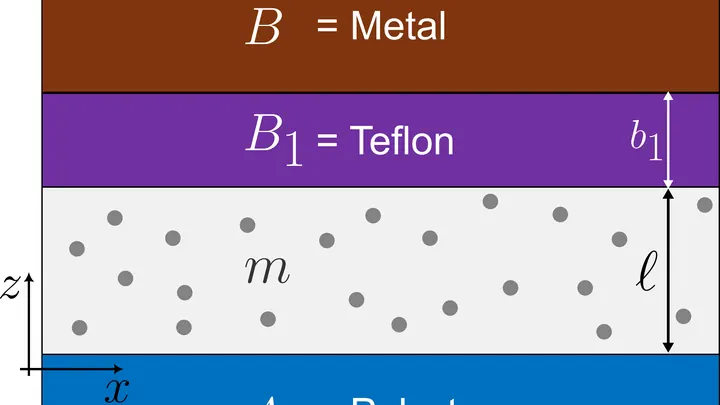
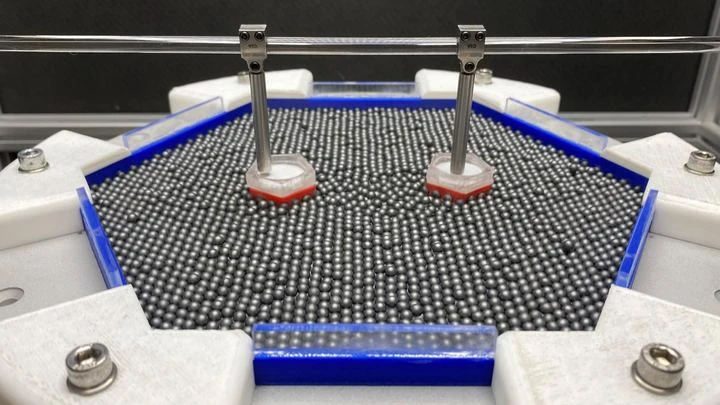
Shake a jar of sand and marbles, and you'll see large objects float or sink depending on their size. But if you shake it cleverly, you can make the marbles gather into pairs and chains, as if glued together. It's this kind of 'invisible glue' that physicists from India and Germany have now caught and measured for the first time.
Quantum Physics2026-01-201 minarXiv:2601.14381express
Magnetic field turns the void into a motor
Two metal plates in a perfect vacuum attract each other. Even Richard Feynman compared emptiness to a boiling foam: particle pairs are born and immediately vanish, creating the Casimir effect. If the plates are asymmetric, they also start to twist — that's a vacuum motor. But rotation doesn't require oddly shaped parts.
Quantum Physics2026-02-142 minarXiv:2602.13829express
A Levitating Sphere Measures Invisible Forces
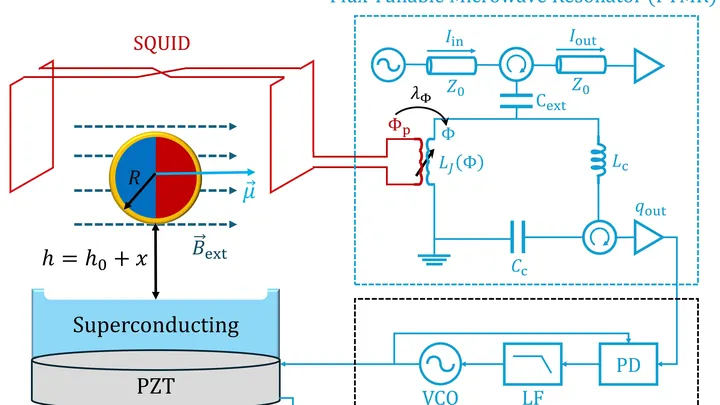
A magnetic sphere hangs in a vacuum above a cold metal plate. No strings, no stands — only the invisible field of a superconductor keeps it from falling. Give the sphere a gentle nudge, and it starts to oscillate up and down; the frequency of those oscillations depends on how strongly the plate pulls on it.
Applied Physics2026-02-211 minarXiv:2602.18730express
Liquid and Ultrasound Move Objects Without Touch
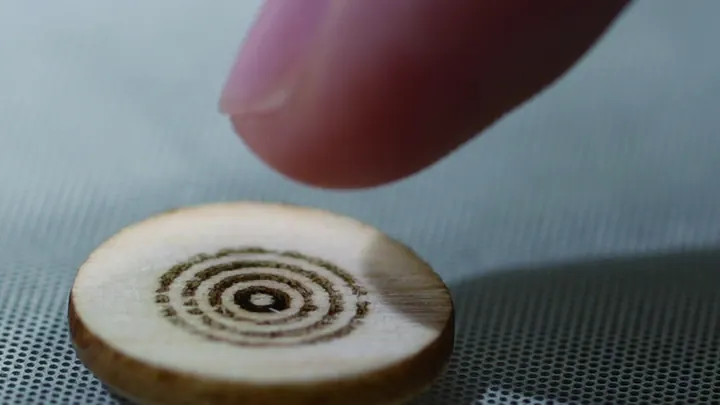
On the table sits a plastic figurine. Underneath it is a drop of water, and around it, a mesh that keeps the drop from spreading. From below, inaudible sound waves strike the drop, propelling it, and the figurine glides across the table like a little boat on an invisible river. No motors, no wires, just sound and water.
Optics2026-02-261 minarXiv:2602.23476express
The Light That Shakes Mirrors
You can squeeze light between two mirrors like a spring in a vise. It bounces back and forth, growing denser: that's how you get ultra-bright beams. But there's a limit: at too high a brightness, the mirrors start to shake. The light rocks them the way wind rocks a swing, and some energy leaks into that jitter.
HEP Experiment2026-02-271 minarXiv:2602.23835express
How Particles Are Born from the Void
In a circular accelerator, electrons are accelerated to nearly the speed of light and smash into positrons: their antiparticles. At the collision point, a burst of pure energy briefly appears, from which new particles are born. The BESIII detector, like a high-speed camera, captures the tracks of these short-lived guests.
HEP Theory2026-03-212 minarXiv:2603.20880express
Light in the Crooked Mirror of Emptiness
Light travels across a room, bouncing off mirrors and walls. The emptiness in between seems perfectly neutral: it doesn't hinder the beam or curve its path. But what if, at the deepest foundations of the world, emptiness is more complex? Physicists have long suspected that the symmetry of space might break at tiny scales, and then light would behave differently.
Mesoscale2026-04-031 minarXiv:2604.02961express
Electronic Vortices Sang on Nanostrings
In the cold heart of a pure crystal, electrons flow like a viscous fluid — an idea predicted by Lev Landau. But the vortices of this fluid remained invisible, like a painting inferred from the noise of a crowd. Now scientists have created a nanostring: a semiconductor tuning fork with a circular cavity.
Quantum Physics2026-04-062 minarXiv:2604.04856express
Memory in Motion: How Light Reads the Traces of the Past
Throw a stone into a pond — the ripples spread and die down. But if the water is thick, like syrup, the waves will keep coming back for a long time. That's exactly how the environment around a tiny mirror in a laser trap behaves: it doesn't just dampen the oscillations; it remembers them.
Atomic Physics2026-04-081 minarXiv:2604.06703express
Quantum Noise Saves Electronic Patterns
In a dark room, an invisible lamp flashes. Its light is unlike anything familiar: it has no steady brightness, only rare but powerful bursts. This is bright squeezed vacuum — a state of light with no ordinary wave but strong quantum fluctuations. It is with such light that physicists bombarded xenon atoms.
Quantum Physics2026-04-121 minarXiv:2604.10406express
Birth of Light from the Quantum Void
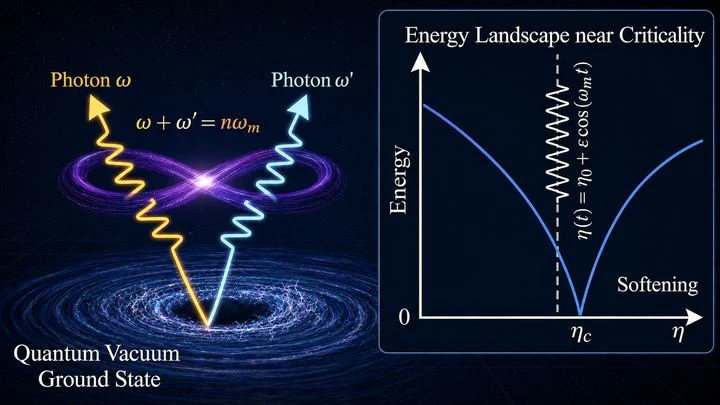
The quantum vacuum is not emptiness, but a tautly stretched string, where particles constantly appear and vanish. Abruptly changing conditions, like shifting the mirrors of a microcavity, causes the 'string' to emit real photons.
General Relativity2026-04-151 minarXiv:2604.14378express
The Rubber Band That Gives Birth to Antimatter
The void can produce particles if a strong enough field is applied. Physicists call this the Dirac–Klein paradox. Previously, explaining it required the most complex calculations of quantum field theory. But we can make do with a visual image: a tightly stretched rubber band with a knot. The knot is a particle.
Quantum Physics2026-04-161 minarXiv:2604.14721express
How the Void Sticks Atoms to the Wall
Vacuum is not silent emptiness, but a boiling cauldron of quantum fluctuations, born from nothing and vanishing in billionths of a second. This invisible symphony acts like a constant wind, pressing an atom against a wall — as if a powerful bass note pushes a light ball.
Strongly Correlated2026-04-182 minarXiv:2604.16847express
How Distant Bands Shuffle the Cards in the Quantum World
Two sheets of paper slightly offset, and against the light, a moiré pattern appears: dark and light stripes. The same happens with semiconductor layers like molybdenum telluride.
Optics2026-04-192 minarXiv:2604.17408express
Time Crystals: Light Trapped in an Infinite Well
A drummer beats a rhythm, and the drumhead vibrates in time. If you strike often enough, the vibrations overlap, and a nearly stationary zone, a node, forms at the center. A similar effect occurs with microwaves in a material whose properties change over time. When the changes resonate with the wave, its motion freezes.
HEP Theory2026-04-241 minarXiv:2604.22248express
Magnetic Field Makes Emptiness Bloom
An invisible film, a quantum field, is stretched over a rubber bagel. While the bagel is small, the film stays taut and doesn't sag anywhere: the vacuum remains empty. But once you stretch the bagel to a certain size, a dent spontaneously appears in the film — the field starts to be felt at every point. This dent is not random.
Quantum Physics2026-04-242 minarXiv:2604.22593express
Invisible Obstacles in the Hunt for Quantum Gravity
Physicists are trying to hear a whisper in a noisy room. They build a soundproof booth, but even inside, their own breathing and heartbeat create interference. That's roughly how the search for quantum gravity goes: they want to see gravity bind two particles into a single whole — entangle them.
Superconductivity2026-04-251 minarXiv:2604.23117express
Vortices Herd Together
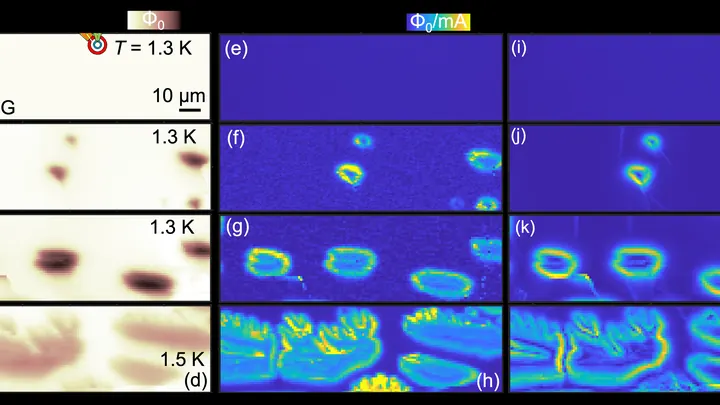
A magnetic field penetrates a superconductor not as a continuous flux but as thin filaments — vortices. Usually, they repel each other and arrange into a neat triangular lattice, like floats on water. But in CaSb₂, things went differently: vortices bunched into tight clusters, with almost empty space between them.
Mesoscale2026-04-261 minarXiv:2604.23713express
Disorder Traps Sound
Imagine a long corridor with an uneven floor: bumps here, pits there. If you roll a toy car along it, it will get stuck in the deepest pit, not where you gave it a push. That's roughly how sound behaves in a phononic crystal — a material made of periodically arranged elements that controls the propagation of elastic waves.
Quantum Physics2026-05-022 minarXiv:2605.01551express
Quantum Cocktail: How Light Creates Order from Chaos
Picture a crowded hall where each person is a molecule, and their private conversation is the motion of electrons within it. Normally, everyone talks to themselves, and the overall buzz is chaotic. But if a bright spotlight is turned on in the center, it begins to conduct the crowd: people synchronize their movements, even though the light merely reflects off the walls.
Alchemy of the Void: Nonlocal Magic of Particle Birth
When an electric field reaches monstrous strength, emptiness ceases to be empty. Back in the mid-20th century, Julian Schwinger showed that the vacuum literally explodes with pairs of particle-antiparticle if the field is intense enough.
General Relativity2026-05-101 minarXiv:2605.09783express
Black Hole Protects Vacuum from Disturbances
Normally, by rapidly oscillating a mirror in a vacuum, you can conjure real particles from nothing: this is the dynamical Casimir effect. But near a black hole, things are different. The spacetime curvature itself stifles any attempt to create something.
General Relativity2026-05-251 minarXiv:2605.25417express
Even a Slow Warp Violates Energy Rules
A warp bubble compresses spacetime in front of the ship and stretches it behind, like a boat pushing through water. The ship doesn’t accelerate to the speed of light; instead, it glides inside the bubble.
High Energy2026-05-251 minarXiv:2605.26387express
Magnetic Mirrors in Galaxy Clusters
A crowd is trapped in a narrow corridor between two rows of mirrors. Every now and then, someone shoves the wall hard, and a rumble rolls down the corridor — similarly, in the plasma of galaxy clusters, whistler waves and ion-cyclotron waves appear.
General Relativity2026-05-261 minarXiv:2605.26490express
How to Get Quantum Communication from Nothingness
Two antennas in a soundproof room pick up only noise. But if you spin them, especially in opposite directions, a common signal emerges from the static. Quantum sensors in a vacuum work similarly: acceleration helps them pull quantum entanglement out of the void — an invisible link akin to what forms near the horizon of a black hole.
Quantum Physics2026-05-292 minarXiv:2605.30815express
How a Laser and Mirrors Squeeze Time
An orchestra without a conductor: each musician hears only their neighbor and is slightly late or early. In ordinary atomic clocks, the picture is similar — atoms oscillate, but their rhythm is disrupted by thermal jitter, limiting timekeeping accuracy. However, a group of physicists has managed to turn this flaw into a feature.
HEP Theory2026-06-142 minarXiv:2606.16024express
Vacuum cracks not with a bubble but with a pair of rings
An empty glass on the table seems reliable. But if there's a microcrack in the bottom, one day it will break — not with a crash, but quietly, spreading in a web of lines. So too with the vacuum: it may not be the true vacuum but a false one — temporarily stable, yet ready to transition to a deeper, real state.
General Relativity2026-07-082 minarXiv:2607.07583express
Vacuum Around a Thin Shell
Quantum vacuum is not absolute emptiness. It is more like a taut membrane that constantly ripples from invisible particles popping in and out of existence. Even in total darkness, this membrane trembles. Physicists decided to see how it behaves around a thin spherical shell, inside which is ordinary flat space, like in our room.
Cosmology2026-07-103 minarXiv:2607.09432
Quantum Gases2026-07-191 minarXiv:2607.17334express
Two Orders in One Crystal
A mosaic of squares and triangles covers the floor without gaps, yet it never settles into a simple repeating pattern. Such a pattern is a quasicrystal — a solid where atoms are arranged not periodically but according to a pattern of several waves of different lengths. These waves are incommensurate with each other, and together they create long-range order.
Materials2026-07-191 minarXiv:2607.17434express
Mirrors of Detectors: The Dance of Defects in Glass
Glass lenses and mirrors appear perfectly smooth and still. But beneath the surface, a hidden life teems. Atoms in an amorphous material (a substance without a crystalline lattice) are packed haphazardly, and this disorder creates a complex energy landscape, like a mountainous region with countless hills and valleys.
General Relativity2026-07-241 minarXiv:2607.22876express
Wormholes Powered by Vacuum Energy
Two metal plates in a vacuum attract each other without any magnets or charges. This is the Casimir effect: the void is not empty; particles constantly pop in and out of existence, and there are fewer of them between the plates than outside. The pressure difference pushes the plates together.
Materials2026-07-252 minarXiv:2607.23383express
How a Flash of Light Softens Ceramics
The furnace is white-hot, but the ceramic powder remains loose. Turn on the electric field, and within seconds the material settles, hardens, and turns into a solid monolith. This technique is called flash sintering (from the English "flash"), and it saves hours of firing and gigawatts of energy. But what exactly happens to the atoms at the moment of the flash remained a mystery.