Entanglement on a Lattice: Ion Trap Fixes Errors express
A quantum computer is like an orchestra where each musician plays their part, but if one hits a wrong note, the melody falls apart. Errors arise constantly: from thermal jitter, from imperfect instruments. To keep the symphony going, you need a "conductor" who hears the off-key notes and corrects them on the fly. In the quantum world, error-correcting codes take on this role.
One of the most elegant is the Gottesman-Kitaev-Preskill (GKP) code. It doesn't just watch for errors; it cleverly packs quantum information into the oscillations of a particle — for instance, an ion in a trap. This is like not a single string but a whole lattice: the sound is distributed across nodes, and if one node buzzes, the melody doesn't spoil. In the new work, they used a single ion but made it oscillate in two directions at once, as if one guitar string sounded both lengthwise and crosswise. This yielded two logical qubits (cells of quantum information) that were initially "blanks"—states without specific data, like a blank sheet of music with ruled lines.
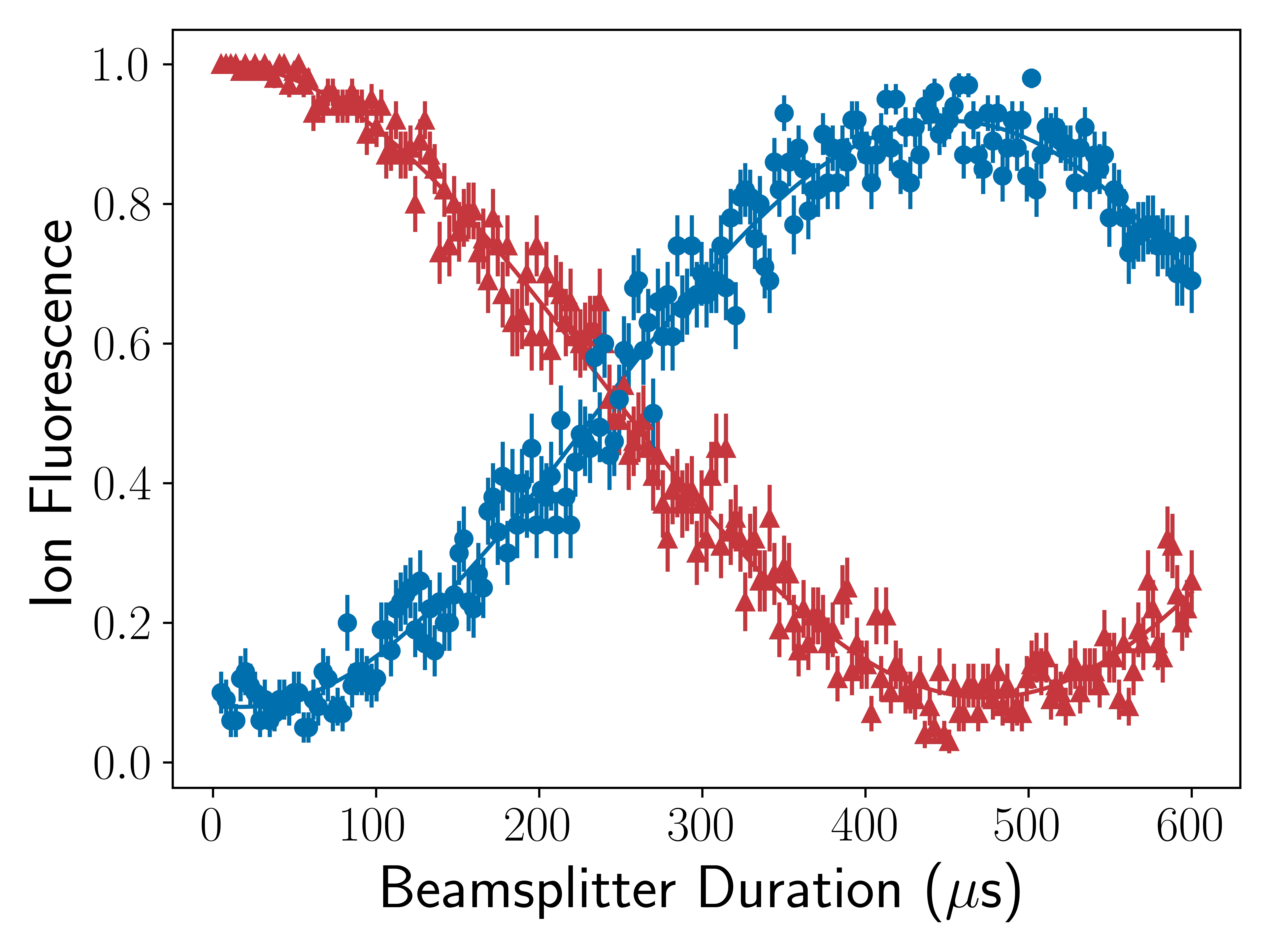
Next, these two qubits were passed through an analog of a beam splitter — a device that mixes oscillations like two beams of light in a half-silvered mirror. On the output, they got all four types of quantum entanglement (the so-called Bell states)—a special connection where particles behave as a single whole, even if separated far apart. The accuracy averaged 69%. Not perfect, but enough for the entanglement to "live" and be correctable.
The most important thing: the entangled state was held longer than usual. They turned on quantum error correction, and the "melody" didn't fade as quickly as without it. The ion trap worked like a conductor who tunes the pegs in time and keeps the orchestra from going out of tune.
Now that all the necessary "Gaussian operations"—basic manipulations of oscillations that don't destroy the code — are working, the path opens to multimode quantum systems. You could entangle not just two but many qubits in a single trap, building complex quantum networks. And also test fundamental limits of information transmission, like testing how loud you can play before the hall starts to vibrate.
An oscillating ion in a trap can be compared to a pendulum that swings simultaneously back-and-forth and left-to-right. These two motions barely interfere with each other, like two independent metronomes on the same stand.