instrument

beam splitter

An optical device that divides a beam of light into two or more beams.
42 related articles

Description

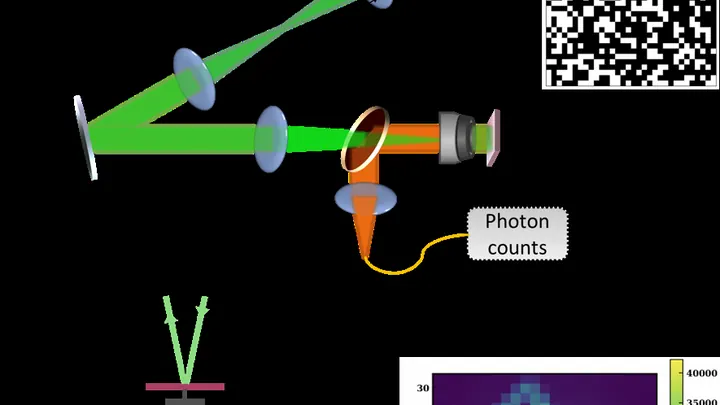
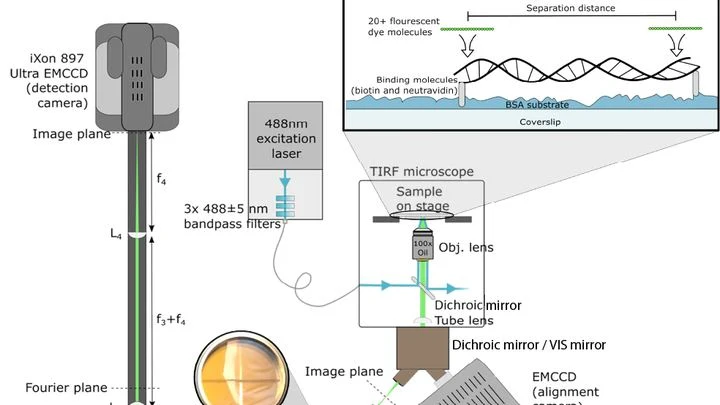
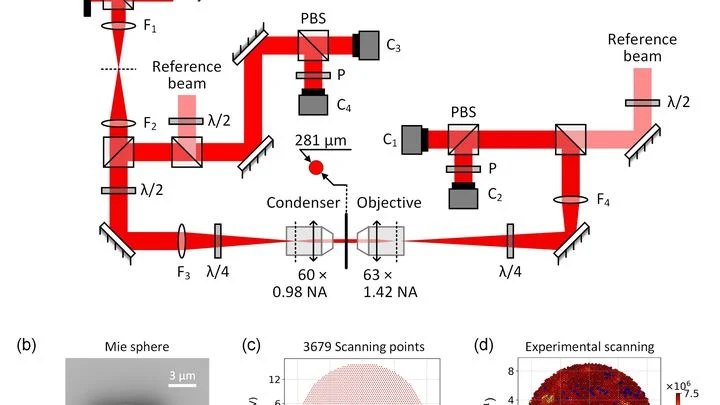
A beam splitter is an optical device that divides an incoming light beam into two or more separate beams, typically by reflecting part of the light and transmitting the rest. It is a fundamental component in many optical instruments, from simple microscopes to complex quantum experiments. Beam splitters are essential for interferometry, where they split light to create interference patterns, and for routing light in imaging systems.

History

The concept of splitting light beams dates back to the 19th century, with early interferometers by Albert Michelson using partially silvered mirrors. Modern dielectric coatings, developed in the mid-20th century, improved efficiency and control.

How it works

Most beam splitters are made from a glass plate or cube with a thin partially reflective coating. The coating is designed to reflect a certain percentage of light (e.g., 50%) and transmit the rest. When light hits the splitter, it divides into two beams that travel along different paths. In a cube beam splitter, two prisms are cemented together with a semi-transparent layer, allowing compact and stable operation.

In practice

Beam splitters are used in laser interferometers (like LIGO), cameras, spectrometers, and quantum optics experiments to manipulate and measure light.

Fun fact

In quantum experiments, a beam splitter can create entangled photon pairs, a phenomenon central to quantum cryptography and computing.


Concept graph →

Related articles · 42

Quantum Physics2026-08-201 minarXiv:2608.20032express
A Lens the Size of a Nanoparticle
Light passing by a tiny structure changes direction. If the structure is smaller than the wavelength of the light, it acts like a lens and focuses the light into a spot smaller than the wave itself.
Instrumentation2026-08-191 minarXiv:2608.18912express
A Light Lantern for Many Streams
Light in an optical fiber is like a stream: it flows inside a glass thread and doesn't spill out. A thick thread carries many streams at once, a thin one only one. Astronomers often need to pour light from a thick fiber into several thin ones to split it into colors.
Atomic Physics2026-08-181 minarXiv:2608.17576express
A Clock and an Interferometer in One Beam
The two states of a strontium atom are like twins running down the same track, but one is slightly higher than the other. Usually, the light used to manipulate atoms pushes one twin harder and the other more weakly. Here, they chose a wavelength of 813 nanometers—'magic'—where both get the same kick.
Glowing Fibers Catch Particles More Precisely
A passing particle leaves a flash of light in a long transparent bar — a scintillator. Inside the bar, like threads in a rope, thin fibers are stretched to collect this light and channel it to a sensor. Particle detectors have worked this way for decades.
Optics2026-08-092 minarXiv:2608.08899express
Light Switches Crystal Without Heating
A stack of playing cards lies still. You can slide the top card with your finger: that's crude intervention. Or you can blow so that the whole stack momentarily changes shape, but the cards don't scatter. That's roughly how light, in a new experiment, rearranges a crystal of tin selenide (SnSe). Usually, to change the structure of a solid, you heat it or pass a current through it.
Instrumentation2026-08-011 minarXiv:2608.00734express
Conducting a Thousand Cameras for the Sharpest Telescope
When an orchestra of thousands of musicians plays in harmony, the credit goes not only to each player's talent but also to the invisible work of the conductor.
Quantum Physics2026-07-302 minarXiv:2607.28231express
Light Fringes Betray a Photon’s Spin
On the wall: light and dark fringes. That’s what light looks like when it cancels itself out. Way back in the 17th century, Christiaan Huygens suggested that light is a wave.
Materials2026-07-181 minarXiv:2607.16886express
A Light Trap Rewrites the Fate of Molecules
Organic light-emitting materials are like a busy intersection without traffic lights. Molecules receive energy but, instead of honestly giving it back as light, they often turn into dead ends: they form dark pairs (exciplexes — short-lived complexes that do not emit) or collide with each other, losing charge.
Computer Vision2026-07-161 minarXiv:2607.14710express
How a Self-Driving Car Builds a Map from Above
The cameras of a self-driving car capture light like telescopes aimed at a distant galaxy. Each frame is a fragmented observation; together they must form a map of the road ahead. The computer, like an astronomer, doesn't just stitch images together: it generates several possible bird's-eye views and compares them to real data.
Robotics2026-07-141 minarXiv:2607.12265express
Radar Sculptor: How Robots Perceive a Seamless World
A regular radar works like an amateur photographer: it takes a series of blurry snapshots and tries to stitch them into a panorama. Details are smeared, and in a long corridor or crowd, the robot easily gets lost. The principle is simple: like a bat, the radar emits a wave and catches the echo.
HEP Phenomenology2026-05-292 minarXiv:2606.00237express
How to Catch Dark Matter with a Wave
Drop two pebbles into a pond at the same time — the ripples will spread evenly and in sync. The same happens in a quantum interferometer: a particle is split into two waves that travel along different paths and then meet. Ideally, their crests align.
Optics2026-05-162 minarXiv:2605.17092express
A Rainbow at Your Fingertip
Light can be more than just a beam: it can be a precision ruler. If you take very short pulses, shorter than a fly's wingbeat, and fire them one after another, you get an optical comb: a set of colors spaced at exactly equal intervals, like the teeth of a comb. This rainbow lets you measure distances, time, and the composition of materials with unimaginable accuracy.
Quantum Physics2026-04-281 minarXiv:2604.25615express
Two Photon Factories Strike a Chord in Unison
Two musicians in separate rooms play the same note. The sound must be so identical that a listener can't tell who is playing. In the quantum world, these musicians are single-photon sources — particles of light that must be indistinguishable from one another.
Atomic Physics2026-04-241 minarXiv:2604.22406express
Atom Traps: How to Fill Them to the Brim
An optical tweezer is a laser beam that holds an atom in place, much like fingers holding a pea. Arrays of these tweezers form the basis of future quantum computers. But there's a catch: not every tweezer catches an atom. Typically, only half of the traps get filled, and for molecules, even fewer. Empty spots break the whole setup.
Optics2026-04-121 minarXiv:2604.10463express
Random Light Patterns Instead of Long Scanning
Hunting for a single glowing spot in a dark sample is like trying to find a needle in a haystack: the microscope beam crawls line by line, wasting time and light. Physicists replaced this slow sweep with random light patterns. The sample is illuminated with a broad field, but each time with a new pattern of bright and dark patches, as if random shadows from a grid were projected onto it.
Quantum Physics2026-04-102 minarXiv:2604.09068express
A Receiver That Picks Its Own Direction
A conventional antenna array is like a choir: many voices singing in unison, with the sound amplified in only one direction. To catch a signal from another side, you have to rearrange the whole choir. Now imagine a single voice that can change its timbre so that the sound itself focuses in the desired direction.
Atomic Physics2026-04-041 minarXiv:2604.03629express
Laser Trap for Fast Atoms
Atoms in a beam travel at different speeds, like runners on a track. A regular laser pulse only pushes those moving at one speed, but the new one acts like a coach giving commands to the whole group at once. This approach involves more atoms in the measurement.
Optics2026-04-011 minarXiv:2604.00413express
Rethinking Light Distribution Reveals the Invisible
A conventional light microscope hits a fundamental limit: it cannot distinguish two points closer than 200 nanometers — roughly the thickness of a soap bubble divided by a hundred. To see deeper, scientists have made molecules in the sample blink or fade, but these tricks are slow and harmful to living cells.
Optics2026-03-291 minarXiv:2603.27815express
How to Measure an Ultrashort Laser Pulse
A laser flash lasts a few femtoseconds — imagine a single instant stretched into a million parts. Such a flash mixes many colors, from red to violet. Instruments that measure the pulse shape often err: they see some colors well and others poorly, blurring the picture. The authors propose a simple fix.
Materials2026-03-251 minarXiv:2603.24834express
A Layered Crystal Learns to Catch Light
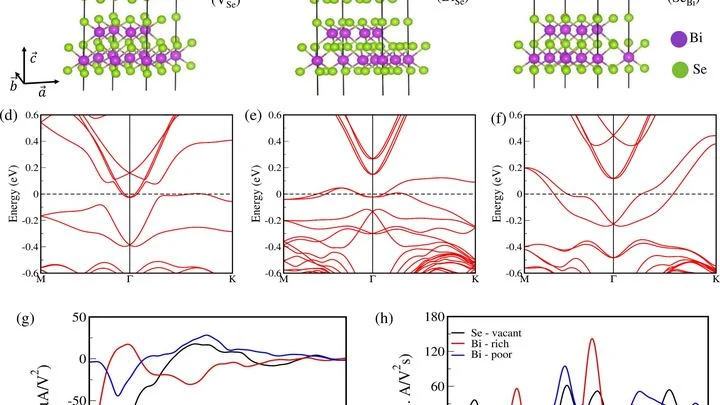
The crystal bismuth selenide (Bi₂Se₃) is symmetric by itself, like a neatly stacked sandwich: flip it over, and nothing changes. But twist one layer slightly relative to the other, and the symmetry breaks. The material begins to 'feel' which side the light comes from and responds with an electric current.
Quantum Physics2026-03-232 minarXiv:2603.22547express
Entangled Photons: A New Way to See the Invisible
Entangled photons are like two couriers marching in lockstep: their quantum states, particularly polarization, are synchronized so that measuring one instantly determines the state of the other, even at a distance. In a material, this synchronization gets disrupted.
Cubes for Catching Neutrinos: How to Reject a Million Parts
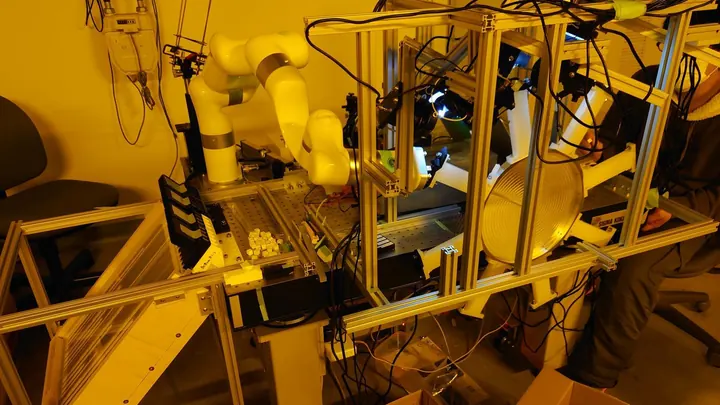
The future neutrino detector will contain millions of tiny plastic cubes: each the size of a die. They flash when a ghostly particle passes through, and that flash must be captured and measured. But if a cube is warped, has a burr, or a hole in the wrong place, the signal gets distorted, and the detector starts lying. Checking each cube by hand is like sifting through sand on a beach.
Astronomy Teaches Us to See the Invisible in the Brain
To spot a dim star above a brightly lit city, astronomers subtract one image from another — removing the glare of streetlights. They do the same with living neurons: their faint flashes drown in noise, but if you subtract everything unchanging, only they remain.
Optics2026-03-181 minarXiv:2603.17827express
Light Through a Glass Bead: Catching Scattered Rays
A flashlight beam in fog breaks into thousands of faint specks. Each speck is light that has bounced off countless water droplets before reaching your eye. To make sense of this mess, physicists construct a special table — the scattering matrix. It records how each incoming ray turns into a set of outgoing ones.
Atomic Physics2026-03-161 minarXiv:2603.14777express
An Atomic Compass That Never Loses Its Way
When an aircraft is on final approach or a submarine is navigating blind, the navigator needs an instrument that never loses track of motion. Conventional gyroscopes based on atomic waves are extremely precise, but they have a quirk: the signal repeats like a wallpaper pattern, and after half a step, the pattern starts to look the same. The instrument loses its sense of position.
Mesoscale2026-03-081 minarXiv:2603.07806express
A Qubit for Two: Reading Two Bits in One Go
A quantum computer based on electron spins is like a row of tiny spinning tops. Each top spins either clockwise or counterclockwise: that's a qubit. To find out the result of a computation, you typically stop the top and see which way it fell. But if you have many tops, each one needs its own "eye"—an extra helper qubit.
Spectrometer on a Chip: Catching Light from Distant Galaxies
The receiver doesn't catch radio waves but submillimeter light — the radiation emitted by cold clouds of gas and dust in distant galaxies. Inside, there's an array of tiny resonators, each tuned to its own frequency, like the strings of a grand piano tuned to notes.
Optics2026-02-211 minarXiv:2602.18778express
Tiny Optical Chip Sorts Images Without Training
Light passing through ripples on a water surface paints dancing patterns on the bottom of a pool. Engineers have used a similar idea to make light compute. They fabricated a tiny plate with a wavy relief: each ridge and groove deflects rays in its own way. When an image falls on such a surface, the light transmitted through it converges at different points behind it.
Optics2026-02-141 minarXiv:2602.13714express
Light Solves Problems with Greater Precision
Light passing through a lens bends slightly. For an optical computer, this is like a warped mirror for an artist: the image is there, but the details blur. An Ising machine using light beams tackles problems like packing luggage or planning a courier's route.
Optics2026-02-041 minarXiv:2602.04259express
Light Splits Evenly: Geometry Instead of Mirrors
Light from a single bulb usually spreads in all directions, and catching it in equal portions across several channels is quite a puzzle. In the new work, light is split into nine identical beams without a single lens or mirror. Instead, there's a glass plate with etched waveguide paths, along which light naturally flows in the desired way.
Instrumentation2026-02-032 minarXiv:2602.03233express
Light That Gives Itself Away
Light from a star is not just a stream but a wave that can oscillate in different directions. Ordinary light is like a crowd where everyone waves their arms randomly. But after reflecting off dust grains or passing through a magnetic field, some waves align in a single line, like soldiers in a row.
Optics2026-02-011 minarXiv:2602.00958express
A Beam That Sees Through Fog
Infrared light with a wavelength of about three micrometers is the working range for identifying molecules: each molecule absorbs light at its own characteristic frequencies, leaving behind "fingerprints." But until now, instruments for this range could not simultaneously provide broad frequency coverage, sufficient power, and…
Quantum Physics2026-01-201 minarXiv:2601.13617express
Quantum Light for Satellites
A light beam sent from Earth to a satellite scatters in the atmosphere, like a flashlight in fog. To keep the signal intact, you need short-wavelength light that spreads less. Such light is born in special crystals, but shrinking them to chip size is tough.
Optics2026-01-202 minarXiv:2601.13691express
Spiral-Twisted Light Now Reads Computer Chips
Light doesn't always travel in a straight line. Its wave can be twisted into a spiral, like a stream of water from a rapidly rotating hose. This twist is called orbital angular momentum, and it can hide information: each turn acts as a separate communication channel. The problem was that only bulky setups of lenses and mirrors could recognize these twists.
Optics2026-01-182 minarXiv:2601.12228express
A Spectrometer That Fits in Your Palm
A conventional spectrometer is like a comb that untangles light and sorts it by wavelength. But a comb is rigid: one type of light needs one comb, another needs a different one. The new device works differently. It asks light a series of questions, changing its shape each time to glean more meaning from the answers.
Optics2026-01-171 minarXiv:2601.11955express
A Light Sorter as Thin as a Hair
Two light beams run side by side along silicon tracks narrower than a human hair. One oscillates up and down, the other left and right. The task is to separate them into different outputs without losing a drop of power. Engineers built a device just 20 micrometers long — roughly a quarter of the thickness of a sheet of paper.
Optics2026-01-171 minarXiv:2601.12162express
A Camera That Sees the Unseen
Light is like a many-voiced choir: color, direction of oscillation, and instantaneous changes all intertwine. An ordinary camera hears only one voice, while the rest are lost. Scientists have built a camera that listens to the entire choir at once, and from a single image understands what is happening.
Optics2026-01-142 minarXiv:2601.09802express
Light Without Strict Order
A laser pointer shines a neat spot: all its light waves march in step, like soldiers on parade. Such light is called coherent. But nature and technology also feature another kind of light—'messy' light, where waves are out of sync, like a crowd at a market. It's called partially coherent.
Quantum Physics2026-01-022 minarXiv:2601.00966express
Four Photons in One Spot
Light from a single source can be made to 'meet' itself, and then fringes appear on the screen, like ripples from two pebbles dropped into water. Physicists have long known how to do this with two photons, but making four particles of light merge at once was tricky: single-photon sources lost too many particles along the way.
General Relativity2025-11-271 minarXiv:2511.22276express
How a Black Hole Splits Light by Polarization
A black hole doesn't just suck in matter — like a giant cosmic whirlpool, it warps the very fabric of reality and bends light rays around itself, focusing them. The effect is even stronger for black holes that spin at nearly the speed of light: their rotation twists space into a tight spiral.