A fault-tolerant quantum computer is a quantum computer that can perform reliable calculations even though its physical qubits are prone to errors from decoherence, noise, and imperfect operations. Unlike classical computers, quantum errors are continuous and can affect both the value (bit flip) and the phase of a qubit. Fault tolerance is achieved by encoding logical qubits into many physical qubits using quantum error correction codes, and by designing operations that correct errors faster than they accumulate. This is essential for scaling quantum computers beyond small demonstrations to solve practical problems, as no physical qubit is perfect.
History
The concept of fault-tolerant quantum computation was introduced by Peter Shor in 1995, shortly after he discovered quantum error correction. The threshold theorem was proven by Dorit Aharonov and Michael Ben-Or in 1996, and later refined by others. The surface code, a leading candidate for practical fault tolerance, was developed in the early 2000s by Alexei Kitaev and others.
How it works
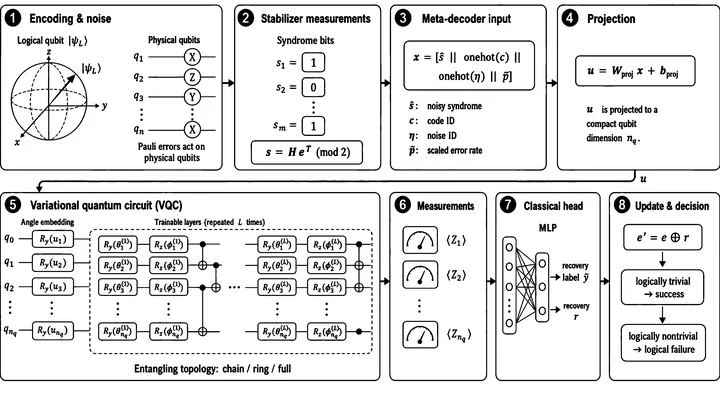
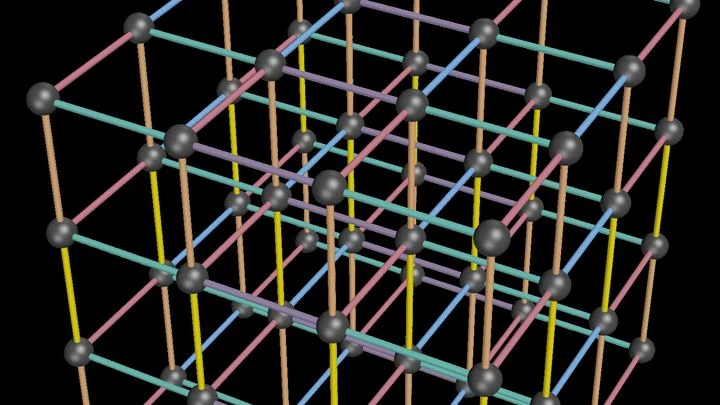
The core idea is redundancy: a logical qubit is encoded in a larger set of physical qubits, such as in the surface code, where information is spread across a lattice. Quantum error correction works by measuring parity checks (e.g., whether neighboring qubits are the same or different) without disturbing the encoded information. These measurements reveal errors, which are then corrected by applying appropriate operations. For fault tolerance, the error correction circuits themselves must be designed to be robust, using techniques like transversal gates and magic state distillation. The threshold theorem states that if the error rate per physical operation is below a certain threshold (typically around 1% for surface codes), then arbitrarily long computations are possible by adding more qubits.
In practice
Fault-tolerant quantum computers are the ultimate goal for running algorithms like Shor's factoring algorithm and simulating quantum systems, which require millions of error-corrected logical qubits. Current research focuses on building small demonstrations of error-corrected logical qubits, such as those by Google and IBM.
Fun fact
The error rate threshold for fault tolerance is so demanding that current quantum processors have error rates about 100 times too high, but recent experiments have shown that increasing the code size can reduce logical errors, a key milestone toward practical fault tolerance.
Picture a vast hall where thousands of janitors are sweeping the floor at the same time. Each one knows only their own patch and sweeps debris toward the nearest wall, without asking a manager. It used to be thought that such an approach was impossible for a quantum computer: too many errors, and you need a central brain that sees the whole picture.
In 1996, physicists asked: how much noise can a quantum channel withstand before it stops transmitting information? A phone call where every third word is replaced by random noise is still understandable. Up to what level of interference can the listener still grasp the meaning?
A quantum computer is like an orchestra where each instrument is a qubit and the conductor is the control processor. The conductor must not only set the tempo but also change the score on the fly if a soloist plays something unexpected.
Quantum computers make mistakes. Each qubit is like a ball balanced on the tip of a pencil: a slight tremor in the hand and it rolls off. To keep the balls from falling, you need someone to notice the wobble and correct it in time.
A quantum computer is like an orchestra where each musician, a qubit, plays their part but keeps hitting wrong notes. To keep the music from turning into cacophony, you need a conductor who instantly hears the off-key notes and corrects them.
A cup of hot coffee sometimes freezes faster than cold tap water. This paradox, known as the Mpemba effect, has long been considered a curiosity of classical physics. Now its quantum counterpart has helped test and tune quantum processors — devices that may one day power supercomputers.
A superconducting qubit is like a finicky musical instrument: until you tune it, you won't get a clean note. But even after tuning, the pitch drifts. The culprits are tiny defects in the material that physicists call two-level systems. They're like invisible cracks that appear and disappear, throwing off the processor's rhythm.
A quantum computer is like an orchestra where each musician-qubit easily loses the rhythm. The slightest noise, and the melody of computation turns into cacophony. To keep the orchestra playing in harmony, you need a conductor who instantly spots wrong notes and corrects them without stopping the performance.
A quantum computer based on neutral atoms is like a city where couriers, laser tweezers, physically carry packages between addresses. While one courier drags an atom across the entire chip, the others sit idle. This is slow and error-prone.
The new architecture replaces couriers with a shared radio wave.
One hundred milliseconds. In that time, after a lightning strike or a short circuit, the power system either returns to normal operation or loses stability. A new-generation Neural Network Oscillations learns to sense this moment, like an experienced tightrope walker anticipating a gust of wind.
A quantum computer is like an orchestra where each musician is a fragile qubit. The slightest noise, and the melody falls out of tune. To keep the harmony, you need a conductor who instantly hears the false notes and brings the instruments back into line.
A quantum computer is like an orchestra where every musician must hit their note exactly. If one plays off-key, the melody falls apart. The musicians here are qubits, storing information.
In the courtroom, a string is presented as input. Twelve jurors (computation paths) examine it symbol by symbol. Each can render a 'guilty' (accept) or 'not guilty' verdict. For a conventional nondeterministic automaton (NFA), one 'yes' vote suffices.
Quantum computing suffers from 'false notes' — errors that arise from the slightest inaccuracy. Now they are eliminated with the precision of tuning a concert grand piano. The idea traces back to the dreams of pioneers — David Deutsch and Peter Shor — of flawless operations.
A lithium battery is like a tiny city: lithium ions are the residents who move between electrode neighborhoods, generating current. But to understand how much energy the city can deliver, you need to know not only the street layout (the material's structure) but also how residents interact with neighbors, transportation, and even the weather.
In the ocean of bank transactions, fraud is rarer than neutron stars in space, just 0.1% of all operations. A conventional detector gets used to the clean flow and loses vigilance.
Enter Q-SYNTH, a hybrid system with a quantum generator. It creates plausible fake transactions itself, drawing on scraps of real data.
A quantum computer is like an orchestra where each musician plays their part, but if one hits a wrong note, the melody falls apart. Errors arise constantly: from thermal jitter, from imperfect instruments. To keep the symphony going, you need a "conductor" who hears the off-key notes and corrects them on the fly.
Quantum calculations are a recipe with perfect ingredients, but nature-the-chef cooks in her own way. Machine-learned models of atoms memorize the recipe and predict material properties in seconds instead of weeks.
A quantum processor is like a busy intersection: the more cars, the harder it is for them to navigate without collisions. In the quantum world, qubits play the role of cars — elementary carriers of information that, unlike classical bits, can be both 0 and 1 simultaneously.
A quantum computer is like an orchestra where every musician must come in at exactly the right moment. Previously, to play a complex piece, you had to constantly move the instruments around — slow and noisy. The new scheme, called "parity architecture," keeps everyone in place, and the conductor simply changes the notes.
The quantum Fourier transform is like a musical instrument that breaks a signal into pure notes. If the instrument is slightly out of tune, the melody sounds wrong. Scientists are checking whether you can spot the detuning by listening to just a few random notes.
Previously, it was thought that if the instrument plays well on average, it would also work for complex pieces.
In a quantum computer, a qubit is like a tightrope walker: any puff of wind and balance is lost. Errors accumulate, and the computation falls apart. Usually, they are corrected by comparing neighboring qubits, but that's like asking the tightrope walker to glance at his neighbors — extra movements and risk.
A quantum computer is like an orchestra where each musician plays their own part. If the conductor slips up, the music falls apart. In digital quantum simulations, the conductor's role is played by a sequence of simple operations, and errors accumulate like wrong notes.
Instead of millions of rigidly fixed particles — 10,000 atoms, working as beads on a quantum abacus. Each bead can be both zero and one at the same time. But the key is: if an error creeps into the calculation, the atoms can be physically moved: as if you could rearrange the abacus on the fly so that the glitch doesn't ruin the result.
A typical quantum bit is destroyed by the slightest disturbance — heat, magnetic fields. Physicists made a pair of atoms work together so that disorder wouldn't erase the record. Information was encoded not in each atom individually, but in the difference of their states — like the tension of a rope between two buoys.
Like an iceberg, the visible part of the code is the data, while beneath the surface lies a massive foundation of auxiliary particles. They quietly monitor noise and fix errors without touching the information. This approach squeezes many protected logical qubits into a modest number of physical ones.
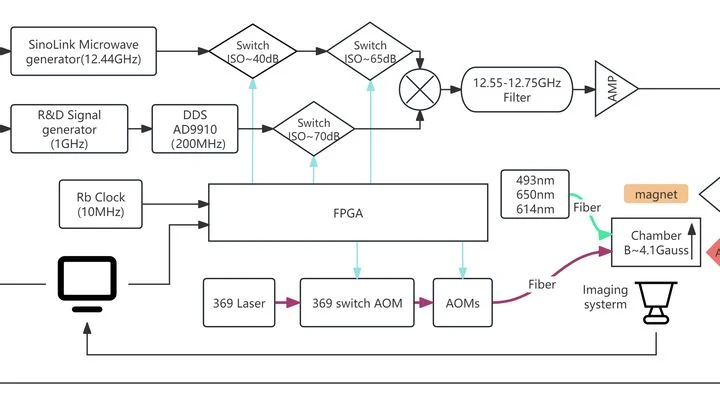
The experiment ran on a 98-ion processor inside an electric trap.
A quantum computer is like an orchestra where each musician, a qubit, must play its note without missing a beat. But every now and then, a passerby, a particle of radiation from space, bursts into the hall and throws the musicians off rhythm. Such glitches are called error bursts, and they disrupt computations.
A quantum computer is like a finicky orchestra: each qubit is a musician who hears the slightest noise and loses their place. To play a complex symphony of computations, you need hundreds of instruments tuned in unison.
A bread recipe written in disappearing ink: while you read, the original fades. That's how qubits behave — any measurement changes them irrevocably. Copying them is forbidden by the 1982 theorem (Вуттерс, Зурек): a qubit contains энтропия — unknown information that can't simply be doubled.
A tossed coin is the simplest source of randomness. But if the coin is shaved, it starts cheating. In the quantum world, light plays the role of the coin: its properties are fundamentally unpredictable. The catch is that the device that “flips” the quantum coin might be faulty or even swapped by an adversary.
A quantum computer is like an orchestra where every musician plays their part, but the slightest thing throws them off. Errors in qubits happen constantly: an instrument goes out of tune, a musician misses a note. Usually, the conductor has to guess who made the mistake, and that's really hard.
Quantum computers have gained a built-in self-repair mechanism. The new two-dimensional scheme works like living tissue: each qubit-cell interacts with neighbors by local rules, automatically suppressing random disorder — entropy. Unlike previous methods, it doesn't require constant measurements, which themselves generate errors.
A quantum computer is like an orchestra where each musician plays their own part but sometimes hits a wrong note. To keep the music from turning into cacophony, you need a conductor who corrects mistakes in time. In quantum computing, the role of the conductor is played by error-correcting codes.
A quantum sensor is like a telegraph line transmitting a hypersensitive message. The slightest disturbance distorts the signal. It used to be thought that accurate measurement required an error-free 'telegraphist' — a perfect error-correction system. But in practice, all elements are noisy. The new approach allows for errors at every step: in sending, verification, and reception.
Quantum computers use GKP states, dreamed up by Alexei Kitaev, John Preskill, and Daniel Gottesman. Their hallmark is built-in stabilizer checks that catch errors. For a long time, it was believed that a successful check guaranteed a nearly perfect state. Alas, it's an illusion.
Quantum computers require magical states — special helper particles for error-free operation. Previously, they were obtained through repeated purification, akin to endless distillation of alcohol: each step added энтропию (disorder), like weeds in a garden, and consumed resources.
A quantum computer is like an exquisite dish. There are recipes for ordinary kitchens, but special quantum states are secret ingredients that turn the dish into a masterpiece. One of them is 'magic'. The term was coined by John Preskill in 2018.
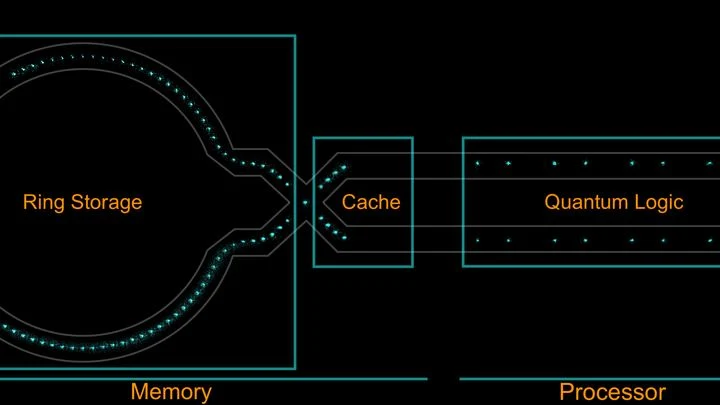
In the new Helios processor, 98 barium ions circle along a closed loop, like horses on a carousel. This architecture allows any ion to exchange data with any other, making the system flexible and powerful. Laser pulses, like a conductor's baton, issue commands at the speed of light.
Turning CO₂ into fuel is like finding the one perfect way to pack billions of items into a suitcase. A classical computer tries options one after another, taking decades, while a quantum computer sees all combinations at once.
Atomic qubits 'snap' computations in microseconds, but capturing the result with a light-sensitive camera stretches out to milliseconds — thousands of times longer.