Thermal jitter is the constant, random motion of particles—atoms, molecules, or even electrons—that arises from their thermal energy. At any temperature above absolute zero, particles possess kinetic energy, and this energy manifests as ceaseless, chaotic movement. In solids, this jitter appears as vibrations around fixed lattice positions; in liquids and gases, it translates into free, erratic motion. The magnitude of this jitter scales directly with temperature: hotter systems exhibit more vigorous, larger-amplitude fluctuations.
History
The concept emerged in the mid-19th century with the development of kinetic theory, notably through the work of James Clerk Maxwell and Ludwig Boltzmann, who linked temperature to molecular motion.
How it works
The mechanism is rooted in the equipartition theorem of statistical mechanics. Each degree of freedom of a particle (translational, rotational, vibrational) carries an average energy of (1/2)kT, where k is Boltzmann's constant and T is the absolute temperature. This energy drives the random motion. Because the motion is stochastic, it constantly disrupts any ordered arrangement—for example, it prevents atoms in a crystal from staying perfectly still, and it causes molecules in a fluid to diffuse and mix.
In practice
Thermal jitter is a key consideration in precision engineering and electronics, where it limits the stability of atomic clocks, causes noise in electrical signals, and sets the fundamental resolution limit of scanning probe microscopes.
Fun fact
At room temperature, a typical atom in a solid vibrates around its equilibrium position with a frequency of about 10^13 times per second, moving a distance of roughly one-tenth of an angstrom.
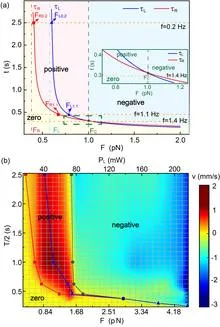
A swing that rocks on a sawtooth hill behaves strangely: without kicks, it gets stuck in the first dip, but with rhythmic pushes it can move uphill, downhill, or stay frozen in place. That is exactly what physicists saw when they placed a single dust grain in a trap with a sawtooth bottom and started pushing it alternately with laser beams.
A light field, like a neat waffle iron, presses a regular pattern of bright and dark regions into space. Atoms get stuck in the brightest spots as if in tiny dimples: that's an optical lattice. It's a favorite tool for physicists who want to study quantum behavior of matter in its pure form.
In a glass of water, oil gathers into droplets: that's equilibrium separation dictated by chemistry. But there are systems where order arises not from rest but from a constant flow of energy.
Imagine water as a ballroom, where each molecule is a dancer, constantly forming fleeting partnerships. These hydrogen bonds give rise to local patterns: some resemble a stiff waltz — an ordered network with cavities (low-density structure), others a wild jitterbug, where partners crowd into chaotic dense clusters.
A thin layer of oil on the surface of water breaks into separate droplets at the slightest disturbance. Something similar happens in the pulsar wind — a stream of particles ejected by a rapidly rotating neutron star. This stream also contains plasma layers, which can break apart into clumps — magnetic islands.
A pot of water on the stove: the hotter the burner, the faster ice turns to water, and water to steam. Heat destroys order. But sometimes nature pulls a trick, and heating makes a liquid freeze, like a puddle turning to ice on a frosty morning.
Ordinary window glass may seem frozen forever, but inside, atoms never stay still. In amorphous germanium telluride (GeTe)—a material used in rewritable discs and non-volatile memory — physicists have for the first time directly tracked how atomic bonds stretch and bend in trillionths of a second.
A handful of sand on a vibrating table is like a crowd on a dance floor that still holds the rhythm of the old song for a second after the DJ has switched to a new one. Scientists made a thin layer of grains bounce on a vertically shaking platform and abruptly changed the shaking intensity.
According to the laws of the microworld, an electron obeying the Dirac equation trembles even at complete rest. This is Zitterbewegung — an oscillation with an amplitude of trillionths of a millimeter, like a spinning top on an invisible axis.