Quantum gyroscope made of cold droplets express
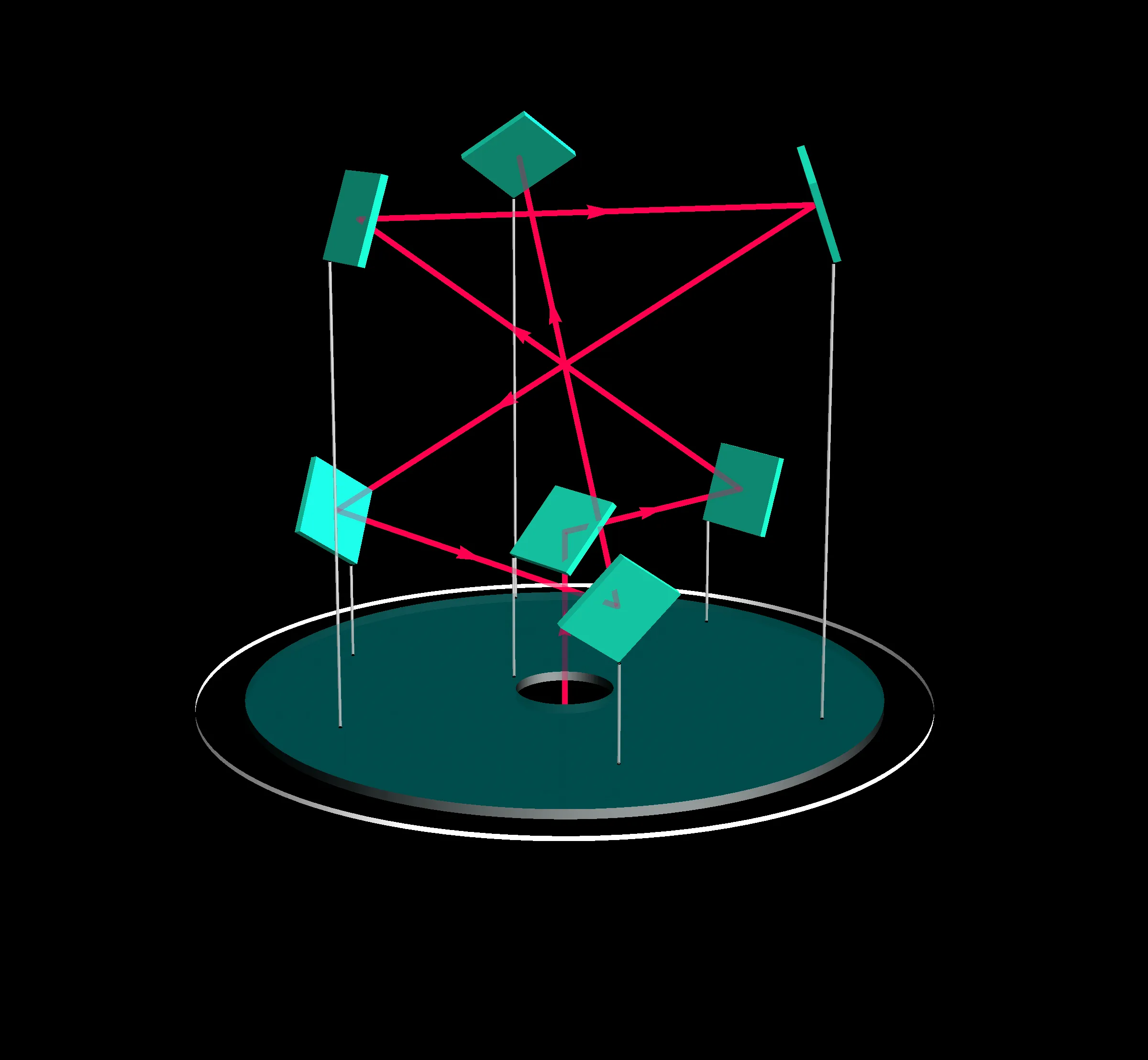
Four tiny puddles, and in them ripple droplets of a superfluid. These droplets are atoms cooled to near absolute zero and paired up like little magnets. When the whole setup rotates, the fluid flows between the puddles. Simply counting how many droplets end up in each reveals the angle and angular velocity.
Usually, such measurements are limited by quantum noise — an unavoidable ripple that smears the picture. But here, physicists found a way around this barrier. The system turned out to be superintegrable: it has so many hidden conservation laws that the motion of atoms becomes almost predictable, like the orbits of planets. Thanks to this, precision soars beyond the Heisenberg limit — a theoretical ceiling long considered unbreakable.
The practical implementation does not require complex entangled states or tricky interferometers (devices where waves overlap). All you need is four potential wells, cold dipolar atoms, and measuring the population difference. Such simplicity promises compact and reliable quantum gyroscopes for navigation where GPS is unavailable — in deep space or underwater. And crucially, the work shows that superintegrability can not only be observed but used as a resource for a breakthrough in precision.
So droplets in puddles, flowing upon rotation, turn hidden order into a measurable signal, and open the way for devices that sense the slightest rotation.
Original abstract
as written by the authors arXiv:2605.09709
Detection based on quantum principles such as entanglement has the capacity to achieve finessed levels of sensitivity, bringing transformative impacts to applications. In this study, we propose a rotation sensor using ultra-cold dipolar atoms trapped in a four-well configuration. The design, based on a simple population imbalance measurement to quantify rotation, profits from the property of superintegrability. The implementation of the measurement protocol achieves rotation-detection sensitivity beyond the Heisenberg limit. Our results spotlight superintegrability opportunities for advancing the field of quantum sensing.
Superfluid helium, cooled to two degrees above absolute zero, can flow forever through a closed loop without friction, like a perfect perpetual motion machine that does not violate the laws of physics.
In Stanisław Lem's novel 'Solaris', the planet's ocean exhibits behavior reminiscent of a superintegrable system: its movements obey hidden laws, inaccessible to direct observation but manifesting in anomalously precise responses to external stimuli.