A quantum detector is a sensor that exploits quantum mechanical effects to register individual photons—the smallest quanta of light—with high sensitivity and precision. Unlike classical light sensors that measure an aggregate intensity, a quantum detector can resolve single photon arrivals, making it an essential tool in quantum optics, cryptography, and fundamental tests of quantum mechanics. In experiments, such detectors are used to observe phenomena like photon entanglement, quantum interference, and the violation of Bell inequalities, where the click of a single photon carries meaningful information.
History
The concept of detecting single photons dates back to early 20th-century photomultiplier tubes, but modern solid-state and superconducting designs emerged in the late 20th century. The first practical avalanche photodiode for single-photon detection was developed in the 1980s, while superconducting nanowire detectors were introduced in the early 2000s.
How it works
Most quantum detectors operate by converting a photon's energy into a measurable electrical signal. For example, avalanche photodiodes use a semiconductor junction biased near breakdown; a single photon generates an electron-hole pair, which triggers an avalanche of charge carriers, producing a macroscopic current pulse. Superconducting nanowire detectors, on the other hand, rely on a thin superconducting wire cooled below its critical temperature; a photon breaks Cooper pairs, creating a hot spot that momentarily destroys superconductivity, leading to a voltage spike. Both mechanisms amplify the effect of one photon into a detectable signal, enabling single-photon counting with high timing resolution.
In practice
Quantum detectors are used in quantum key distribution for secure communication, in lidar for high-resolution ranging, and in medical imaging techniques like positron emission tomography (PET) where single-photon sensitivity improves image quality.
Fun fact
Some superconducting nanowire detectors can count photons at rates exceeding 100 million per second while maintaining near-unity detection efficiency.
You can walk a long road, or you can fold it into a shorter route without losing the key landmarks. In quantum computing, that road is the time evolution of a state: it demands ever longer chains of operations, which quickly drown in noise on a real processor. Physicists have found a way to compress each step of the evolution into a compact, tunable circuit while keeping accuracy above 99%.
Light passing by a tiny structure changes direction. If the structure is smaller than the wavelength of the light, it acts like a lens and focuses the light into a spot smaller than the wave itself.
A billiard ball hangs in midair. Tiny peas shoot at it from a blowgun. Each hit is barely perceptible, but if the ball is very light and barely trembles from heat, you can make out individual nudges. That's essentially the setup: a glass sphere the size of a bacterium levitates in a vacuum while a narrow beam of xenon atoms flies at it.
Catching light one particle at a time is like hearing a whisper in a roaring factory. An electron-multiplying camera (EMCCD) can do exactly that: it turns a single photon hitting a pixel into an avalanche of electrons that can be measured. These cameras are mounted on telescopes to spot a barely visible planet next to a dazzling star.
When an orchestra of thousands of musicians plays in harmony, the credit goes not only to each player's talent but also to the invisible work of the conductor.
Empty space is not as empty as it seems. According to quantum theory, the vacuum is filled with particles that constantly pop in and out of existence. In 1976, physicist Bill Unruh showed that if an observer moves with acceleration, this 'quantum soup' turns into a genuinely warm bath for them — the Unruh effect.
Low-frequency radio waves (from 30 to 300 kilohertz) carry information through water and earth. But catching them with an ordinary antenna is hard: the wavelength reaches several kilometers, and a small receiver barely feels such a field.
In a room, air touches the skin, and we feel its temperature. But if your body suddenly accelerated at a colossal rate, heat would come even from absolute emptiness. This is not fiction but a strict consequence of quantum field theory: for an accelerating observer, the vacuum becomes a warm bath.
A spotlight blazes straight into your eyes, and a few steps away a tiny firefly flickers. That's roughly what it's like hunting for an Earth-like planet around a neighboring star: the planet is a hundred million to ten billion times fainter than its star, and in the sky they almost merge into a single point.
Dark matter leaves no trace in ordinary detectors: it passes through them like wind through gauze. To spot it, you need instruments that can feel a mosquito's punch in a storm. Quantum sensors with a threshold of a fraction of an electronvolt (a thousand times less than the energy of visible light) are just that.
A laser isn't just about light. If you make a particle oscillate like a pendulum and those oscillations sustain themselves, you get a phonon laser. Sounds complicated, but the idea is simple: instead of light waves, the device emits orderly waves of mechanical vibrations — phonons.
A tiny defect in a boron nitride crystal behaves like a microscopic indicator bulb. Shine light on it, and it glows, with the shade shifting with temperature: the warmer it gets, the redder the glow.
Ordinary magnetic sensors lose sensitivity as they shrink. But scientists turned a tiny diamond into a light-based compass. Unlike jewelry diamonds, what matters here isn't purity but artificially created defects — these are what turn the crystal into a compass.
In a dark room, a glass bead the size of a dust grain hangs on a laser beam. Beneath it are two mirrors: one aluminum, one silver. If axions (light, invisible particles that could make up the mysterious dark matter) whiz by, they exchange with the mirror atoms, and the bead shifts ever so slightly.
An ordinary photometry detector can't tell a left photon from a right one. But let it start moving, and everything changes.
Imagine a rower moving between two flutists playing the same note. His ear is perfectly tuned to that note and ignores all others. As he moves, the pitch from the flutist ahead sounds higher, and from the one behind sounds lower.
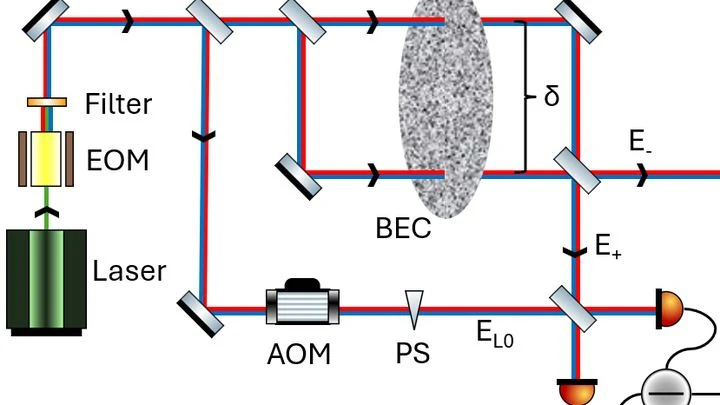
Physicists have proposed an experiment: a laser beam acts as a quantum detector and splits into two beam-ears. Each ear is directed through a tiny cloud of ultracold atoms — in this state, atoms merge into a single wave.
Four tiny puddles, and in them ripple droplets of a superfluid. These droplets are atoms cooled to near absolute zero and paired up like little magnets. When the whole setup rotates, the fluid flows between the puddles. Simply counting how many droplets end up in each reveals the angle and angular velocity.
An ordinary rain gauge collects water in a bucket and shows the total volume of precipitation. But the new device is like a sensitive palm that feels every falling drop and keeps count, even when the drops number in the thousands.
That's exactly what physicists have built.
A tiny glass bead hangs in a laser beam like a speck of dust in sunlight. Around it is a rarefied gas: atoms of krypton, xenon, and heavy molecules of sulfur hexafluoride. They collide with the bead, and each hit transfers a tiny impulse, like a pea thrown at a taut sheet makes it tremble.
Impulse is a measure of motion: mass times velocity.
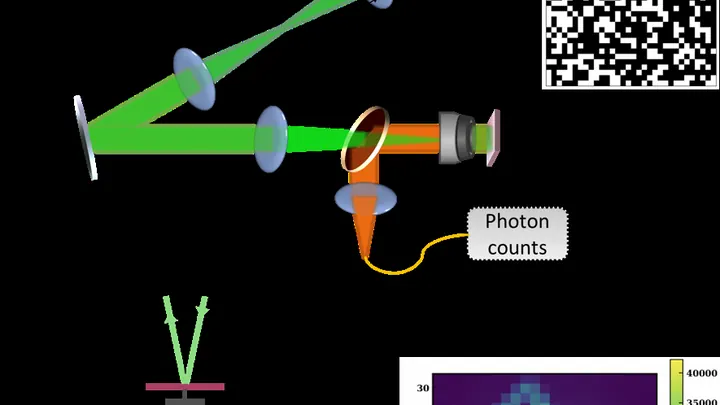
Hunting for a single glowing spot in a dark sample is like trying to find a needle in a haystack: the microscope beam crawls line by line, wasting time and light. Physicists replaced this slow sweep with random light patterns. The sample is illuminated with a broad field, but each time with a new pattern of bright and dark patches, as if random shadows from a grid were projected onto it.
A security guard needs to check five rooms but can't go inside. He knocks on the door and listens: silence means someone is inside, while an echo means the room is empty.
An ordinary antenna picks up radio waves, but there are fields it barely feels. We're talking about slow electric fields: those that change once a second or less. For them, physicists built a sensor from a beam of rubidium atoms.
A detector that hunts for rare particles is like an ear trying to catch a whisper in a noisy room. The quieter the signal, the harder it is to tell apart from random noise. In the NUCLEUS experiment, such detectors, cryogenic calorimeters, are cooled to near absolute zero so they can pick up even a faint pulse of heat from a single particle.
Infrared light is invisible to the eye, but it's everywhere: from TV remotes to the heat of the human body. Catching it requires special materials. Conventional detectors are bulky, rigid, and not easily tuned to specific wavelengths.
To spot a dim star above a brightly lit city, astronomers subtract one image from another — removing the glare of streetlights. They do the same with living neurons: their faint flashes drown in noise, but if you subtract everything unchanging, only they remain.
A single antiproton, trapped and cooled to near absolute zero, behaves like a tuning fork that needs a very precise strike to produce a clean note. Catching that 'note' directly is nearly impossible — the signal is too weak.
A photon is like a car in a multi-story parking lot, where each floor is its frequency (color). Usually it gets stuck on one level, but scientists added an elevator — a programmable modulator that moves the photon between floors on command.
An X-ray machine at the dentist's office takes a single flat image of a tooth. But if you need to see the insides of a microchip from all sides, you have to take the sample to a synchrotron — an accelerator the size of a football field.
Imagine a vast field of fireflies, each flashing alone rather than in a swarm: that's what the new automated setup is hunting for. It sweeps a laser across the sample like a flashlight and records the color and brightness of the glow at every spot.
At the Large Hadron Collider, physicists accelerate protons to nearly the speed of light and smash them together. Usually, the protons themselves take part in such collisions, but sometimes they pass close by without touching, and it is their electric fields that interact.
A particle trapped in a light field behaves like a ball on a spring: give it a nudge and it starts to oscillate. If you suddenly stiffen the spring, the ball freezes for an instant at the very bottom, where its position is known most precisely. That's exactly the moment physicists exploited to turn a nanoparticle into an ultrasensitive accelerometer.
A regular radio receiver picks up waves with a metal antenna. Here, the antenna is a single atom with an electron boosted to a distant orbit, like a satellite in a high orbit around Earth. Such atoms are called Rydberg atoms.
An ordinary sensor is like a scale that always shakes a little on its own. Even in total silence and at zero temperature, every particle jitters — this is quantum jitter, and it limits the precision of any measurement.
The light from a single molecule is like a lone voice in a vast choir. To hear it, you need not a microphone but a delicate instrument that catches each photon and notes its arrival time.
Light, regardless of its source, consists of photons — elementary particles, quanta of the electromagnetic field. The simplest light detector, such as a photometric illuminance meter, operates in a binary mode: it merely registers whether photons hit it or not, giving a 'yes/no' answer.
Dark matter doesn't emit or reflect light, yet its gravity holds galaxies together. What it's made of is a mystery. One leading candidate is the axion, an ultra-light particle. Searching for axions is like listening for a very faint radio signal, but the receiver's own noise gets in the way.
Dark matter is an invisible substance that holds galaxies together but emits no light. Catching its particles is like trying to hear a whisper in a noisy hall. Ordinary detectors only pick up loud impacts, while weak signals get drowned out by background noise.
Dark matter is an invisible substance, five times more abundant in the universe than ordinary matter. Its particles barely touch atoms, but occasionally they can nudge an electron, like a string brushed by the wind.
A camera that sees ultraviolet light typically costs as much as a nice car. That's because it requires a special crystal and a complex fabrication facility. Engineers in Korea took a different approach: they grabbed a run-of-the-mill chip, the kind made by the millions for phones, and sprayed a thin layer of metal-oxide nanoparticles onto it, like paint from a can.
A chain of atoms on a light-guiding chip behaves like a row of pendulums on a shared support: swinging in opposite directions, they barely transfer energy to the air and freeze for a long time.