The interferometer is like a clever detective that investigates the difference in the paths of two beams. Imagine you and your friend running towards each other from opposite ends of a maze; when you meet, you can tell who ran slower by how out of breath you are. The interferometer 'sees' even a difference of a thousandth of the thickness of a hair — by how the light and dark fringes shift, like sand in an hourglass.
History
Interference phenomena were observed by Newton ('Newton's rings'), but systematic study began with Thomas Young in 1801 (double-slit experiment). The first interferometer was built by Albert Michelson in 1881 to test the hypothesis of the luminiferous ether. The famous Michelson-Morley experiment (1887) showed with the highest accuracy the absence of ether wind, which became a decisive argument for the constancy of the speed of light. In the mid-20th century, Joseph Weber built resonant gravitational antennas, but did not achieve decisive success. Modern laser interferometers (LIGO, Virgo) were proposed in the 1970s-80s and in 2015 for the first time directly detected gravitational waves (from the merger of black holes). Robert Hooke in 1665 described the colors of thin films, which was a manifestation of interference. Alain Aspect used interferometers in pioneering experiments on photon entanglement.
How it works
In the Michelson interferometer, light from a laser hits a beam splitter, where half the intensity is reflected into a perpendicular arm, and half passes straight through. At the end of each arm, a mirror reflects the beam back. After returning, both beams partially pass through the beam splitter and reach a photodetector. The phase difference Δφ = 2πΔL/λ determines whether interference is constructive (light) or destructive (dark). The intensity of the detected light is described by the formula I = I₁+I₂+2√(I₁I₂)cos(Δφ). Any slightest change in ΔL (due to gravitational waves, thermal expansion, or vibrations) leads to a change in the signal. To enhance sensitivity, Fabry-Perot cavities are installed in the arms, greatly increasing the effective light path. Maxwell's equations guarantee the constancy of the speed of light, allowing interferometry to be used as a 'ruler' of exceptional precision.
Fun fact
The giant LIGO interferometers can detect a change in the length of their four-kilometer arms of less than one ten-thousandth the size of a proton — about the same as if the distance from Earth to the Sun changed by the thickness of a human hair!
At night on a volcano summit, six telescopes stare at the same speck of light. Each catches its own copy of the wave, and if you combine their signals, you get an image that no single instrument could produce alone. But there's a catch: light captured by different stations cannot simply be added like photographs.
When an alpha particle tears through a gas, it leaves behind not a continuous track but a chain of individual ionizations: tiny flashes where electrons are knocked off atoms. In a living cell, such flashes damage DNA, and the denser they are packed into a clump, the more severe the damage.
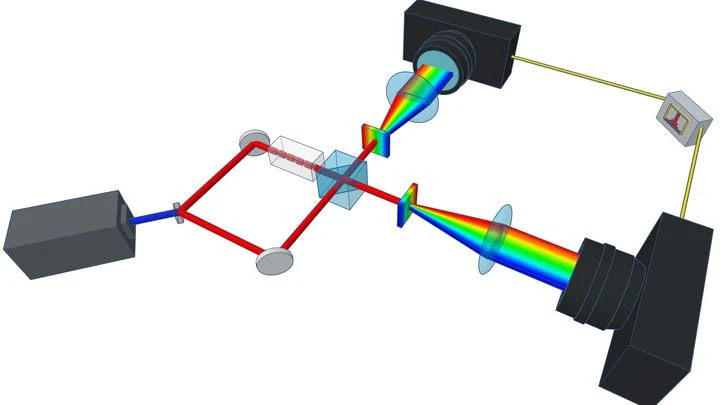
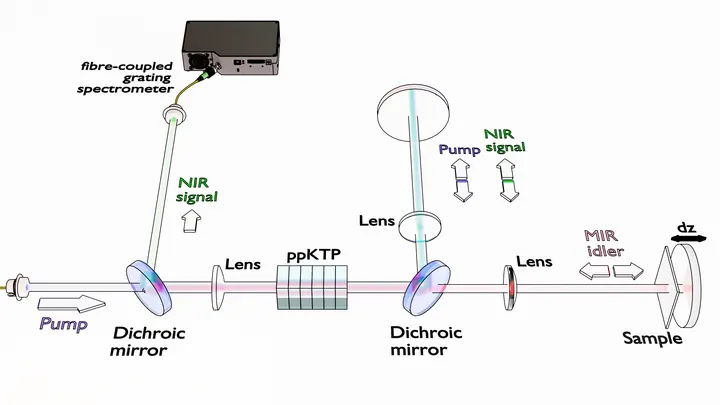
Light that never reaches the camera still leaves its mark on it. That's how the new imaging method works: you illuminate the object with one color, and the picture is assembled from another. Inside the crystal, light waves mix, and information about the invisible transfers to a visible beam.
In the experiment, they used a silver thiogallate crystal.
The two states of a strontium atom are like twins running down the same track, but one is slightly higher than the other. Usually, the light used to manipulate atoms pushes one twin harder and the other more weakly. Here, they chose a wavelength of 813 nanometers—'magic'—where both get the same kick.
The two states of a strontium atom are like twins running down the same track, but one is slightly higher than the other. Usually, the light used to manipulate atoms pushes one twin harder and the other more weakly. Here, they chose a wavelength of 813 nanometers—'magic'—where both get the same kick.
Light passing through a glass of murky water dims — some of it is absorbed. That's how many liquid-analysis instruments work: they measure how much light was lost and infer the composition from that. But if the liquid is heterogeneous, like soup with chunks, a single number isn't enough: you need to know where exactly more absorption happened.
In the kitchen, when a pan heats up, your hand feels the heat before you even touch it. A solar telescope picks up similar invisible heat — only from a star, not a stove. The instrument, called HATS, captures radiation in the terahertz range, which was previously little studied due to technical difficulties.
The orchestra plays, but the conductor hears only a general hum. Each instrument plays its own part, but you can't tell where the flute is and where the double bass is. You need a spectrum analyzer — a device that breaks down sound by frequency.
On the wall: light and dark fringes. That’s what light looks like when it cancels itself out.
Way back in the 17th century, Christiaan Huygens suggested that light is a wave.
Every night, hundreds of observatories scan the sky, yet planets around other stars remain ghosts. Their light is billions of times fainter than the glare of their parent star — the task seems hopeless. But optics found a way: rather than block the star’s light, cancel it with a counter-wave of the same amplitude, shifted by half a period.
Two photons meet at a half-silvered mirror. If they arrive at exactly the same time, they always leave together — side by side, like twins who refuse to be parted. This effect, discovered in 1987, became the basis of a quantum ruler for measuring tiny delays.
When a radio wave encounters a building in its path, it doesn't just reflect or get absorbed: it bends around it, much like ocean waves flowing around a rock, leaving calm water behind. In radiophysics, this phenomenon creates a radio shadow — a complex pattern of zones where the signal is amplified or attenuated, which scientists call a radio portrait.
Conventional antennas for precise direction finding must work coherently: they capture not just volume, but also the wave's phase at a given moment. The slightest tuning mismatch, and the direction is lost. The new method relies solely on signal strength. It's like finding your way in fog, seeing only the brightness of lights, not their color.
A laser beam in a multi-kilometer tunnel trembles as a gravitational wave passes, but the tremor is barely perceptible, on the scale of fractions of a proton's diameter. To hear this cosmic whisper, physicists squeeze every last bit of performance out of light.
In pursuit of gravitational waves, ripples in spacetime left by black holes and neutron stars, detectors like LIGO pump their arms with light of dazzling intensity.
Two sensitive microphones are listening to the Universe. One hears a low hum, the other hears almost nothing. It's not a malfunction: it's about how they are oriented.
Gravitational-wave observatories like LIGO don't just catch loud bursts from black hole mergers.
The planet-spanning web of undersea internet cables acts like a giant ear. The glass thread inside responds to water movements: currents, tides, and distant earthquakes bend the cable. Light traveling along the thread takes slightly longer: this delay is measured on shore against a reference. That’s how the speed of light reveals itself.
A gravitational wave observatory is like a set of microphones scattered across the Earth. When a signal arrives from space (say, from a black hole merger or a supernova explosion) each microphone hears something slightly different.
The universe is permeated by invisible mass, dark matter, whose existence was first proposed by Fritz Zwicky in the 1930s, based on his observations of galaxies moving in clusters.
An ultra-sensitive microphone listens not to sound, but to the trembling of space itself. That's how gravitational wave detectors work — LIGO, Virgo, KAGRA.
Physicists have achieved three-dimensional Anderson localization of electromagnetic waves — a phenomenon where waves become permanently entangled in a random labyrinth of metal particles and cease to propagate.
The Universe is pervaded by an invisible substance — ultralight dark matter, which doesn't collide with ordinary matter but can tremble like a taut string. Its oscillations alter the world's most fundamental properties: the electron charge, the speed of light — as if the tuning of a single cosmic note slightly drifts.
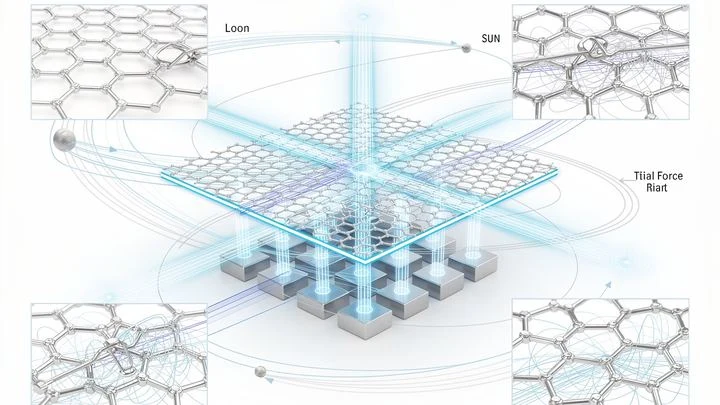
In the quiet of a laboratory, a graphite flake hovers above a magnetic grid. This is not just a demo of diamagnetism's magic — it's listening to the Universe. Like a spider casting its web to catch vibrations from an invisible world, this flake has become a gravitational web.
Drop two pebbles into a pond at the same time — the ripples will spread evenly and in sync. The same happens in a quantum interferometer: a particle is split into two waves that travel along different paths and then meet. Ideally, their crests align.
Two beams of light race around a closed loop, heading toward each other. Since the speed of light is constant, when the ring turns, one beam has to catch up with a moving finish line, while the other meets it sooner. Their meeting creates a pattern, and from that pattern we can tell how fast the whole system is spinning.
Gravitational waves are ripples in space from the mergers of black holes and neutron stars. Existing detectors, built with contributions from Kip Thorne and Rainer Weiss, work like highly sensitive microphones but only hear the highest 'notes'.
A musical instrument sounds cleaner when its strings don't touch anything extraneous. Roughly the same principle drives the new optical magnetometer: a glass cuvette the size of a matchbox is filled with rubidium vapor, and its walls are coated with a thin layer of paraffin, like wax on a ski track.
Mirrors in gravitational wave detectors listen to the Universe, but they're drowned out by their own trembling — like a microphone in a noisy train station.
Gravitational wave detectors are microphones listening to the trembling of space. But their own noise drowns out weak signals. To hear more, physicists add special "squeezed" light to the instrument: it reduces quantum noise, like noise cancellation in headphones.
A film of aluminum nitride, as thin as a soap bubble, hangs above a mirror with a micrometer-sized air gap between them. When invisible infrared light with a wavelength of about 15 micrometers hits it, the film starts to vibrate in sync with the light, like a string that responds only to its own note.
An X-ray beam is a stream of tiny packets of energy, photons. Ordinary detectors count them but don't distinguish shades: two photons with close energies look the same to them. The new device works like a sensitive thermometer: it catches each photon and measures how much it warms a thin film. From the warming, you can tell exactly how much energy the photon brought.
A balloon with a dried drop of glue inflates unevenly: the glue stretches differently than the rubber. The cornea, the eye's transparent outer layer, behaves similarly after procedures that alter its elasticity. Engineers tested this on pig eyes.
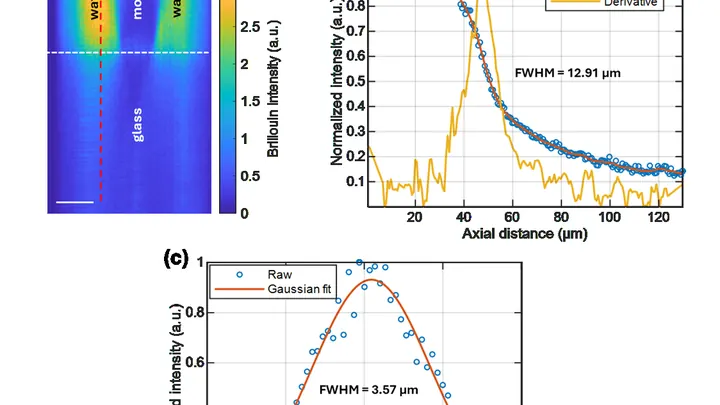
A laser beam passes through a cell, and the cell responds to the touch, like a taut string plucked by a finger. The frequency of this 'ring' reveals how stiff or soft the material is. That's how Brillouin microscopy works, named after the French physicist Leon Brillouin.
In the headphones used to listen to a distant orchestra, there is an occasional crackle. The crackle can be so loud that it drowns out the music or even blends in with it.
A security guard needs to check five rooms but can't go inside. He knocks on the door and listens: silence means someone is inside, while an echo means the room is empty.
Atoms in a beam travel at different speeds, like runners on a track. A regular laser pulse only pushes those moving at one speed, but the new one acts like a coach giving commands to the whole group at once. This approach involves more atoms in the measurement.
Infrared light is invisible to the eye, but it's everywhere: from TV remotes to the heat of the human body. Catching it requires special materials. Conventional detectors are bulky, rigid, and not easily tuned to specific wavelengths.
Galileo, legend has it, dropped balls from the Tower of Pisa to prove that heavy and light objects fall equally. This law formed the foundation of Einstein's theory of gravity. Today, scientists have turned an entire space station into such a tower.
Microplastics, tiny fragments of synthetic polymers, are now found everywhere, from mountain glaciers to food. The traditional analytical approach, spectroscopy, which relies on light interacting with matter, has long required costly detectors to register invisible infrared radiation.
An atomic gravimeter works like a very precise scale for gravity: it tosses up a cloud of atoms and watches how fast they fall. But these instruments have a hidden flaw — the shape of the signal they produce is slightly skewed. This skew, like a ruler with a chipped edge, subtly shifts every measurement.