Rydberg atoms are atoms in which one or more electrons are excited to very high principal quantum numbers (n >> 1), placing them far from the nucleus. These atoms have exaggerated properties: their size scales as n², their dipole moments scale as n², and their polarizability scales as n⁷. This makes them extraordinarily sensitive to external electric and magnetic fields, and they can detect extremely weak electromagnetic signals — down to microvolts per centimeter — without any conventional antenna.
History
Rydberg atoms were first studied in the late 19th century (Johannes Rydberg's formula), but their use for sensing was pioneered in the 2010s by researchers at the National Institute of Standards and Technology (NIST), led by Christopher Holloway and colleagues, who demonstrated the first Rydberg-atom-based electric field sensor in 2012.
How it works
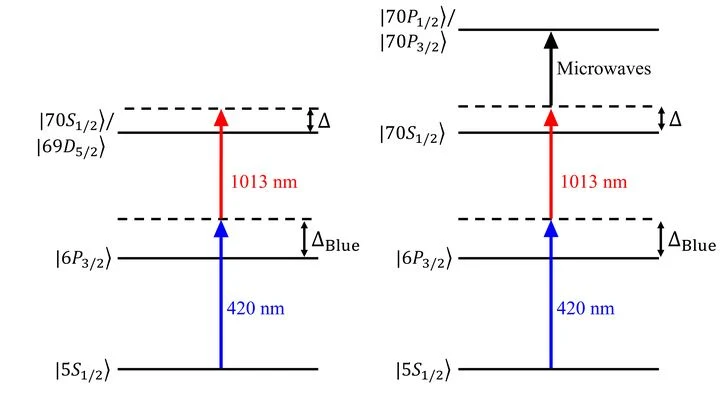
The key mechanism is electromagnetically induced transparency (EIT) combined with Rydberg states. A vapor cell containing alkali atoms (like rubidium or cesium) is illuminated by two laser beams: a probe beam and a coupling beam. The coupling beam excites atoms to a Rydberg state, making the vapor transparent to the probe beam. When an external electric field (the signal to be measured) is present, it shifts the Rydberg energy levels via the Stark effect, which changes the EIT spectrum. By measuring the probe beam's transmission as a function of frequency, one can precisely determine the applied field's amplitude and frequency. The effect is so sensitive that it can detect signals from a few kilohertz to over a terahertz.
In practice
Rydberg atom sensors are used for traceable electric field measurements, communications receivers, and potentially for detecting dark matter or gravitational waves; they are also being developed for quantum radar and spectrum analysis.
Fun fact
A Rydberg atom can be so large that its electron orbits at a distance comparable to a bacterium's size, making it a million times larger than a ground-state atom.
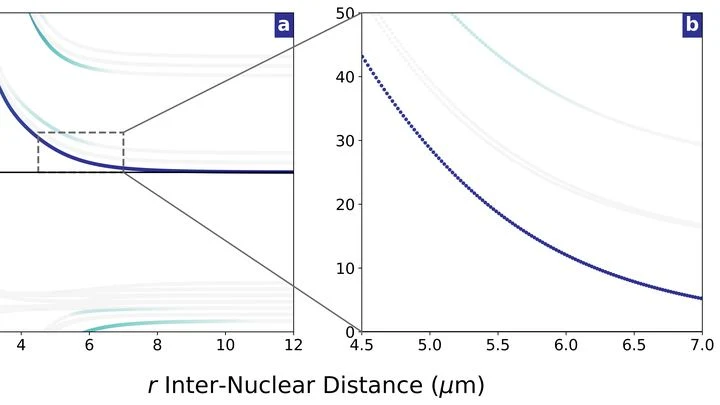
Rydberg molecules are like a pair of dancers holding hands at arm's length. One partner is an ion, the other is an atom, and the bond between them is as weak as an invisible thread. Such a pair can exist for only an instant, but that instant stretches into microseconds — an eternity by the standards of the microworld.
A copper oxide crystal looks like a dark red pebble. But when a short laser pulse hits it, pairs are born inside: an electron and a 'hole'—a place where an electron is missing. Such a pair is called an exciton and behaves almost like a hydrogen atom: the particles circle each other, bound by electric attraction.
A radio receiver the size of a palm can measure signal power more accurately than expensive lab benches. Inside, there are no coils or antennas, just a glass head and a cloud of rubidium atoms cooled to near absolute zero.
The quantum many-body world is a jazz ensemble, where each electron improvises, continuously listening to all the others, and the overall wave function is born from this tense dialogue.
Quantum entanglement — a phenomenon where the states of two or more particles become interconnected regardless of the distance between them — usually links intrinsic properties such as spin or polarization. However, a new experiment has for the first time realized entanglement of the positions of two atoms in space.
Four tiny puddles, and in them ripple droplets of a superfluid. These droplets are atoms cooled to near absolute zero and paired up like little magnets. When the whole setup rotates, the fluid flows between the puddles. Simply counting how many droplets end up in each reveals the angle and angular velocity.
A big sticky ball thrown onto a dusty shelf bounces off and kicks up a cloud of dust, but if you roll it slowly, it picks up every bit. Rydberg excitons behave just like that — they're giant 'atoms' inside a crystal, named after Johannes Rydberg.
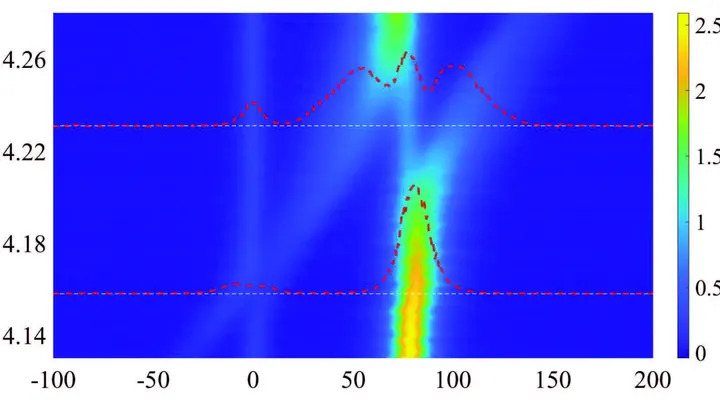
A laser is tuned to a frequency at which a rubidium atom normally does not get excited. But if an excited atom is already nearby, it shifts the energy levels of its neighbor, and the neighbor starts absorbing light. So the pair of atoms acts like a duo: one helps the other light up.
A neutral-atom quantum computer is like a library where books not only need to be read but also quickly returned to the shelf. Slow readout of results is like a sluggish librarian holding up the entire queue. Scientists have found a way to speed up this process by adding helpers.
Eight red giants — bloated old stars like the future Sun — are not behaving by the book. Their surfaces oscillate steadily, like a bell, but within this chime there are glitches: some tones are missing, and the rhythm breaks. Scientists suspected an invisible hand inside — a magnetic field — and tried to calculate its strength.
An ordinary antenna picks up radio waves, but there are fields it barely feels. We're talking about slow electric fields: those that change once a second or less. For them, physicists built a sensor from a beam of rubidium atoms.
Dark matter is an invisible mass holding galaxies together. Its nature remains unknown, but one likely candidate is the axion — an ultra-light particle that barely interacts with matter. To catch it, physicists built a hybrid trap.
Inside a glass capsule the size of a pea, rubidium atoms float. A laser beam puts them into a special state — Rydberg — where the electron flies far from the nucleus, making the atom extraordinarily sensitive to external fields.
Radio waves that oscillate less than once per second pass through the earth and water with almost no loss. Such signals are used to communicate with submarines and to search for minerals. But a conventional antenna for them would need to be hundreds of meters long, and its sensitivity leaves much to be desired.
A quantum computer is like an orchestra where each musician plays their own part, but all must sound in harmony. Until now, most quantum circuits were built from identical atoms — as if the orchestra consisted only of violins. Now physicists have taught two different elements to work together: rubidium and cesium.
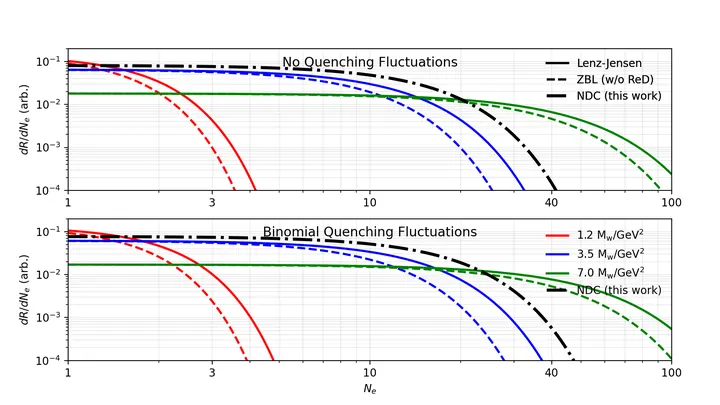
In the dark chamber of the detector, argon waits. When an invisible particle (say, a dark matter candidate) flies through, it gives the argon nucleus a gentle shove. The nucleus is knocked out of place, and charges are born around it. Exactly how many charges is no trivial question: physicists use that number to tell what kind of visitor dropped by.
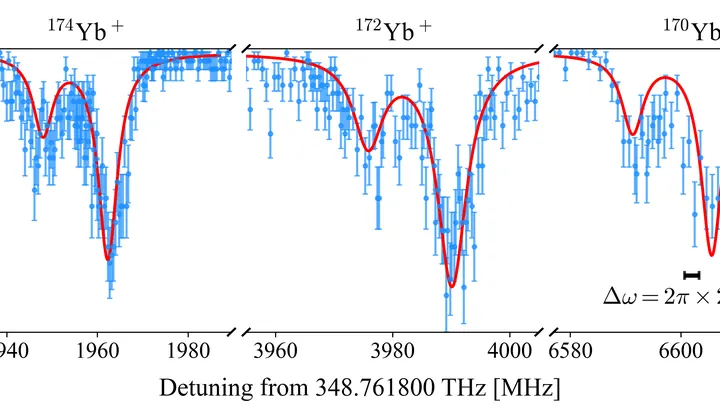
The light an atom emits or absorbs is like a fingerprint: each element has its own pattern of lines. In an ytterbium ion (an atom that has lost one electron), researchers have found three new lines that were previously unused. These lines are very narrow, like thin slits in a fence that let you see far and clearly.
Fourteen rubidium atoms lined up like beads on a string. Each atom is a tiny magnet that can point up or down. Together they follow strict rules, similar to a train schedule: everything is predictable, everything repeats. But introduce a barely noticeable change, and the schedule goes off the rails.
A regular radio receiver picks up waves with a metal antenna. Here, the antenna is a single atom with an electron boosted to a distant orbit, like a satellite in a high orbit around Earth. Such atoms are called Rydberg atoms.
Dark matter is an invisible substance that holds galaxies together but emits no light. Catching its particles is like trying to hear a whisper in a noisy hall. Ordinary detectors only pick up loud impacts, while weak signals get drowned out by background noise.
A chain of atoms on a light-guiding chip behaves like a row of pendulums on a shared support: swinging in opposite directions, they barely transfer energy to the air and freeze for a long time.
Picking up an ultraweak microwave signal is like trying to hear a whisper in a storm. Rydberg atoms, inflated to the size of bacteria, promise to become perfect antennas. But there's a fatal catch: during optical readout, up to 98% of messenger photons vanish without a trace in the detector.