Rotation measure is a quantity in radio astronomy that quantifies how much the polarization angle of a radio wave rotates as it travels through a magnetized plasma. It depends on the integral of the electron density times the magnetic field component along the line of sight. This measurement is crucial for mapping magnetic fields in the Milky Way, in other galaxies, and in the intergalactic medium.
History
The concept was developed in the mid-20th century as radio astronomy matured, with key contributions from astronomers like Hanbury Brown and others who recognized the importance of Faraday rotation in interpreting polarized radio sources.
How it works
When linearly polarized radio waves pass through a magnetized plasma, the plane of polarization rotates due to the Faraday effect. The rotation angle is proportional to the square of the wavelength, and the proportionality constant is the rotation measure. By observing a source at multiple wavelengths, astronomers can measure the rotation measure and infer the magnetic field strength and electron density along the line of sight.
The rotation measure of a distant quasar can be used to detect magnetic fields in the otherwise invisible intergalactic medium, revealing the cosmic web's magnetic structure.
Rotation measure, proportional to integrated electron density times magnetic field along the line of sight — rotation measure= varies (e.g., 0.812 rad m^-2 for typicalradian per metre squared
Two caravans travel toward each other along a narrow road. One is wide and slow, carrying a load of density. The other, a string of light carts carrying current, slips between the first. Thus, in a magnetron discharge, two structures rotating in opposite directions coexist: the density spoke and the current filaments.
Radio waves from a distant pulsar travel through the interstellar medium, encountering invisible magnetic structures the size of the distance from the Sun to Earth. One such structure is a current sheet, where the magnetic field abruptly changes direction, like a compass needle flipping from north to south.
Imagine a string stretched between two tuning pegs. The slightest touch makes it vibrate, and from the pitch you can guess exactly how it was plucked. Physicists at the University of Arizona have stretched a similar string — not on a musical instrument, but on a silicon membrane just a hundred nanometers thick.
A laser beam is like a swift vortex that briefly captures a passing electron. As the particle moves through the pulse, its spin (the intrinsic rotation, like a tiny top) experiences a weak kick. After leaving the beam, the top no longer points in the same direction; it has turned a little.
Fast radio bursts — millisecond radio pulses arriving from distant galaxies — long remained a puzzle. Their colossal energy, compressed into instants, pointed to cataclysms on neutron stars, perhaps pulsars or magnetars.
At the center of many galaxies lurks a supermassive black hole, ejecting relativistic plasma jets over hundreds of kiloparsecs. One such is the radio galaxy ESO 137-G007 in the Norma Cluster, known as the “Corkscrew Galaxy” for its twisted jets.
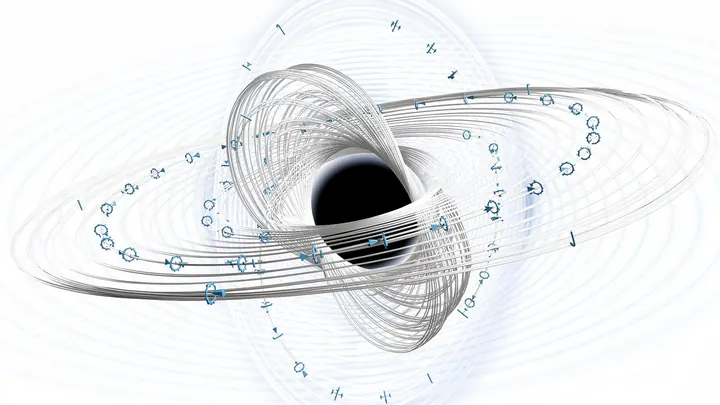
A spinning top whirling so fast that it forces light around it into spirals: that's a fitting image for what happens near a black hole's horizon. Hot plasma falls in and emits radio waves. Their polarization (the plane in which the wave oscillates) becomes an arrow pointing in the direction of energy flow.
Red giants are swollen, aging stars. Deep inside, an ocean of plasma churns: heat forces its way from the core to the surface, generating waves like a mighty surf. The star's magnetic field acts like an invisible seabed – it steers these waves, changing their height and speed.
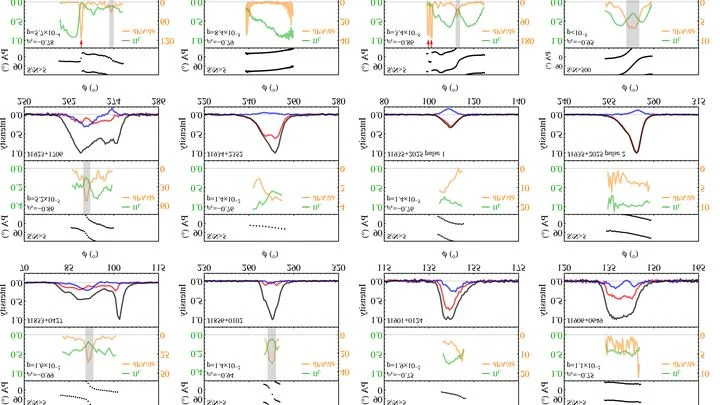
Even Jocelyn Bell Burnell, who first detected the strict periodicity of radio signals, noticed that some pulses would suddenly vanish. Today we know: variability is not a whim, but the voice of intricate electrodynamics.
When two black holes merge, they shake the very fabric of spacetime. The newborn giant doesn't settle instantly (it rings like a cosmic bell, emitting a characteristic pattern of damped gravitational waves) the so-called ringdown.
Four tiny puddles, and in them ripple droplets of a superfluid. These droplets are atoms cooled to near absolute zero and paired up like little magnets. When the whole setup rotates, the fluid flows between the puddles. Simply counting how many droplets end up in each reveals the angle and angular velocity.
The crown of a huge tree sways in the wind, but the roots and trunk are hidden underground. On the Sun, magnetic fields play the role of such invisible roots. They emerge from the depths, thread through the entire atmosphere, and govern the motion of the hot gas — plasma.
Radio waves from a gamma-ray burst — the cataclysmic death of a massive star whose flash briefly outshines an entire galaxy — reach Earth polarized. This means their electric field oscillates predominantly in a single plane, like a compass needle frozen in a magnetic field.
A distant lighthouse flashes for an instant brighter than an entire galaxy. This is a fast radio burst — a mysterious signal from deep space. Some repeat, and astronomers have noticed a peculiarity: these bursts show rapid changes in polarization — a property indicating how the radio wave is twisted in space.
Light, like a shaken rope, oscillates in a specific plane. Astronomers and engineers often rotate images using a three-mirror system, the so-called K-mirror, but this inadvertently rotates the plane of oscillation as well. For precise measurements, that's a problem.
A figure skater glides across the ice, gradually moving toward the center. Their trajectory isn't a perfect spiral: sometimes they catch the rhythm of the music and add an extra turn, slightly changing their speed. That's roughly how a small black hole behaves when it falls into a supermassive one.
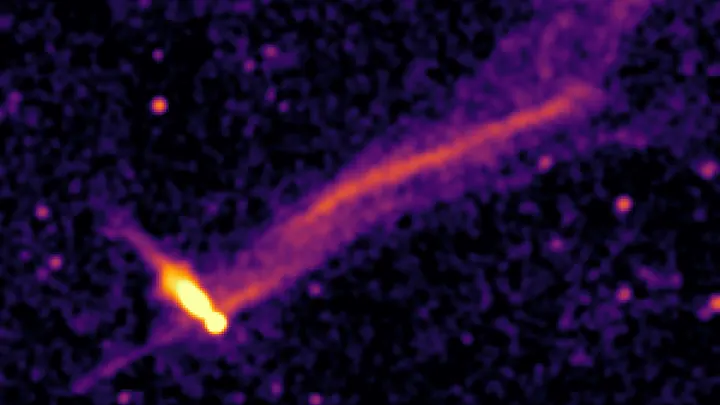
Deep in space, a rapidly spinning neutron star, a pulsar nicknamed the Lighthouse, speeds through tenuous gas. Like a motorboat cutting through water, it leaves a glowing trail of charged particles behind. In X-rays, this trail appears as a bright tail and a thin filament stretching over many light-years.
Light from thin semiconductor layers can be polarized: its waves oscillate in a single plane. Previously, it was thought that the direction of oscillation was set by how the sample was illuminated.
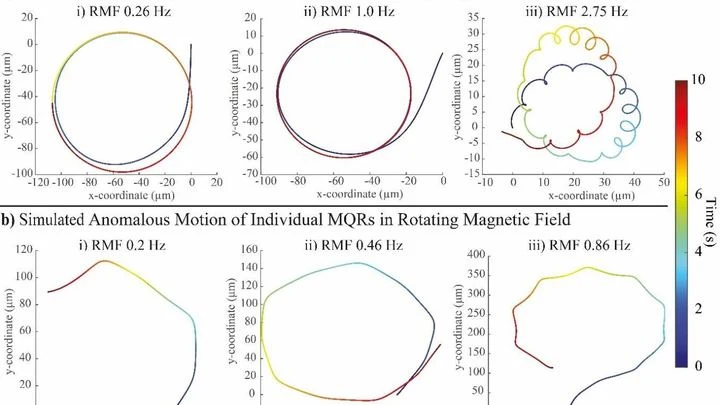
A small ball with an iron core lies on a surface while a magnetic field spins around it. The ball starts rolling like a wheel and usually goes in the direction the field rotates. But sometimes it suddenly turns around and rolls the other way — against the field.
Think of a stack of paper: when the sheets lie perfectly aligned, light passes through them uniformly. But turn one sheet by a few degrees, and the picture changes. Something similar happens with layers in certain materials: rotate them relative to each other, and their properties change — sometimes dramatically.
Spectroscopy isn't the key here, or rather, it's not the method used.
You can make a light beam look like a flower with several petals. If you send such a beam through a cloud of cold rubidium atoms and switch on a magnetic field, the petals start to rotate. The angle of rotation is directly linked to the field's strength.
Radio pulsar J1574+4703 behaves like a finicky lighthouse. Instead of shining steadily, it turns its radio beam on in short flashes and then falls silent for long stretches. Objects like this are called 'rotating radio transients', or RRATs for short.
A flashlight beam in fog breaks into thousands of faint specks. Each speck is light that has bounced off countless water droplets before reaching your eye. To make sense of this mess, physicists construct a special table — the scattering matrix. It records how each incoming ray turns into a set of outgoing ones.
In particle scattering experiments, the target is often polarized: nuclei are aligned so that their spins point predominantly in one direction. The degree of this alignment affects the collision outcomes.
Magnetic fields are invisible, but they can be heard. Rubidium atoms inside a glass cell respond to them like strings to a bow: radio waves make them oscillate between energy states.
In laboratories where atoms are cooled to near absolute zero, even a tiny change in the magnetic field throws off all the settings. Conventional sensors, Hall plates or coils with ferrite cores, sit a few centimeters away from the vacuum chamber because they themselves create interference.
A neutron star the size of a city spins faster than a kitchen blender, flinging particles around itself. A glowing cloud forms around it — called a pulsar halo. The shape of this cloud depends on invisible magnetic fields that, like ocean currents, steer the particles.
A garden hose blasts a powerful stream of water. If you pinch it or give it a jerk, the stream starts to writhe like a snake, and spray flies everywhere. Something similar happens with the giant plasma jets that black holes shoot out.
A tiny diamond hangs in the air, held by an electric field like a speck of dust in a beam of light. Hidden inside are defects — places where a carbon atom is replaced by nitrogen, with a vacancy nearby. These defects behave like little magnets that can be flipped with laser and microwaves.
The Sun is not a calm sphere. Waves constantly ripple through its interior, like a bell after being struck. These oscillations reach the surface and reveal what's happening on the far, invisible side. Astronomers have long been able to 'listen' to this ringing and find large sunspot groups there.
A fridge magnet sticks because the tiny atomic arrows inside it are aligned in one direction. But quantum mechanics makes these arrows jitter, so the overall magnetization falls short of the ideal.
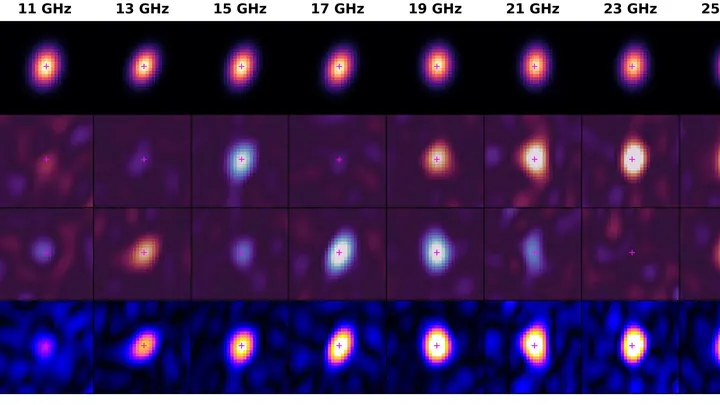
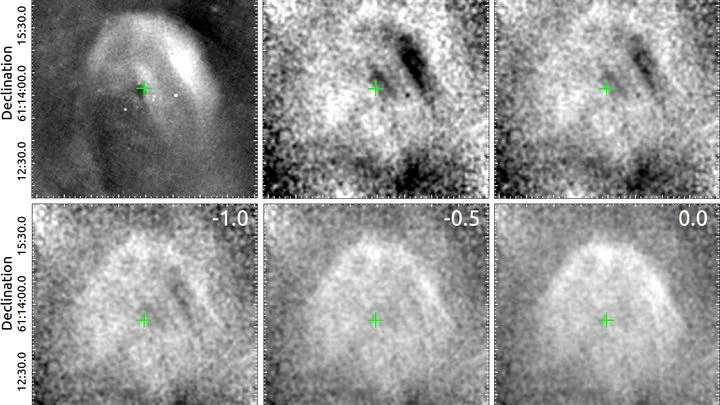
The VLA radio telescope peered into the Boomerang Nebula — a cloud inflated by the wind from a rapidly spinning neutron star. The new images reveal details as small as a lunar disk on the sky: an elongated core around the pulsar and a long arc curving around it from the north.
In a giant particle accelerator, where protons traveling at nearly the speed of light smash into a neon target, charmed baryons are born — particles that live for less than a billionth of a second.
In the dark cloud L43, where stars are born, dust grains twirl like tiny compasses. Light from a young star pushes them, while the magnetic field lines them up in a specific direction. When a grain is turned sideways to us, its heat reaches us polarized, like light passing through a narrow slit.
Light can draw patterns right inside your eye — no screen or glasses needed. When a specially shaped beam enters the pupil, it creates dark rays in your field of view, like the spokes of a spinning wheel. You see these rays because they are born in the retinal cells, not outside.
A beam of circularly polarized light hits a MAPbI3 perovskite crystal. The electrons inside start behaving like tiny spinning tops, their axes aligning along the beam. This phenomenon is known as optical spin orientation.
Light traveling through an optical fiber is like a runner in a narrow corridor: it can run straight, or it can weave from side to side. The direction of these "weaves" is polarization. Physicists have learned to keep the runner on a straight path: they constantly check its trajectory and gently correct it, not letting it veer off.
An ordinary magnetic compass freezes when lightning strikes nearby. A sudden jump in the magnetic field throws the needle off. A similar problem has been hindering scientists trying to measure magnetism in strong pulsed fields: those that switch on for a thousandth of a second.
The new setup tackles this with a laser beam.