The Perfect Mirror: Quantum Fields on a Donut and the Geometry Within express
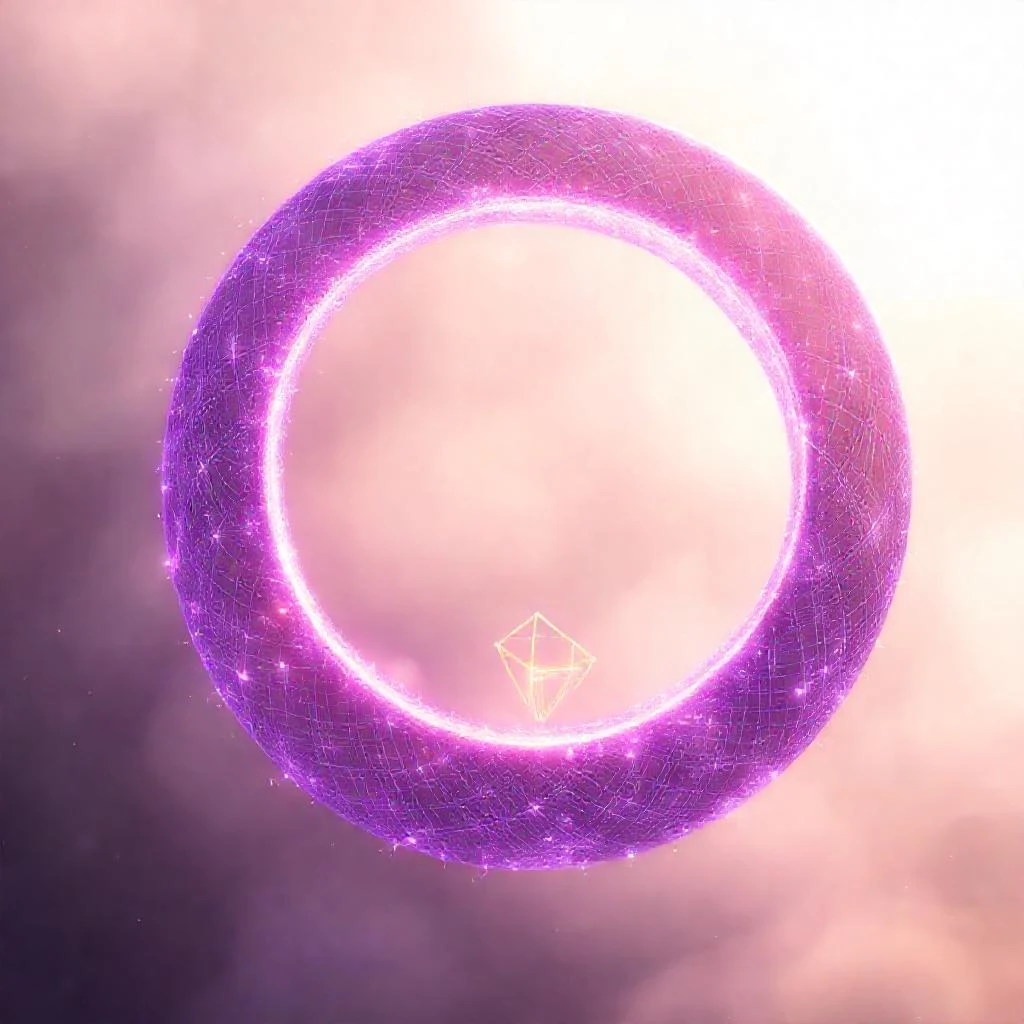
On a donut-shaped ring, the theory lives on the surface, while inside hides a curved space — like a saddle widening toward the edge. According to the holographic principle of Juan Maldacena, everything happening inside can be described by data on the boundary.
It turns out that for such a shape, this connection becomes a perfect mirror: a simple measure of one point's influence on another on the surface exactly equals the length of the shortest path through the curved inner space. This is a strict equality, not an approximation, and it works even for the simplest fields, where the most complex calculations unexpectedly simplify down to a single line.
The same holds for quantum entanglement: its measure — entanglement entropy — between two parts of the surface matches the area of a special cross-section inside. This builds an exact dictionary: information on the boundary is a reflection of the geometry in the bulk. Such an approach promises simplified calculations and helps understand quantum gravity near black holes.
Original abstract
as written by the authors arXiv:2605.15776
We show that for a CFT$$_D$$ on a flat open solid torus, the two point function in the Weyl frame is exactly paired with a finite geodesic lying entirely in the AdS$$_{D+1}$$ bulk interior. This relation is exact and requires neither large $$N$$, strong coupling, nor heavy operators. The exactness is that of conformal kinematics; no semiclassical bulk dynamics is assumed. The standard boundary-anchored relation is a singular limit of the exact pair. For the free scalar, a mode expansion along $$S^1$$ generates an infinite tower of effective masses on $$H_{D-1}$$, whose intricate propagators resum exactly to the same simple higher-dimensional geodesic expression. Together with another exact pair between disjoint entanglement entropy and entanglement wedge cross-section found on the same open solid torus, this result points toward a broader exact-pair program in AdS/CFT.
The donut shape lets you hide extra dimensions, like in an old videogame where a character goes off one edge of the screen and instantly pops out on the other side.
The holographic principle echoes 'The Matrix' and the novels of Alastair Reynolds: reality could be just a projection from a surface.