In physics, a boundary is the surface or edge that separates a region of space from its surroundings. In the context of the holographic principle, the boundary is a lower-dimensional surface that encodes all the information about the volume it encloses. This idea, inspired by black hole thermodynamics, suggests that the physics of a volume of space—including gravity—can be fully described by a quantum field theory living on its boundary. The boundary is not just a mathematical convenience; it is where the degrees of freedom of the system are thought to reside.
History
The holographic principle was proposed by Gerard 't Hooft in 1993 and refined by Leonard Susskind in 1995, building on the Bekenstein-Hawking entropyformula for black holes. The precise AdS/CFT realization was introduced by Juan Maldacena in 1997.
How it works
The holographic principle is most concretely realized in the AdS/CFT correspondence, where a gravitational theory in a five-dimensional anti-de Sitter space is equivalent to a conformal field theory on its four-dimensional boundary. The boundary acts as a 'hologram' of the bulk: every process in the interior has a counterpart in the boundary theory. Information about the bulk geometry, such as the location of a black hole horizon, is encoded in the entanglement structure of the boundary quantum state. The boundary is not a physical wall but a conceptual one—it is the asymptotic 'infinity' of the spacetime where the dual theory lives.
In practice
The boundary concept is used in quantum gravity research to compute black hole entropy, to model strongly coupled quantum systems like quark-gluon plasmas, and to explore the nature of spacetime at the Planck scale.
Fun fact
The holographic principle implies that the maximum amount of information that can fit in a region of space is proportional to its surface area, not its volume—a fact that has profound implications for the nature of reality.
For a long time, the event horizon behaved like a cosmic dictator: everything that crossed its boundary vanished irretrievably from our Universe. But quantum mechanics, like a dissident's voice, whispered: information cannot simply disappear.
An endless ocean where every wave carries information about what happens in the depths. That is roughly how our Universe works under the holographic principle: the physics inside a volume can be described by processes on its boundary.
Dim the lights. The stage belongs to a shadow theater, with just r puppeteers, but the screen obeys the laws of hyperbolic geometry. Every wave of the hand births a pattern that mathematicians call a discrete group of isometries.
A classical black hole has a temperature and other thermodynamic properties. When physicists began accounting for changes in the cosmological constant, the energy of empty space, a strange coupling emerged in the equations.
At the very beginning of the universe, when all of space was compressed into a point, the laws of physics break down. This point is called a singularity — an edge where our equations lose meaning. But what if it's not an end, but a special type of boundary?
The authors of this work propose viewing the singularity as a free boundary.
If you clap your hands in an empty room, the echo will tell you about its size and shape. Every object (a chair, a book, a person) adds its own signature to this echo: sound reflects off it in a particular way. The authors of the paper have figured out how to completely rewrite this acoustic signature. They surrounded a region of space with a closed surface of microphones and loudspeakers.
Spacetime isn't a flat sheet, but a crumpled fabric: stars and planets leave creases on it. Information is written into every crease, and to erase it, heat would have to be released — that's how Landauer's principle works. Thus, the 'crumpledness' of space can be measured through entropy — the universal measure of disorder.
In the mid-20th century, Roger Penrose described a black hole using the concept of a “trapped surface” – a region where even a light ray directed outward inevitably falls inward. A situation familiar to everyone: water in a sink’s vortex is irretrievably sucked down the drain.
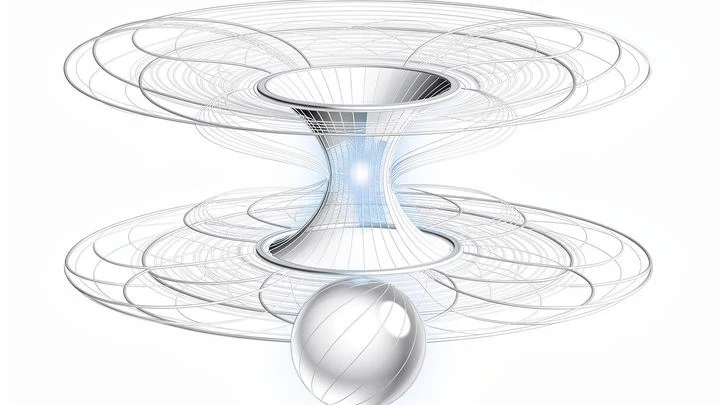
First thing that comes to mind when thinking about the birth of the Universe is an explosion. But modern cosmology paints a more refined picture: birth through the neck of a wine glass. This geometry is not a sommelier's fantasy, but a rigorous form of Euclidean wormhole that connects two anti-de Sitter worlds.
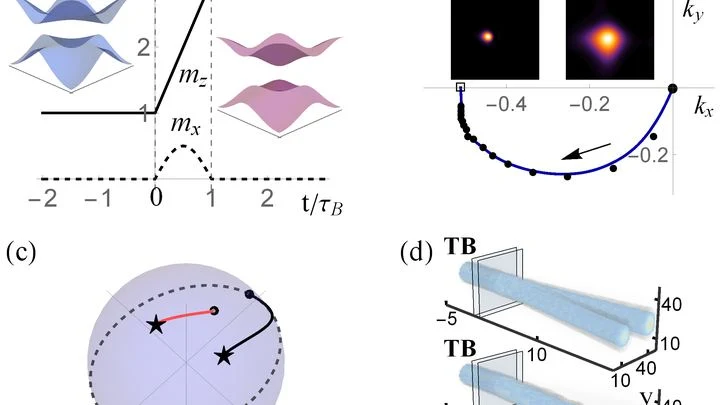
A stone falls into a pond, and ripples spread across the water. They reflect off the shore, overlap, and die out. All this motion unfolds in space. But what if the pond itself changed its depth or density for an instant — not at one point, but everywhere at once? A temporal boundary is exactly such a jump in properties over time, not space.
A stone falls into a pond — near the shore, the ripples are barely visible, while the water churns at the point of impact. The electric field around a charge behaves similarly: close in, it's sharp and tangled, but at a distance it stretches into a smooth wave that carries energy away. Physicists call this distant region the radiation zone.
A drop of cream falls into a cup of coffee, and within a minute, the entire drink turns beige. This mixing process can be quantified: how much "stirring" is needed to transform one distribution of particles into another? In mathematics, this approach is called optimal transport, and the measure of effort is the Wasserstein distance.
The authors applied this idea to quantum systems.
A black hole is like a dark ball in space onto which luminous matter falls. A black hole has a shadow — a region from which rays cannot escape. But due to light bending, the shadow appears larger than the hole itself: just like a ball's shadow on a wall grows bigger when the lamp is far away.
Each qubit has its own little ring, freely sliding on the doughnut. All quantum logic boils down to smooth movements: shift, flip, connect. Entanglement, for example, is when two doughnuts stick together, and the rings on them begin to spin synchronously, like figure skaters in pairs skating.
The key insight: the geometry of the surface dictates the rules of the game.
Picture a globe divided into cells: near the poles they shrink into narrow wedges, while at the equator they stretch into wide bands. If you connect random points on such a globe with lines, the compass arrows will lie: connections will point to where there are more cells, not where the flows actually go.