The Perfect Mirror: Quantum Fields on a Donut and the Geometry Within express
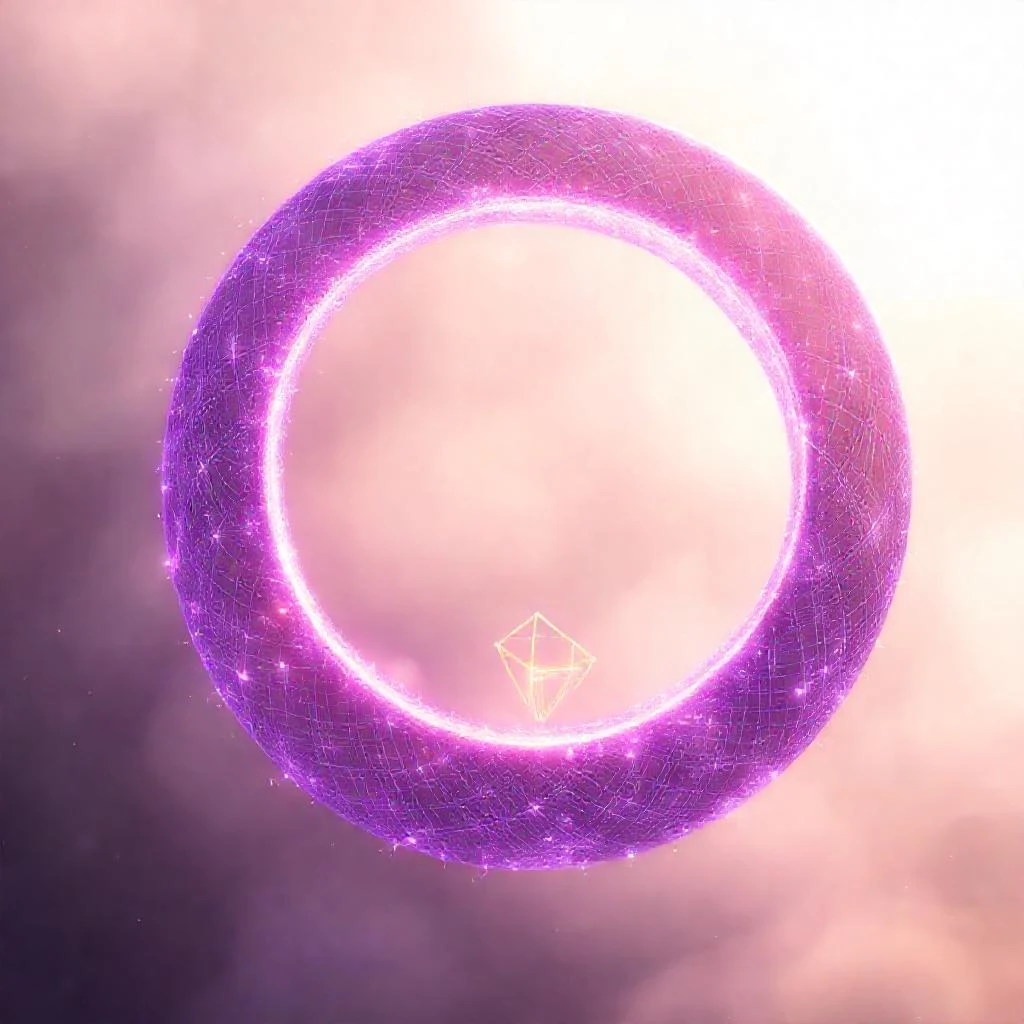
On a donut-shaped ring, the theory lives on the surface, while inside hides a curved space — like a saddle widening toward the edge. According to the holographic principle of Juan Maldacena, everything happening inside can be described by data on the boundary.
It turns out that for such a shape, this connection becomes a perfect mirror: a simple measure of one point's influence on another on the surface exactly equals the length of the shortest path through the curved inner space. This is a strict equality, not an approximation, and it works even for the simplest fields, where the most complex calculations unexpectedly simplify down to a single line.
The same holds for quantum entanglement: its measure — entanglement entropy — between two parts of the surface matches the area of a special cross-section inside. This builds an exact dictionary: information on the boundary is a reflection of the geometry in the bulk. Such an approach promises simplified calculations and helps understand quantum gravity near black holes.
The donut shape lets you hide extra dimensions, like in an old videogame where a character goes off one edge of the screen and instantly pops out on the other side.
The holographic principle echoes 'The Matrix' and the novels of Alastair Reynolds: reality could be just a projection from a surface.