In the 1970s, Jacob Bekenstein suggested that black holes have entropy proportional to the horizon area, and Stephen Hawking derived the exact formula S = A/(4Gℏ) (in units k_B=c=1). In 1993, Gerard 't Hooft realized the generality of this idea: if the black hole entropy is maximal for a given volume, then any system cannot contain more information. Leonard Susskind formalized the principle: the number of fundamental states (degrees of freedom) in a region of space is bounded by the area of the boundary in Planck units. The AdS/CFT correspondence became an exact realization of the holographic idea.
History
Jacob Bekenstein (1972) linked black hole entropy with horizon area, and Stephen Hawking (1974) computed the 1/4 coefficient, discovering Hawking radiation. Gerard 't Hooft (1993) formulated the holographic principle as a resolution of the information loss paradox in black holes. Leonard Susskind (1995) developed it into a full program, introducing the holographic bound. Juan Maldacena (1997) provided a concrete realization via AdS/CFT. In the 21st century, the principle is actively applied in quantum information theory and entropic gravity.
How it works
The principle is applied in quantum gravity theories to resolve black hole paradoxes: information is preserved on the horizon. Boundaries: for static asymptotically flat spacetimes it is precisely defined; for cosmological horizons (de Sitter) there are modifications. Limitation — a complete holographic theory for a realistic Universe has not yet been built. In quantum cosmology, the holographic principle imposes constraints on inflationary models.
In practice
Reinterprets the nature of black holes, inspires concepts of quantum computers and holographic memory.
Fun fact
According to the holographic principle, the visible Universe could be a giant hologram recorded on the cosmological horizon.
Picture a vast hall where thousands of janitors are sweeping the floor at the same time. Each one knows only their own patch and sweeps debris toward the nearest wall, without asking a manager. It used to be thought that such an approach was impossible for a quantum computer: too many errors, and you need a central brain that sees the whole picture.
The holographic principle is often compared to a hologram: all the information about a volume is encoded on a flat surface. In physics, this means that three-dimensional spacetime with gravity could be equivalent to a two-dimensional theory without gravity — a so-called conformal field theory (CFT).
A black hole devours everything, even light. Yet it obeys the laws of physics: it possesses entropy — a measure of the hidden information an object 'remembers.' In the 1970s, Jacob Bekenstein and Stephen Hawking discovered a strange pattern: a black hole's entropy grows not with its volume, but…
The universe rang piercingly in its first moments. During the inflation epoch, when space expanded faster than light, energies were monstrous — trillions of times higher than in the Large Hadron Collider.
A black hole cooled to nearly absolute zero resembles a musical instrument with only a limited set of possible notes. Strike it, and it will respond not with any sound, but only with a strictly defined set of frequencies.
Water turns to ice at zero degrees — sharply, with no intermediate states. Something similar happens to complexity when we take a random quantum state of an entire system and look only at a part of it. As long as that part occupies less than half the system, its complexity grows smoothly. But as soon as the fraction crosses 50%, a jump occurs.
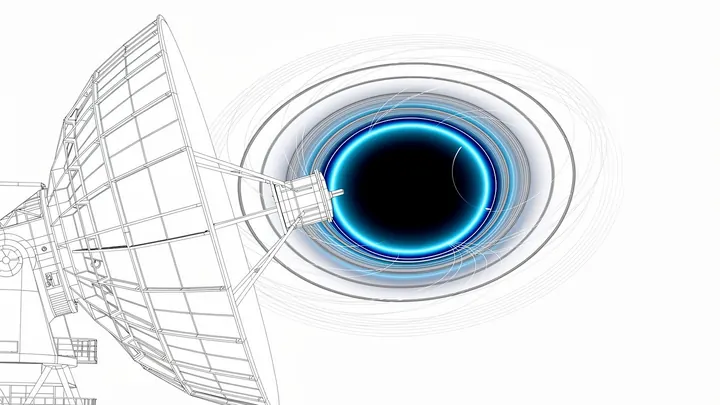
At the center of most galaxies lurk supermassive black holes — the overlords of gravity. Since 2019, thanks to interferometry with very long baselines, we’ve glimpsed their shadows: dark silhouettes set against a blazing gas backdrop. But what exactly is painting that shadow?
The cosmological horizon — the edge of the observable Universe, which is expanding at an accelerating rate — is like a safe with a timer. Information about what crosses this boundary doesn’t vanish but returns, albeit with a delay. Physicists have figured out how long this pause lasts.
The cosmological principle – the notion that the Universe is homogeneous and isotropic on large scales – has guarded our understanding of the world since the time of Edwin Hubble and Georges Lemaître, whose ideas formed the basis of the Big Bang model.
Einstein’s cosmological constant — a blunder or a boomerang insight? The universe’s acceleration caught physicists off guard: ΛCDM works, but why is the vacuum energy so absurdly tiny? Imagine an ocean heaving with quantum fluctuations, yet on the surface only a microscopic ripple.
Our universe is expanding, and its future, according to cosmologists, is empty, cold de Sitter space. Understanding its quantum nature is like trying to read a book by looking only at its cover. The holographic principle suggests that all information about what happens inside a volume can be encoded on its boundary, like a picture on a film.
Erasing even a single bit means releasing heat. This discovery by Rolf Landauer hinted that information is neither material nor illusory. Imagine that every event casts a shadow: that is information, the collection of all unrealized possibilities.
If you clap your hands in an empty room, the echo will tell you about its size and shape. Every object (a chair, a book, a person) adds its own signature to this echo: sound reflects off it in a particular way. The authors of the paper have figured out how to completely rewrite this acoustic signature. They surrounded a region of space with a closed surface of microphones and loudspeakers.
Light from an ordinary bulb seems utterly chaotic: its waves oscillate out of sync, like a crowd where everyone walks in their own direction. Such light is called incoherent. For a long time, it was believed that elegant topological structures (knots, rings, links) could only be created in coherent laser light, where all waves march in step.
Spacetime isn't a flat sheet, but a crumpled fabric: stars and planets leave creases on it. Information is written into every crease, and to erase it, heat would have to be released — that's how Landauer's principle works. Thus, the 'crumpledness' of space can be measured through entropy — the universal measure of disorder.
A person hunting for keys mentally runs through places where they might be. A bird that tucked hundreds of seeds into crevices in autumn retrieves them flawlessly in winter. How can a brain hold so many addresses when all birds have roughly the same number of neurons? The answer lies in geometry.
The universe hums like an orchestra: its notes are gravitational waves — ripples in spacetime predicted by Albert Einstein. The LIGO observatories, made exquisitely sensitive thanks to Rainer Weiss, strive to catch these whispers.
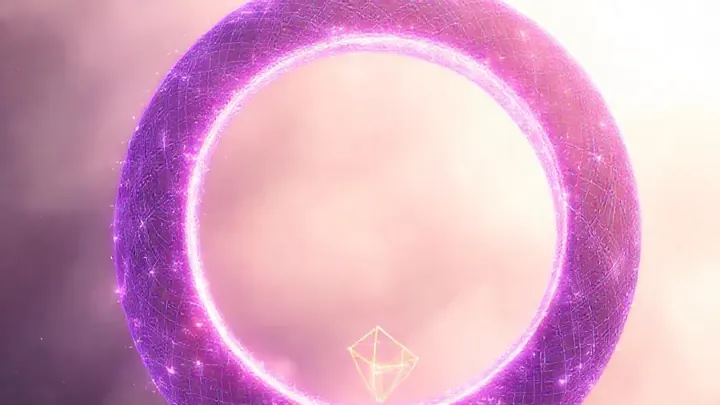
On a donut-shaped ring, the theory lives on the surface, while inside hides a curved space — like a saddle widening toward the edge. According to the holographic principle of Juan Maldacena, everything happening inside can be described by data on the boundary.
In the mid-20th century, Roger Penrose described a black hole using the concept of a “trapped surface” – a region where even a light ray directed outward inevitably falls inward. A situation familiar to everyone: water in a sink’s vortex is irretrievably sucked down the drain.
A stone thrown into a pond leaves ripples spreading across the water. In quantum physics, the role of such ripples is played by equations that relate the properties of particles. Recently, mathematicians proposed a set of such equations for a world without gravity but with a large number of 'degrees of freedom'—roughly like the complex ripples on water.
A drop of cream falls into a cup of coffee, and within a minute, the entire drink turns beige. This mixing process can be quantified: how much "stirring" is needed to transform one distribution of particles into another? In mathematics, this approach is called optimal transport, and the measure of effort is the Wasserstein distance.
The authors applied this idea to quantum systems.
The visible edge of the universe is a holographic screen that, like a black hole, obeys laws discovered by Bekenstein and Hawking. Normally, information is preserved on it, but calculations show that if a few bits are lost, energy is released that accelerates expansion.
Primordial black holes, hypothetical objects that emerged in the first instants after the Big Bang from the collapse of superdense fluctuations, should have vanished long ago according to Stephen Hawking's classic prediction: they would completely evaporate via quantum radiation, much like a puddle of…
According to one physical hypothesis, our voluminous world might be a projection from a flat surface. From such a Universe, tiny closed bubbles — baby universes — sometimes pinch off. For a long time, they were thought to be empty, devoid of internal diversity.
It turned out that the information inside them is scattered, like shards of a broken mirror.