How to Fish the Laws of Nature Out of Noise express
A voice recorder captures a city square. You hear the hum of a crowd, footsteps, snatches of conversation, the rumble of traffic. Somewhere in that sonic stew, a street musician plays a simple tune on a flute. Hearing it isn't easy: there's just too much mixed together.
That's roughly the problem a new algorithm called Edwin (maximum-entropy compression with discovery of interpretable nonlinear models) tackles. It takes high-dimensional data (say, hundreds of sensor readings or thousands of video pixels) and looks for hidden simplicity. First, the algorithm compresses the data into a few key variables, as if isolating the pure flute sound from a noisy recording. Then it derives equations that describe how those variables change over time. And all this without losing touch with reality: each variable stays tied to measurable quantities, not becoming an abstract number.
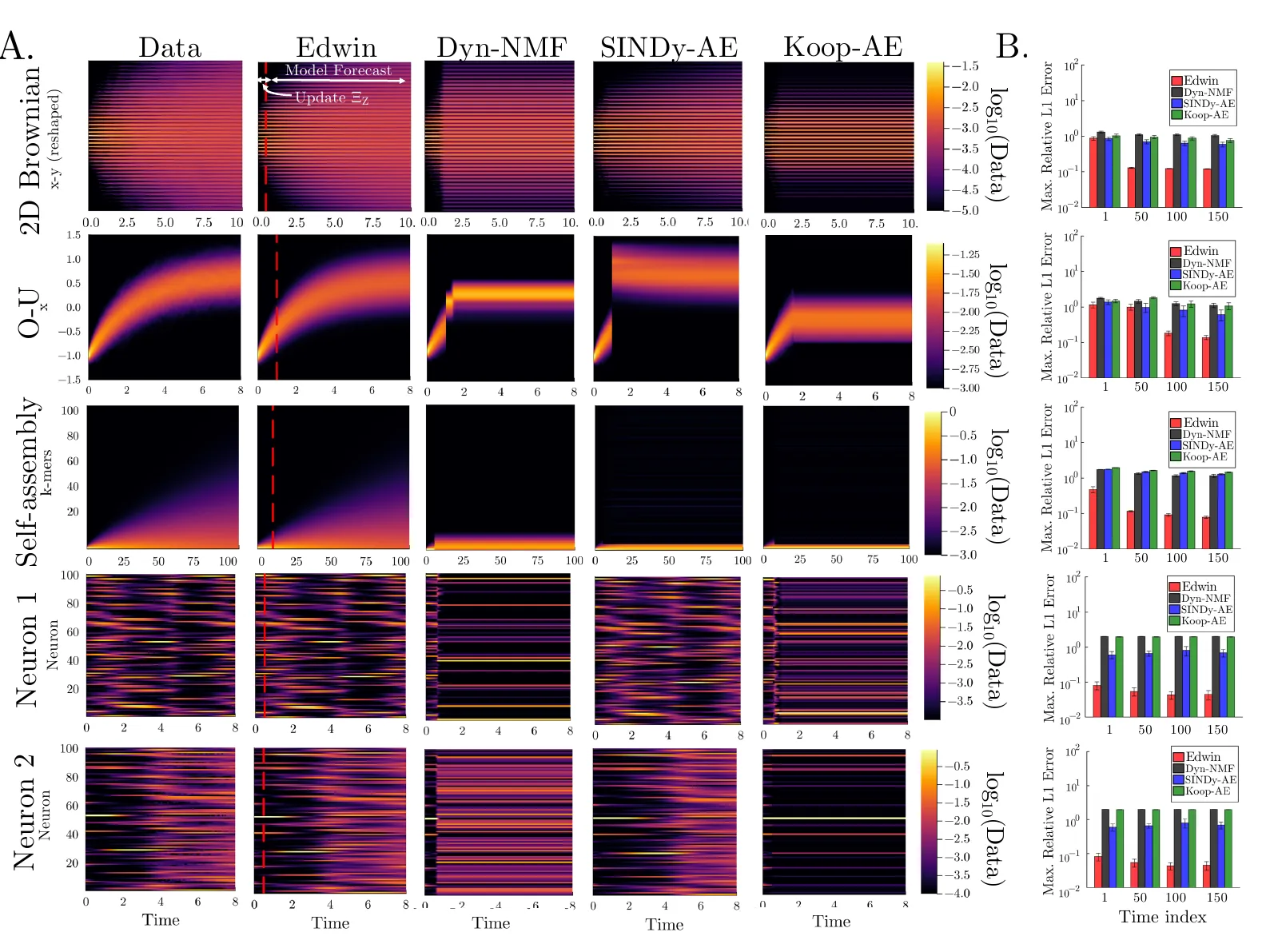
The authors tested the method on six different systems. Among them: random particle walks, molecular self-assembly, the pulsing of a group of neurons, and even a real experiment with RNA-liposome complexes where the data were noisy. In each case, Edwin produced a short equation that wasn't just a fit to the numbers but had physical meaning. For diffusion, for instance, it derived a law resembling the heat equation; for neurons, a model reminiscent of a pendulum with friction.
The big surprise is predictive power. Models found under one set of conditions worked under others the algorithm hadn't been trained on. It's like recognizing a melody in a different tempo or played by a different instrument. That means Edwin truly captures the essence of a phenomenon, not just memorizes data.
This approach could change how scientists seek laws in complex systems — from climate to biological networks. Instead of guessing which variables matter and manually fitting equations, you can hand that job to an algorithm that acts like a seasoned listener, picking the melody out of the noise.
The name Edwin isn't an acronym but a nod to astronomer Edwin Hubble, who discovered the expansion of the universe by spotting a simple pattern in seemingly chaotic data on galaxy motion.
In Carl Sagan's novel Contact, aliens transmit blueprints for a machine hidden in the noise of a radio signal — much as Edwin extracts meaningful structure from chaos.