RNA is a long chain (polymer) of nucleotides (building blocks). It is usually single-stranded, and uses ribose as its sugar (instead of deoxyribose, as in DNA), and contains uracil instead of thymine. RNA types differ by role: messenger (mRNA) — carries instructions from DNA to ribosomes (cellularprotein synthesis machines); transfer (tRNA) — delivers amino acids for protein assembly; ribosomal (rRNA) — forms the ribosomes themselves. There are also regulatory RNAs (e.g., microRNAs that fine-tune protein production) and catalytic RNAs (ribozymes capable of accelerating chemical reactions).
History
RNA was first isolated in 1868 by Friedrich Miescher, but its role remained unclear for a long time. In 1939, it was shown that RNA participates in protein synthesis. In 1961, mRNA was discovered, and in 1965, the structure of tRNA was deciphered. In the 1980s, the catalytic properties of RNA (ribozymes) were discovered, strengthening the RNA world hypothesis. With the discovery of RNA interference in the 1990s, the development of RNA-based technologies began, including mRNA vaccines.
How it works
RNA is synthesized in the nucleus during transcription: RNA polymerase unwinds a DNA segment and builds a complementary RNA strand. In eukaryotes, the primary pre-mRNA transcript undergoes splicing (removal of introns) and modifications. Mature mRNA is exported to the cytoplasm, where it binds to a ribosome. The ribosome—a complex of rRNA and proteins—moves along the mRNA and, with the help of tRNAs carrying amino acids, synthesizes a polypeptide chain. Each tRNA has an anticodon complementary to an mRNA codon. The process is regulated by various factors, and small regulatory RNAs can suppress gene expression by degrading mRNA or blocking translation.
In practice
RNA-based technologies, such as mRNA vaccines, enable rapid development of protection against new viruses.
Fun fact
Some viruses, such as HIV or SARS-CoV-2, use RNA as their genetic material, and their variability is due to the high error rate (mutations) during RNA copying.
An old mouse hangs on a wire two-thirds longer than a mouse its own age, and after running on a treadmill it doesn't collapse from exhaustion. The difference isn't training or diet: the mice had a single molecule suppressed, and their muscles worked like they did in youth. That molecule is microRNA-128-3p, a short chain of nucleotides that silences entire groups of genes.
Every time a cell divides, the protective caps on the ends of its chromosomes, known as telomeres, get shorter. Once those caps become too short, the cell stops dividing.
Picture a long thread trapped inside a sphere with charged walls. The thread is the virus's RNA; the sphere is its protein shell. The thread tries to settle so that its charges sit as close as possible to opposite charges on the wall.
Picture a long thread trapped inside a sphere with charged walls. The thread is the virus's RNA; the sphere is its protein shell. The thread tries to settle so that its charges sit as close as possible to opposite charges on the wall.
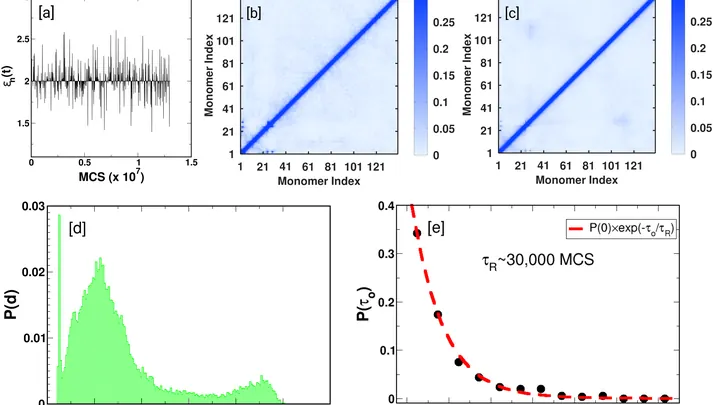
Inside a cell there are tiny droplets that have no membrane yet behave like separate compartments. One such droplet, made of identical short RNA fragments, resembles fresh aspic: it is transparent, springy, and easily changes shape. But if you watch it long enough, something resembling a sponge begins to grow inside it.
In the orchestra of the worm Caenorhabditis elegans, which has 302 neurons, the protein NHR-49 was long cast as a conductor who runs nothing but the fat warehouse. But a new experiment shows that this conductor can walk onstage without a fat score in hand.
A single DNA molecule, squeezed into a tiny metal slit, trembles and flickers under the laser. Its signal is not a clear string of letters but a chaotic mix of flashes and shadows. Deciphering this noise is like trying to make out a whisper in a crowded room.
The new neural network works like an attentive interpreter.
A protein is like a tiny machine that switches on and off on command. The command arrives when another molecule sticks to it, like a key in a lock. The protein then changes shape and passes the signal along. But exactly how the signal travels inside the protein has long been a mystery.
In the long extensions of a neuron, the dendrites, tiny couriers are constantly bustling about. These are messenger RNA molecules carrying instructions for protein assembly. Their journey starts at the cell body and ends at synapses — contacts with other neurons.
In the long extensions of a neuron, the dendrites, tiny couriers are constantly bustling about. These are messenger RNA molecules carrying instructions for protein assembly. Their journey starts at the cell body and ends at synapses — contacts with other neurons.
When biologists measure the activity of thousands of genes, they usually just see a list of coincidences, like two ingredients in a soup that often end up together. The standard method looks for such pairwise connections but doesn't show who influences whom.
A new approach, like a detector of dark matter, uncovers hidden threads of causation.
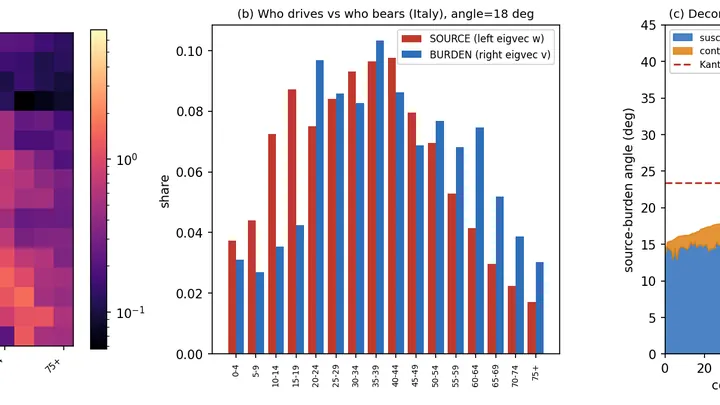
The orchestra plays without a conductor. We know the overall volume: that's the basic reproduction number R0, the spectral radius of the epidemic. But the score itself, the contact matrix between people of different ages, holds the melody: who spreads the infection and who takes the main blow.
A cell is like a library where thousands of books are copied every day. Molecular machines, polymerases and ribosomes, slide along a template chain and assemble a copy, link by link. These machines have several states: they can slow down, make mistakes, or switch. Previously, calculating such a process took hours.
A torn telephone wire is a nuisance, but a torn DNA is a catastrophe. A double-strand break, when both strands of the helix snap at the same spot, threatens the cell with death or transformation into cancer. Fortunately, the cell has its own 'glue': special proteins that gather into a droplet right at the accident site.
Imagine a huge garage with hundreds of parking spots. You're driving a tiny car, a future drug molecule, and you want to find the one free bay where it fits perfectly. But these bays aren't concrete; they're woven from DNA or RNA chains, and no one has posted the parking rules.
Long protein threads, their tangled entanglements, and random contacts: this is how the birth of cellular droplets was usually explained. These membrane-less organelles, where important reactions take place, resemble oil drops in water: they arise on their own when molecules separate into phases.
Nitrogen, the very gas we breathe, behaves like a finicky metal under a million atmospheres of pressure. In a diamond anvil cell, it is squeezed to 78–98 gigapascals and heated with a laser to 1800–2500 kelvin. Under these conditions, N₂ molecules rearrange into crystals that can store energy more densely than explosives.
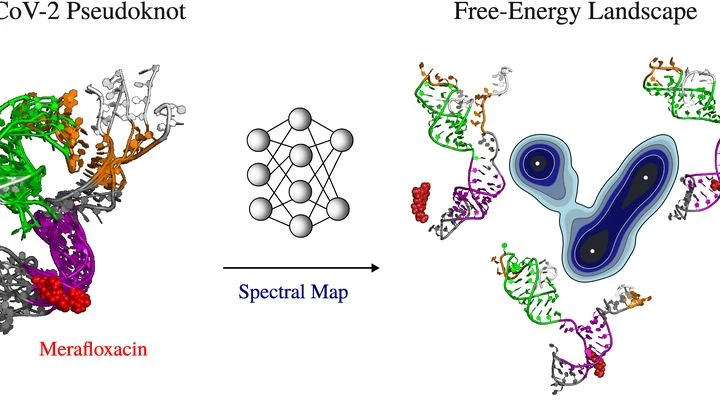
The RNA of SARS-CoV-2 is not just a chain but a complex structure. It contains a region that ties itself into a knot, much like a tangled shoelace. This knot helps the virus produce two proteins from a single stretch of genetic code. Without such a knot, the virus replicates less efficiently, so scientists are hunting for compounds that can undo it.
In a growing bacterium, genes that run protein factories don't drift solo. They clump into liquid droplets, like oily smears in water — no membranes, but sharp boundaries. The NusA protein fuels this condensation. When it piles up, it glues neighboring DNA stretches together, forcing them into foci.
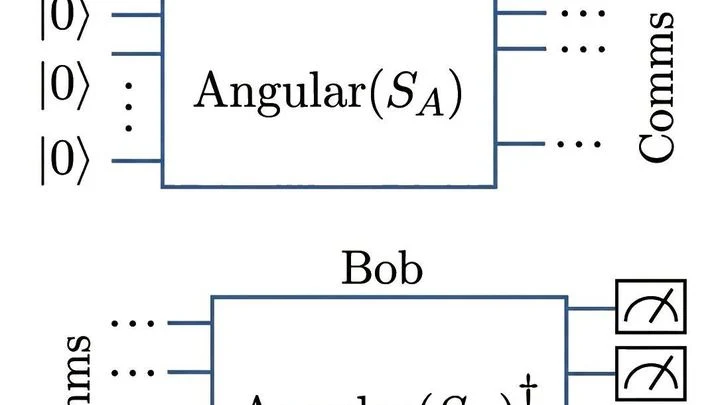
DNA is a long carbon necklace made of four types of beads. Biologists often need to compare two strands to find differences. Normally this requires a lengthy brute-force search. Researchers came up with a clever trick: encode each bead as an arrow that rotates based on its neighbors. The idea came from language models, where words also 'know' context.
Alzheimer's disease is like a tangled ball of yarn: thousands of genes are intertwined, and it's hard to tell which ones snap first. Previously, scientists looked for important genes by simply counting how many connections each node in the network had. But that approach is like judging a person by the number of acquaintances they have — the most sociable isn't always the most influential.
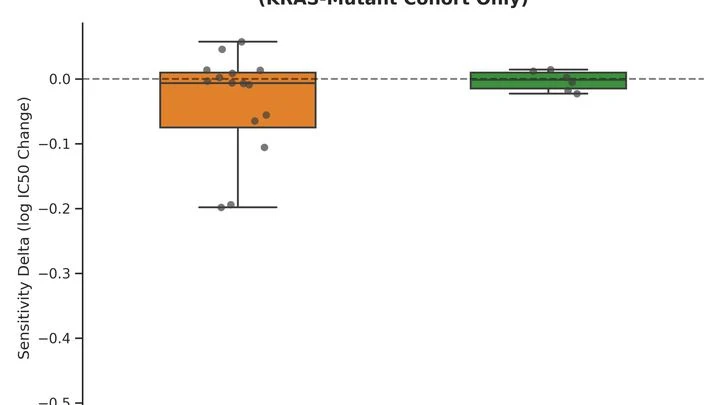
A cancer cell is like a stubborn lock that changes its keys as you try to pick it. The drug acts as a lockpick, but the cell quickly finds a way to keep it out. In a new study, scientists built a computer model that mimics how cancer cells behave with various genetic glitches.
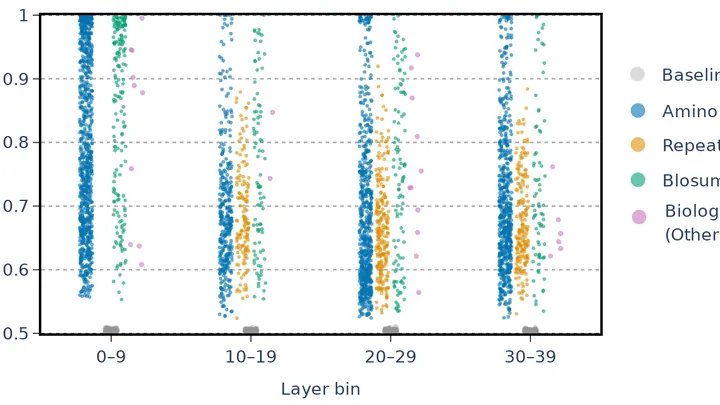
Proteins are chains of amino acids, and they often contain repeated chunks. Sometimes the repeats are exact, like the same phrase said twice. Sometimes they come with typos: a couple of letters swapped, but the meaning is the same. These repeats matter: they help the protein fold into the right shape and do its job.
A tumor doesn't stay put. Individual cells or whole groups break off and set off on a journey through the body. Some crawl solo, like scouts; others stick together, like a flock. Scientists built a computer model to understand how these cells pick a direction.
In the model, cells respond to two signals.
Cometary ice slams into the young Earth. The pressure at the impact point is like stacking six aircraft carriers on your thumbnail. In the lab, such conditions are reproduced by squeezing a tiny sample between two rotating anvils.
This time, adenosine monophosphate — one of the letters of future RNA — was placed under the anvils.
In every cell lives a tireless scribe — an enzyme that copies the long thread of DNA. It moves along it like a read head over a tape, building a new strand alongside. It picks letters by strict rule: opposite A it always places T, opposite G it places C. But sometimes, very rarely, its hand trembles, and a different letter slips in.
Primary human cells, taken straight from the body, are the most honest material for studying diseases and testing drugs. But getting foreign genetic material into them is tricky: cells don't like intruders. Standard methods either damage the cell or work unevenly, especially when the sample is heterogeneous — which it almost always is.
The new platform tackles this with a vortex flow.
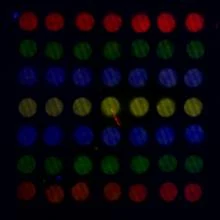
On a two-by-two-millimeter diamond plate, an entire orchestra of forty-nine violins fits. Each string is tuned to its own note, its own DNA fragment. When the right melody enters the hall, the string responds, and the conductor hears a clean sound. That conductor is a quantum sensor hidden within the diamond itself.