Self-supervised learning is a paradigm in which the model generates training signals by extracting them from the very structure of unlabeled data. Unlike unsupervised learning, which often focuses on clustering or dimensionality reduction, here surrogate (pretext) tasks are built that do not require human annotations. For example, in natural language processing, some words in an input sentence are masked, and the network learns to recover them from the context. In computer vision, contrastive methods are popular: two randomly distorted versions of the same image are brought closer in the representation space, while being pushed away from other images. This forms a visual concept reminiscent of how infants distinguish objects from the background.
History
Ideas of self-supervision can be traced to works on autoencoders (Hinton, 2006) and representation learning through reconstruction. The turning point was 2018 with the emergence of BERT (Devlin et al.), which uses word masking. For images, in 2020, the SimCLR method (Chen et al.) showed that a simple contrastive scheme with large batch sizes is comparable to supervised learning. Later, Vision Transformers combined with masked autoencoding (MAE) replicated the success of NLP, demonstrating scalability.
How it works
The general SSL scheme includes: 1) a pretext task — automatic generation of a target signal; 2) an encoder that extracts representations; 3) optionally, a projector for metric comparison; 4) a loss function that solves the specific pretext task. In NLP: masked language modeling (MLM) — the task of recovering hidden tokens. The model receives a sequence with [MASK] tokens and learns to predict the original words via cross-entropy. In CV: contrastive methods learn representations invariant to augmentations, using large batches and a momentum encoder mechanism for stabilization. Recent masked autoencoders (MAE) mask random patches of the image, and the decoder reconstructs the pixels, forcing the model to understand the global structure of objects.
In practice
Speech recognition systems, machine translation, all modern large language models (like GPT), medical diagnostics from images without doctors' annotations.
Fun fact
After self-supervised training on texts, the GPT-3 model turned out to be able to write poems, code, and scientific essays, although no one specifically taught it to do so.
A radiologist looks at an abdominal scan and sees not just organs but their spatial relationships: which kidney is larger, where the tumor lies relative to a vessel. It's like reading a map, where it's not enough to know where a city usually stands; you also need to measure the distance between two points on the ground.
In a nine-story building with a thousand rooms on each floor, some people whisper and others shout. Neighbors pass the message along, but if everyone speaks too softly, the message fades by the third floor. If too loudly, by the top floor it becomes an unintelligible roar. Between these extremes, there is a regime where a whisper makes it all the way through without distortion.
A radiologist looks at an abdominal scan and sees not just organs but their spatial relationships: which kidney is larger, where the tumor lies relative to a vessel. It's like reading a map, where it's not enough to know where a city usually stands; you also need to measure the distance between two points on the ground.
In a nine-story building with a thousand rooms on each floor, some people whisper and others shout. Neighbors pass the message along, but if everyone speaks too softly, the message fades by the third floor. If too loudly, by the top floor it becomes an unintelligible roar. Between these extremes, there is a regime where a whisper makes it all the way through without distortion.
In the Antarctic ice, a ghost particle leaves behind only a faint flash of blue light. The IceCube detector captures these flashes, and from them we need to infer where the particle came from. The PolarBERT model has learned to do this, but what exactly it sees inside has remained a mystery.
Imagine a simultaneous interpreter in a room where two people are speaking: they must keep up with both meaning and intonation, but if the speech is too fast, only a paraphrase remains. That's roughly how scientists feel as the stream of gravitational waves from black hole and neutron star mergers grows, while precise signal calculations lag behind.
A single DNA molecule, squeezed into a tiny metal slit, trembles and flickers under the laser. Its signal is not a clear string of letters but a chaotic mix of flashes and shadows. Deciphering this noise is like trying to make out a whisper in a crowded room.
The new neural network works like an attentive interpreter.
Hunting for a new material is like cooking without a recipe: you try, try again, and often throw things out. Previously, scientists manually flipped through papers and tested compositions one by one. Now there's a "robot chef" that reads the literature itself, mixes components, and checks what came out.
The orchestra plays, but the musicians can't hear each other. The conductor keeps stopping the music and walking over to each player to tune the instrument. That's roughly how space telescopes with segmented mirrors work.
An X-ray machine takes a scan, and the doctor sees only numbers — bone density, fat percentage. But the image holds far more. A team of researchers created a model called LeDXA that reads these scans like a map of hidden bodily signals.
The model was trained on 11,540 scans from the Human Phenotype Project with no labels at all.
In an oven, as temperature rises, molecules move faster and disorder increases. With language models like ChatGPT, it's the opposite. When developers increase the 'temperature' parameter, the model gets access to a wider choice of words, but its long texts suddenly start looping.
A team of researchers tested 11 different AIs by generating 12,000 text continuations.
A magnetoencephalograph, a helmet-like device with hundreds of sensors, picks up the weak magnetic fields generated by active neurons. When a person listens to speech, these signals contain imprints of the heard words. But extracting them is tricky: signals from thousands of sources merge into a tangled mess.
The brain doesn't just react to the world: it's constantly guessing what will happen next. This principle is called predictive coding: neurons compare expectations with reality and update their internal picture when an error occurs. But how such a complex system could be wired into the living tissue of the cortex remained unclear.
A neural network predicts the future of a system — say, how plasma will swirl in a magnetic field or how a face in a video will change. Errors are inevitable, and the further it looks ahead, the more they accumulate. Checking against the correct answer during operation is impossible: it simply doesn't exist.
The human mind is like a construction set that builds itself. New ideas don't die with their creators: they are passed on, mixed, and selected. This process is called cultural evolution: useful inventions stick, useless ones are forgotten. That's how a ratchet works — a mechanism that only turns forward.
But what exactly happens in the head when one thought displaces another?
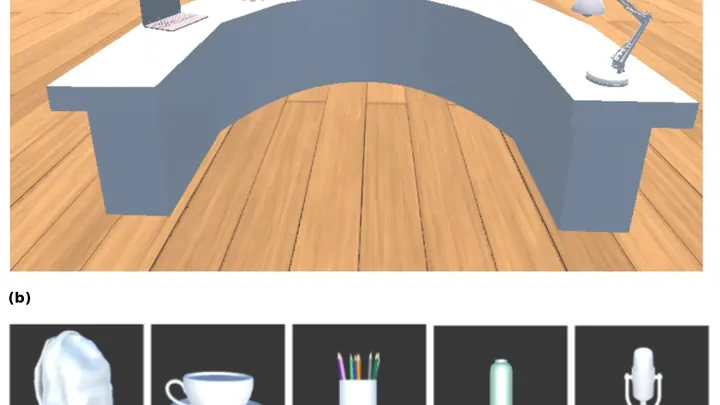
An eye prosthesis sends the brain not a photograph but a sparse pattern of bright dots — phosphenes. To make out a cup or keys in this flickering noise, a person has to move their head like a flashlight in the dark, piecing together the object's outline bit by bit. It's a slow process, like assembling a puzzle where most pieces have been thrown away.
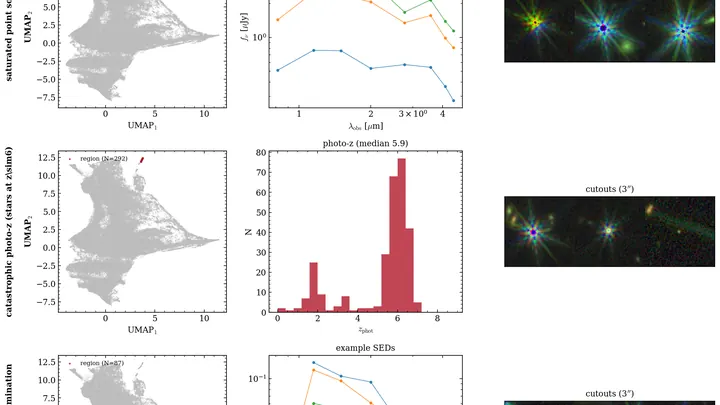
Two hundred forty-two thousand three hundred twenty-seven galaxies — like grains of sand on a beach. But astronomers turned this chaos into a map: the UMAP algorithm (a machine learning method) took from each galaxy eleven parameters — seven colors from optical to mid-infrared (that's photometry), magnitude…
Reconstructing a full picture from fragments is like discerning an orchestra's melody in a noisy hall. Such challenges arise in photometry, where a star's brightness is recovered from faint twinkling. Traditional methods need precise noise information, which is almost always unknown.
The cameras of a self-driving car capture light like telescopes aimed at a distant galaxy. Each frame is a fragmented observation; together they must form a map of the road ahead.
The computer, like an astronomer, doesn't just stitch images together: it generates several possible bird's-eye views and compares them to real data.
Many natural processes are described by differential equations, but scientists often have only fragmentary data — a sort of torn map. The new computational method works like a cartographer who reconstructs a complete map of the terrain from a few landmarks.
A tour with a single robot is a tedious monologue with no one to exchange glances with. Researchers turned that one-man show into a lively stage: they added a hologram sidekick to a real robot guide. This tandem chats, argues, jokes, drawing visitors into conversation instead of just spouting facts.
A typical tracking program resembles a navigator steering a ship by the stars. But as soon as the sky clouds over, coordinates drift, and entropy (a measure of uncertainty) builds up in the data. The new algorithm gets a ‘co‑pilot’ — a module that monitors how confident the main navigator is.
You're standing in the shower: you turn the tap, and the water is either freezing or scalding. The pipes have a mind of their own — the pressure jumps unpredictably. The new controller learns on the go: it doesn't know the plumbing layout, but within minutes it adapts and gently guides the temperature to comfort, without breaching safety limits.
The modern standard approach to AI training is like a child locked in a library: he remembers millions of books but doesn't know that fire burns and falling hurts.
Learning a foreign language is like tuning a musical instrument. The new technology works like a smart tuner: it takes your recording and a native speaker's reference speech, stretches or compresses them in time (like adjusting a string) to align them precisely, and evaluates three key parameters: clarity of sounds, rhythmic precision, and intonation.
After a stone is thrown, the circles on water vanish, but the liquid retains microscopic oscillations. The slightest gust, and ripples appear again. Neural networks behave similarly. When electrical signals quiet down, the memory of them remains in the contact points — synapses.
The brain communicates in short electrical clicks. Previously, to learn this language, thousands of examples with translations from the experimenter were needed. MOJO takes a different path: like learning a language through immersion, it first listens to the 'stream of consciousness' without any hints and finds recurring patterns on its own.
In a soup pot, you only need two thermometers to gauge the temperature everywhere — if you know heat travels in circles from the bottom. Science works the same way: from a handful of measurements, you want to reconstruct the full heat picture.
The system captures the gist of heat flow, compressing it into a handful of governing numbers.
For a long time, biologists studied cells by listening to just one voice in a polyphonic choir: measuring gene activity while ignoring how DNA is packed. It's like trying to grasp a conversation knowing only one language. LATTICE fixes this: the program learns five molecular 'languages' at once — from gene activity to spatial markers.
Automatic speech judges are algorithms that evaluate pronunciation and emotions. However, they often work like a food critic who delivers a verdict after reading the menu but not tasting the dish.
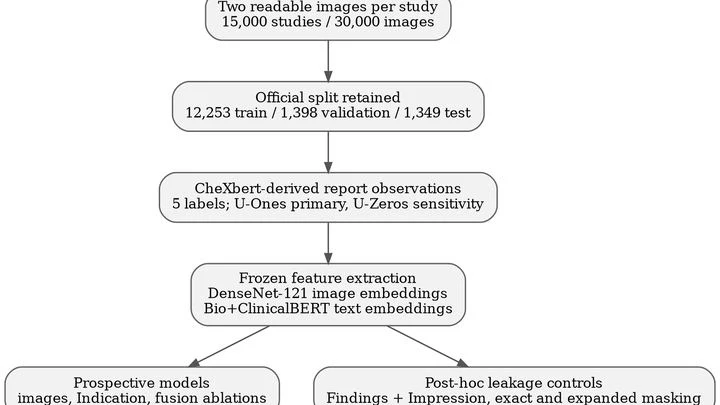
The AI diagnostician learns like a med student before an exam. You have an X-ray and patient complaints. But sometimes, a ready-made doctor's report pops up in the training materials — the full answer. Then the neural network memorizes it, and test accuracy jumps to 98%. However, that's cheating: real skill isn't developed.
A child exploring an unfamiliar apartment crawls from object to object and remembers what is visible from each corner. This is how the brain builds a mental map — an internal model of space. The gradCSCG algorithm works on the same principle: it receives a video stream from a camera and independently draws a map of the room, relying only on the changing images.
Traditional hearing aids resemble a chef who cooks from a recipe blindly. They analyze the sound chaos from the microphone and amplify speech based on it. In a noisy café, this approach often errs. The new system behaves like an experienced cook: first processes the signal, then samples the result.
A person in a boat turns by shifting their body weight. An unmanned vessel uses the same trick: a sliding weight inside the hull does the steering. Its movement is controlled by a neural network, anticipating the chaos of waves and gusts of wind. The propeller pushes the boat forward, while the weight shifts balance — like moving from one foot to the other.
Neutron stars are the last clumps of visible matter before collapsing into a black hole. In their interiors, matter is squeezed to trillion-fold densities. Here, nuclear forces and gravity weave into an exotic substance inaccessible to any earthly particle accelerator.
Power systems with solar panels and wind turbines are like a chess game: cloud cover and load changes are the opponent's moves, impossible to foresee. To maintain balance, operators used to run through dozens of scenarios (uncertainty) — that took too much time and computing power.
A driver on a slippery road doesn't know exactly how the car will respond to the steering wheel, and learns on the go, leaving room for error. A smart control algorithm behaves in a similar way.
Traditionally, machine learning algorithms operate in a static environment, like water flowing along a pre-cut channel without changing its shape. The new method flips this paradigm: it lets an agent simultaneously master actions and deliberately modify the very environment it inhabits.
In a noisy room, a person picks out a desired voice thanks to two ears capturing the difference in sound arrival. A computer with several microphones does the same: it gets spatial cues — where each voice is coming from.
Previously, these cues were used to focus on one direction, like a flashlight beam.
A cook who learns to cook from hand-drawn pictures risks ruining every dish. The same trap awaits computer vision: models need thousands of labeled images, but collecting them manually is expensive and tedious. Synthetic frames solve the problem, but only if they look real.