Scientist

Charles Bennett

1943–present · quantum information, cryptography, physics of computation
American physicist and information theorist, one of the founders of quantum information theory. Together with G. Brassard, he developed the first quantum key distribution protocol (BB84) and made decisive contributions to the concept of quantum teleportation. He is also known for his work on reversible computing and the thermodynamics of information.

Biography

Born in New York City. PhD from Harvard. Since 1973 he has worked at IBM Research, where he has spent most of his career. In 1993, together with colleagues, he proposed the quantum teleportation protocol. Wolf Prize laureate in physics (2018) for contributions to quantum information.

Key discoveries

💡 Bennett is interested in biology and film history; he can often be seen at conferences with a camera.
"He said that quantum mechanics provides not only new physics but also a new way of thinking about the concept of information."
Concepts
entropyquantum entanglementquantum informationquantum measurement
Laws
Holevo boundLandauer's principle
Scientists
Jacob BekensteinAlain AspectErwin SchrödingerDavid DeutschJohn Stewart BellWilhelm WienLudwig BoltzmannNiels Bohr

Related articles

Materials2024-10-213 minarXiv:2410.15776
Cold from Iron: How a Cheap Alloy Replaces Rare-Earth Magnets
The temperature in a room drops by a few degrees while the refrigerator runs without a single moving compressor. Inside, there is no Freon, but a piece of metal that is alternately magnetized and demagnetized.
Atomic Physics2025-12-222 minarXiv:2512.19923express
Muonium: Testing Gravity with Antimatter
All bodies in vacuum fall with the same acceleration: this principle, formulated by Einstein in general relativity, underpins our understanding of gravity. Yet so far it has been experimentally confirmed only for particles of ordinary matter.
Materials2026-01-241 minarXiv:2601.17444express
Nickel Flower Catches Sugar
Conventional blood sugar sensors rely on enzymes — proteins that recognize glucose. But enzymes are finicky: they spoil from heat, moisture, and time, like cut flowers wilting without water. Here, instead of enzymes, a non-living material does the job: nickel oxide, grown as tiny flowers on a sheet of graphite paper.
Cosmology2026-01-291 minarXiv:2601.22232express
Cosmic Recipe: How Much Helium Was There at the Beginning?
The helium in a party balloon is the very gas that makes it float. But long before balloons, helium appeared in the first minutes after the Big Bang. Its exact abundance in the universe is like a fingerprint: it tells you how many kinds of neutrinos (ghostly particles that pass through walls) exist.
The Demon with a Delay: How to Outsmart the Landauer Bound
The microcantilever oscillates at 1270 Hz, and its position controls a virtual potential: an invisible energy landscape with two wells, created by feedback. Normally, switching between the wells occurs when the system crosses the zero point, but now a delay comes into play: the threshold is shifted by an amount h.
Atomic Physics2026-02-121 minarXiv:2602.12319express
How rubidium atoms wander through inert gases
Two laser beams cross at a tiny angle, and an invisible lattice appears in a cloud of rubidium atoms: some atoms are excited, others are not. Then this lattice begins to melt, like a pattern in the sand under the wind. Atoms collide with surrounding gas molecules and drift apart. The speed of this blurring depends directly on the surrounding gas.
Materials2026-03-091 minarXiv:2603.08299express
Gold Dust at the Edge of Worlds
Gold on carbon is a classic pairing in chemistry. Such materials speed up important reactions, like producing vinyl chloride for plastics. But until now, no one had seen in detail how gold atoms behave on a graphite surface when the whole thing is immersed in a liquid.
Quantum Physics2026-03-101 minarXiv:2603.09096express
Liquid metal bridges quantum chips
Ordinary soldering doesn't work for quantum circuits: when cooled to liquid helium temperatures, metal cracks, and the contacts themselves introduce noise. Engineers from the research group tried something different — a drop of gallium alloy that stays liquid at room temperature, like mercury in an old thermometer.
Medical Physics2026-03-131 minarXiv:2603.12975express
Two beams instead of one: seeing treatment from the inside
A beam of carbon ions strikes the tumor precisely, like a surgeon who can only see the skin. Inside the body, the beam stops, and exactly where used to be a mystery. Now, helium is mixed into the same beam: it passes through the body like an X-ray, and its trail shows where the carbon went.
Mesoscale2026-03-182 minarXiv:2603.17854express
Quantum Carbon Rings: Magnetism by the Rules of Aromaticity
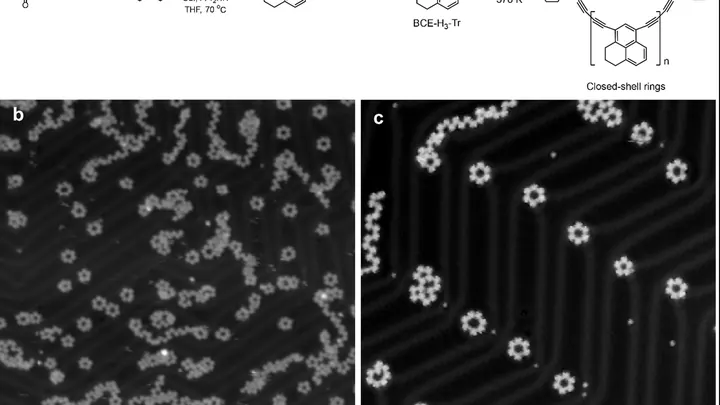
A ring of magnetic atoms resembles a round dance where each participant holds hands with their neighbors. In ordinary magnets, each atom has its own permanent magnetic moment, and they interact like little arrows striving to align opposite to each other.
Nuclear Theory2026-03-261 minarXiv:2603.25081express
Catching the Elusive: Measuring the Decay Width of Helium-5
The helium-5 nucleus is like an overtightened string: touch it, and it falls apart into helium-4 and a neutron. Catching such a decay and measuring its rate is no easy task. Standard calculation methods stumble over mathematical noise. The researchers took a reliable approach to describing nuclear forces and added a clever trick — analytic continuation.
Atomic Physics2026-04-051 minarXiv:2604.03943express
How a Laser Sheds Light on Helium's Hidden States
In a dark room, a flashlight only illuminates what falls within its beam. That's roughly how physicists study atoms: a short flash of light knocks out electrons, and by tracking their paths, you can figure out how the atom is built. But helium has states that don't fall into the ordinary 'beam'—they hide in the shadows.
Materials2026-04-081 minarXiv:2604.07110express
Carbon nanotubes with calcium trap hydrogen
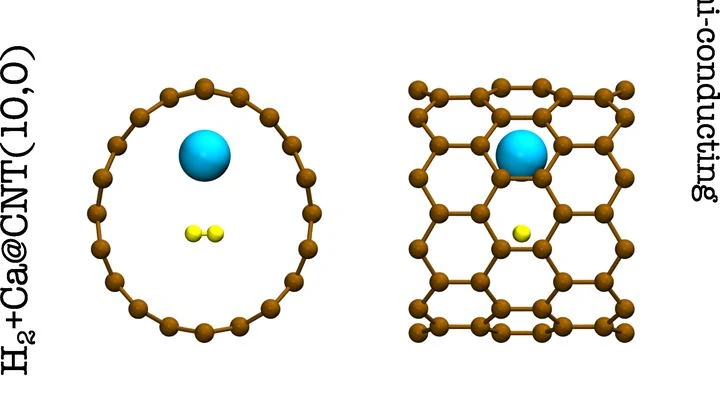
Hydrogen is an ideal fuel: when used, it only produces water, not carbon dioxide. The trouble is that hydrogen is the lightest gas, its molecules leak out of any container. Right now, cars store hydrogen in heavy tanks under extreme pressure, canceling out weight benefits. Researchers bypassed the problem without high pressure.
A Detector That Sees Helium Nuclei
An alpha particle is a helium nucleus that flies out when heavy atoms decay. When it hits a gallium nitride crystal, it deposits its energy and creates an electrical pulse. The pulse height tells you how much energy the particle had.
Biological Physics2026-04-271 minarXiv:2604.23945express
Okra Gel Teaches Electrodes to Listen to the Brain Without Scarring
When a hair-thin electrode is implanted into the brain, the body treats it like a splinter. A scar of glial cells grows around it — a dense insulating sheath that muffles the signal like a wet rag dampens a guitar string. The electrode stops hearing neurons.
HEP Phenomenology2026-04-292 minarXiv:2604.26773express
A Quiet Blow to Liquid Helium
A detector filled with superfluid helium-4 is like a perfectly still lake. The liquid doesn't slosh or bubble: it's frozen in a single quantum state. An invisible guest, a dark matter particle, flies through it. It doesn't shine or leave a track. But sometimes it nudges a helium nucleus.
Chemical Physics2026-04-292 minarXiv:2604.27070express
Neural Network Learns to Read Molecules by Their Carbon Signature
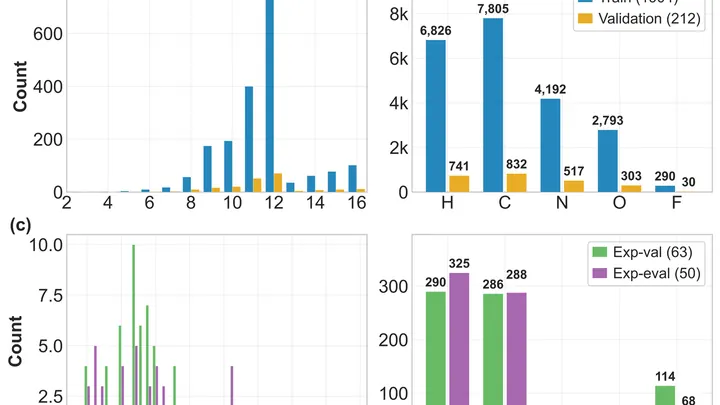
Every carbon atom in a molecule carries a passport — the energy with which its deepest electrons sit in their orbitals. This energy is sensitive to neighbors: add an oxygen nearby or a double bond, and the number in the passport changes. Chemists have long measured such energies with X-rays, but calculating each new molecule takes hours of machine time.
Strongly Correlated2026-05-062 minarXiv:2605.04611express
How Heat Freezes a Magnet
A pot of water on the stove: the hotter the burner, the faster ice turns to water, and water to steam. Heat destroys order. But sometimes nature pulls a trick, and heating makes a liquid freeze, like a puddle turning to ice on a frosty morning.
High Energy2026-05-082 minarXiv:2605.07827express
Helium in the Thermonuclear Fire of a Supernova
A match flares from both ends. First the head ignites, and a moment later the flame engulfs the wooden stick. Something similar may happen in some Type Ia supernovae — except the match is a white dwarf (a star the size of Earth), and the flame is a thermonuclear explosion.
q-bio.BM2026-05-191 minarXiv:2605.19252express
The Chemical Signature of Life: How to Find It by Its Elements
From carbon, nitrogen, oxygen, and sulfur, you can assemble 10⁶⁰ different small molecules: that's a 1 with 60 zeros, more than the stars in the visible universe. Life uses only a tiny fraction of this menu, but not randomly.
Information — The Shadow of What Never Was
Erasing even a single bit means releasing heat. This discovery by Rolf Landauer hinted that information is neither material nor illusory. Imagine that every event casts a shadow: that is information, the collection of all unrealized possibilities.
Galaxies2026-06-152 minarXiv:2606.17141express
Cosmic Cocktail Without the Secret Ingredient
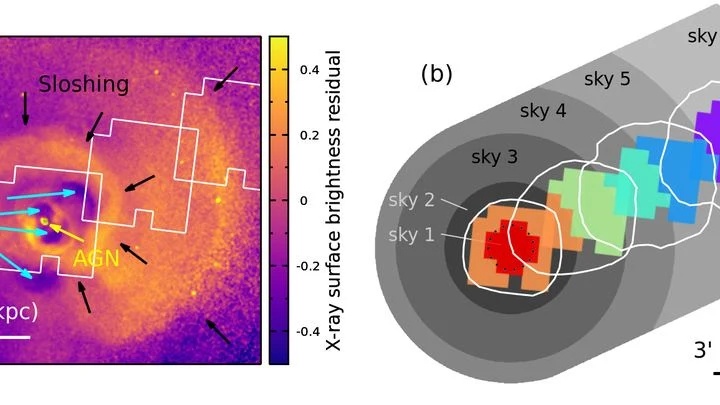
The Perseus galaxy cluster is a giant metropolis of thousands of star islands, bathed in an invisible ocean of scorching gas. Like urban smog, this gas preserves traces of all the chemical factories that have operated in galaxies for billions of years: supernova explosions that scatter freshly forged atoms across the surroundings.
Materials2026-06-233 minarXiv:2606.24480
Roadmap for Ions: How AI Paves the Way to the Batteries of the Future
A solid electrolyte is not just a crystal lattice: it’s a bustling metropolis for ions. Each act of conduction resembles a trip through the city: there are wide highways with low energy barriers, gridlocks in bottlenecks, and tricky detours where an ion can get stuck.
Quantum Physics2026-06-281 minarXiv:2606.29616express
How to Squeeze More Discoveries Out of Gravitational-Wave Antennas
A laser beam in a multi-kilometer tunnel trembles as a gravitational wave passes, but the tremor is barely perceptible, on the scale of fractions of a proton's diameter. To hear this cosmic whisper, physicists squeeze every last bit of performance out of light.
A Cold Crystal Catches Dark Matter
A sodium iodide crystal doped with thallium is like photographic film for invisible particles. When a gamma ray or a hypothetical dark matter particle hits it, it flashes with faint light. Two silicon photomultipliers pressed against the crystal's ends catch the flash from both sides.
Atomic Physics2026-08-132 minarXiv:2608.12747express
The Invisible Spring in the Helium Atom
The helium atom is like a tightly stretched string: every note it plays is strictly predicted by theory. But in recent years, precise measurements of one such "note"—the energy needed to strip an electron from an excited helium atom — have started to sound slightly higher than they should.
Materials2026-08-192 minarXiv:2608.18909
A Magnetic Score from Ions: How Irradiation Rewrites the Notes of CrSBr
In the layered crystal CrSBr, the magnetic moments of atoms are arranged like notes in a score: within each layer they point in the same direction, but between layers they point in opposite directions. This antiferromagnetic melody plays up to 132 kelvin, beyond which thermal motion destroys the order.
A Helium Blanket Instead of an Ice Bath
Instead of an ice bath, a warm gas blanket. That is how the cryogenic current comparator at Japan's National Metrology Institute is now cooled. Previously, this instrument, which compares electric currents to within billionths of a percent, required immersion in liquid helium.
Materials2026-09-082 minarXiv:2609.08878
Chemical lock on the wall of a helium bubble
Inside the steel of a future fusion reactor, tiny helium bubbles form, and on their walls a chemical drama unfolds. Chromium and tantalum atoms, like sentinels, take positions at the cavity boundary and change the rules of the game for hydrogen.