Cosmic Light Changes Polarization
Light from the hottest stage of the universe has been traveling toward us for nearly 14 billion years. This is the cosmic microwave background — a faint glow filling the entire sky.
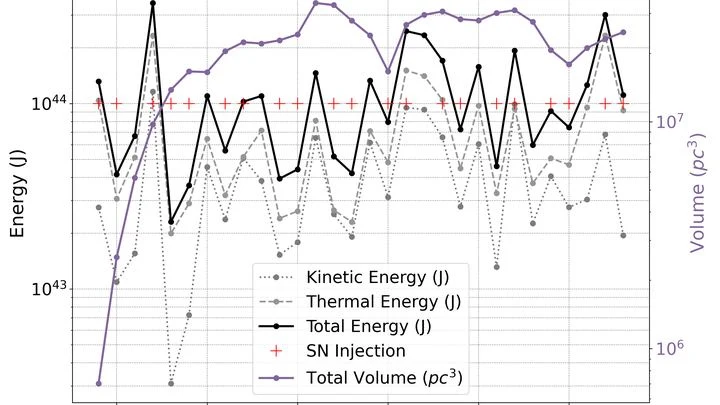
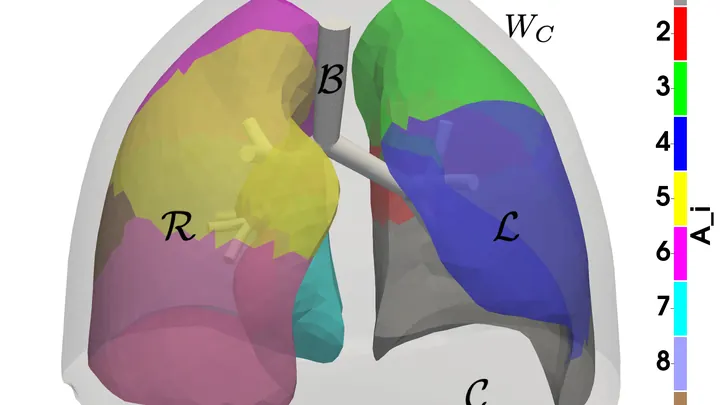
A computational representation of a system in three spatial dimensions, used for analysis and prediction.A three-dimensional model is a computational representation of a system in three spatial dimensions, used for analysis, simulation, and prediction. In physics, these models are essential for understanding complex systems where spatial structure matters, such as fluid flow in the lungs, the evolution of supernova remnants, or the distribution of matter in the universe. They allow researchers to visualize and quantify phenomena that are otherwise too small, too large, or too complex to observe directly.
The model is built from mathematical equations describing the physical laws governing the system, discretized onto a 3D grid or mesh. Numerical methods, such as finite element or finite volume methods, solve these equations iteratively. The model can be refined with observational data, and simulations are run to explore different scenarios or predict future states.
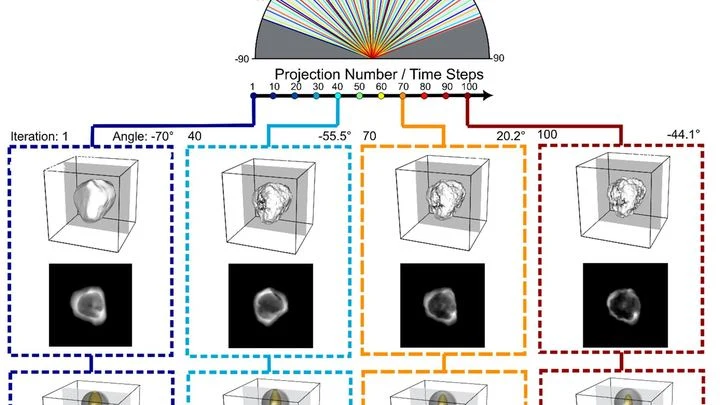
Three-dimensional models are used in engineering design (e.g., aircraft wings), medical imaging (e.g., organ reconstruction), and astrophysics (e.g., simulating galaxy formation).
The first 3D computer models were developed in the 1960s for aerospace engineering, but they required massive mainframe computers and hours of processing time.