How a Shock Wave Swells in Thin Air express
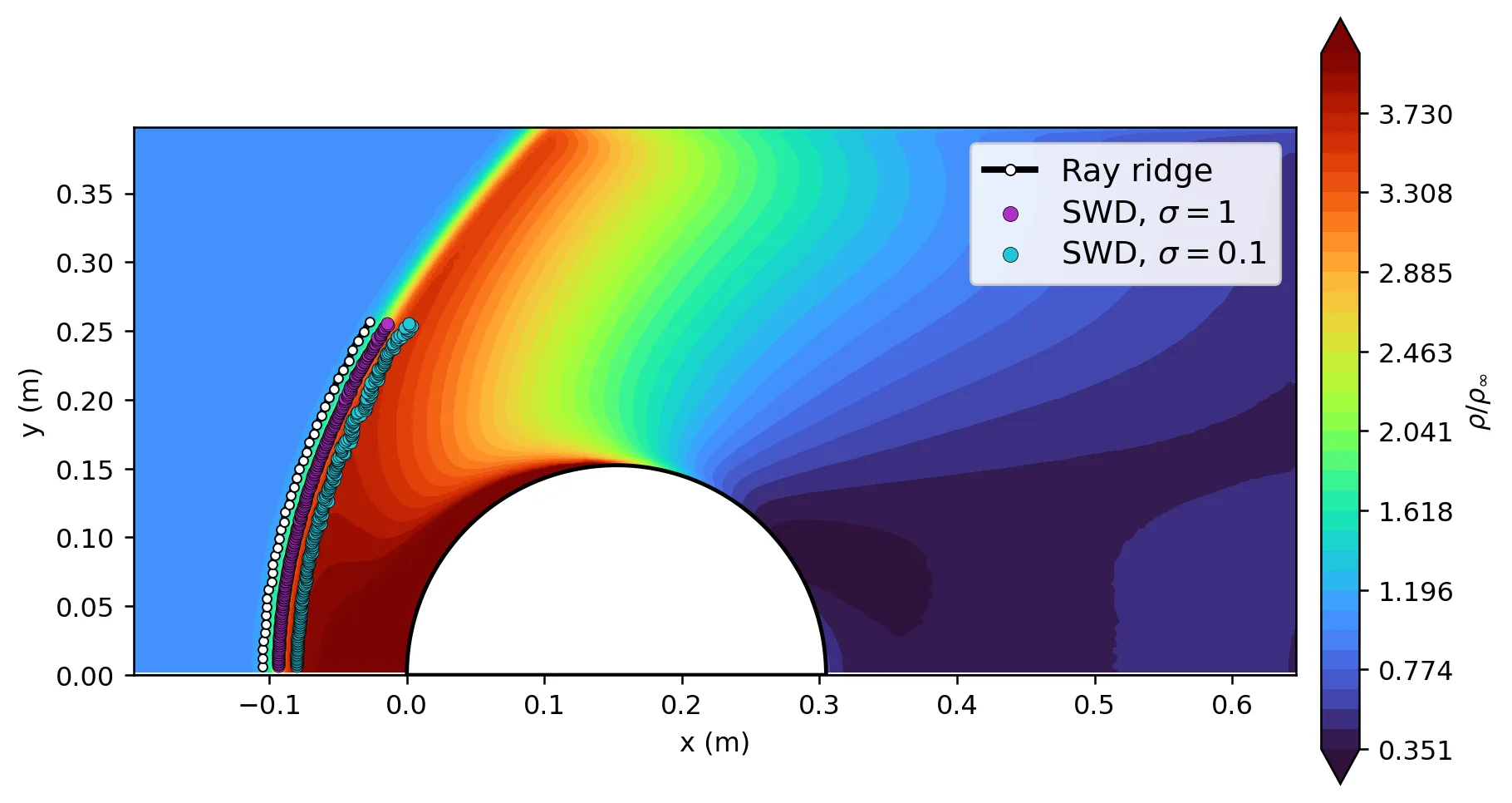
A cylinder slams into the air at enormous speed, and a shock wave is born around it — a sharp boundary where the air is instantly compressed and heated. Ernst Mach was the first to photograph these jumps, and since then we've thought of them as thin, almost invisible walls.
But if the air is very rarefied, like at an altitude of 80 kilometers, molecules fly alone, barely colliding with each other. In the new work, scientists simulated such flow on a computer, tracking the fate of millions of particles step by step. It turned out that at high rarefaction, the sharp boundary disappears. Instead of a sudden jump, a wide, "puffy" transition layer forms, where the gas compresses gradually. This isn't just a swelling of the familiar picture: it's a change in the very mechanism of compression.
The key role here is played by the mean free path — the distance a molecule travels between collisions. In a dense medium, it's microscopic, and the wave is thin. In a rarefied one, the mean free path is comparable to the size of the body itself, and compression smears over tens of centimeters. The authors showed that the growth of the compression layer's thickness is determined by this parameter, not just by the degree of gas compression.
This result is important for designing reentry vehicles and hypersonic aircraft. When a spacecraft enters the atmosphere at Mach 10, an error in shock wave calculations can lead to overheating or an incorrect trajectory. Understanding how the wave "swells" in rarefied air helps make heat shields safer.
Original abstract
as written by the authors arXiv:2605.17099
Rarefied hypersonic bow shocks over blunt bodies inflate as the Knudsen number increases, but it remains unclear whether this inflation is a simple shift and broadening of one common shock layer or a multi-scale change of the macroscopic and internal-energy fields. We address this question using direct simulation Monte Carlo (DSMC) data for Mach-10 flow over a circular cylinder in argon and nitrogen over \(Kn_\infty \approx 0.01\)--\(1\), together with a Mach-number sweep at \(Kn_\infty=0.01\). At low rarefaction, a ray-based density-gradient ridge gives a reproducible bow-shock location and agrees with an independent schlieren-based shock-wave-detection method. As \(Kn_\infty\) increases, this ridge is replaced by a broad kinetic compression layer, so the high-Knudsen cases are analysed using profile-based standoff and thickness metrics rather than by imposing a visual shock line. The Knudsen- and Mach-number sweeps separate two mechanisms. At fixed \(M_\infty\), the continuum normal-shock density ratio provides a useful low-rarefaction reference compression scale, whereas the measured standoff growth is governed primarily by the kinetic mean free path; the effective density thickness shows an intermediate minimum before increasing in the diffuse regime. At fixed low \(Kn_\infty\), changing \(M_\infty\) mainly changes compression strength and curvature, preserving a coherent attached-layer structure. Density-registered profiles and shock-attached proper orthogonal decomposition (POD) show that, within the present maximum-density-gradient registration, density becomes nearly rank one, whereas Mach number and thermal variables retain independent modal content. Rarefied bow-shock inflation is therefore a coupled compression--relaxation process, not a single-scale rescaling of a continuum-like shock.
At an altitude of 100 km, there are so few molecules that sound barely propagates, a shock wave cannot form in the usual way.
In Andy Weir's "The Martian," the hero uses Mars's thin atmosphere for braking, but without a precise calculation of the "puffy" shock wave, he'd be smeared across the sky.