A Pendulum Clock in a Distant Galaxy
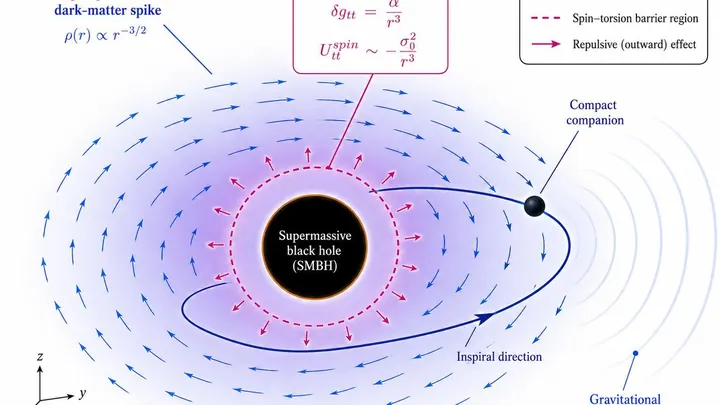
Far away in the constellation Cancer, 3.5 billion light-years from Earth, a pendulum clock is ticking. The pendulum is a secondary black hole orbiting a much more massive primary.
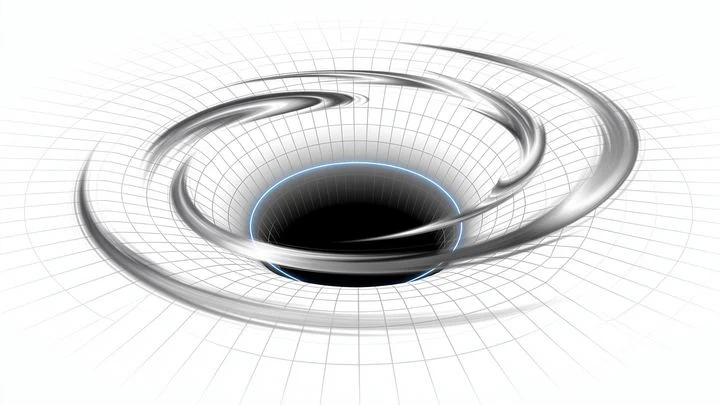
Classical instability where energy piles up catastrophically at a black hole's inner horizon.Mass inflation is a classical instability that occurs at the inner horizon of a rotating or charged black hole. Unlike the event horizon, which is the point of no return, the inner horizon is a boundary where the geometry becomes singular in a subtle way. As matter and radiation fall into the black hole, they get blueshifted and pile up near the inner horizon, causing the local energy density to grow without bound. This runaway growth is called mass inflation because the effective mass parameter of the black hole appears to inflate dramatically near that surface.
The concept was introduced by Eric Poisson and Werner Israel in 1990, who showed that the inner horizon is unstable to perturbations, leading to a curvature singularity.
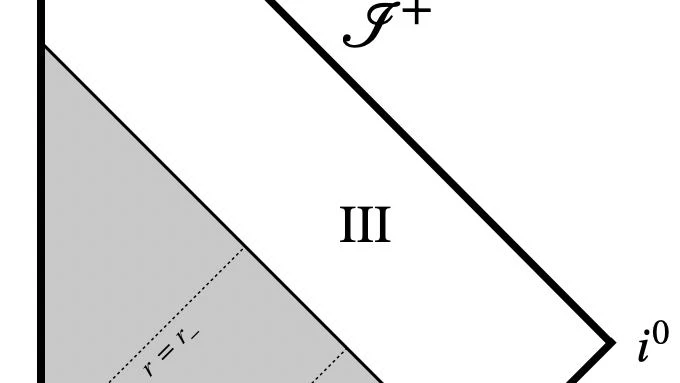
Inside a black hole, the inner horizon is a Cauchy horizon—a boundary beyond which the future is not uniquely determined by initial conditions. Infalling radiation from outside gets infinitely blueshifted as it approaches this horizon. This blueshift amplifies the energy density, which in turn curves spacetime more strongly, leading to a feedback loop: the stronger curvature blueshifts the radiation even more, causing the energy to grow exponentially. This process turns the inner horizon into a singular, crushing region where classical general relativity breaks down.
Mass inflation is primarily a theoretical result, but it informs models of black hole interiors and the cosmic censorship conjecture, which posits that singularities are always hidden behind event horizons.
Mass inflation implies that the interior of a realistic black hole is not a calm, empty region but a violent, chaotic place where the fabric of spacetime itself is torn apart.