The Mach number is a dimensionless quantity in fluid dynamics that compares the speed of an object or flow to the local speed of sound in the surrounding medium. It is a critical parameter for understanding compressibility effects: at low Mach numbers (below ~0.3), air can be treated as incompressible, while at higher values, density changes become significant, leading to shock waves, sonic booms, and dramatic changes in drag and lift. The Mach number is not just a number; it defines entire regimes of flight—subsonic, transonic, supersonic, and hypersonic—each with its own physical phenomena.
History
The concept was introduced by Austrian physicist Ernst Mach in the late 19th century. He studied projectile motion and used schlieren photography to visualize shock waves, naming the ratio in his honor. The term 'Mach number' was coined later, in 1929, by the Swiss engineer Jakob Ackeret.
How it works
The speed of sound in a medium depends on its temperature and composition. The Mach number is calculated as M = v/a, where v is the flowvelocity and a is the local speed of sound. When M < 1, disturbances (like sound waves) propagate faster than the object, so the flow 'warns' the air ahead. When M > 1, the object outruns its own pressure waves, causing them to pile up into a shock front—a thin region where pressure, temperature, and density jump abruptly. This shock wave is what creates the sonic boom and the characteristic 'wall' of high drag at transonic speeds.
In practice
The Mach number is essential for designing aircraft, rockets, and wind tunnels. It is used to predict shock wave formation, optimize airfoil shapes for supersonic flight, and ensure the structural integrity of vehicles crossing the sound barrier.
Fun fact
In the exotic world of quantum fluids, the concept of a 'Mach number' applies to superfluid helium-3, where the 'sound' is replaced by collective excitations, and exceeding the critical velocity creates quantum vortices instead of shock waves.
The churning cauldron of turbulence burns energy in two distinct ways. Vortices, like whirlpools in a maelstrom, twist the fluid and rub layers against each other. Shock waves, like a sudden clap, abruptly compress the gas and turn motion into heat.
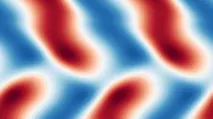
If you push water in a narrow channel too fast, a steep wave forms and breaks into foam. In the world of ultracold atoms, cooled to near absolute zero, quantum laws prevent such a wave from breaking. Physicists took a cloud of rubidium atoms stretched into a thin thread and sharply compressed it from one end with a movable wall of light.
In 2017, the LIGO and Virgo detectors recorded the spacetime tremor from the collision of two neutron star merger — event GW170817. After the initial burst came an after-ring: a kilohertz oscillation of the newly formed superdense remnant.
A laser is like a tuning fork that rings at a single note. But even in complete silence, its sound trembles slightly. Previously, it was thought that this tremor, random kicks from spontaneous emission of light by atoms inside the laser, was the main limit to precision.
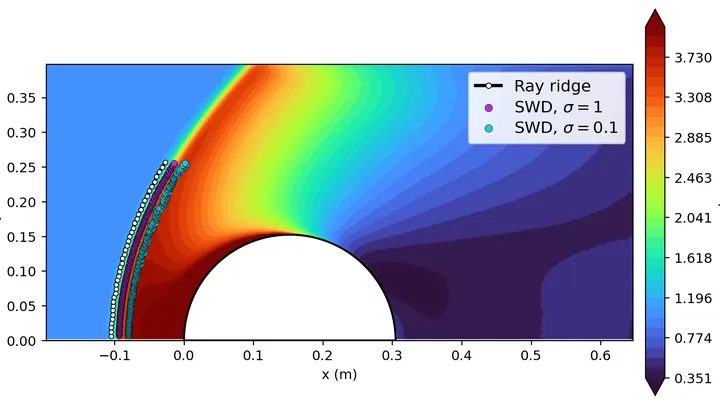
A cylinder slams into the air at enormous speed, and a shock wave is born around it — a sharp boundary where the air is instantly compressed and heated. Ernst Mach was the first to photograph these jumps, and since then we've thought of them as thin, almost invisible walls.
A boiling pot, a gust of wind, a wisp of smoke from a campfire — all obey equations that mathematicians call 'nonlinear and dissipative.' In plain terms, energy is lost to friction, and parts of the flow influence each other so strongly that predicting the motion ahead of time is a task on the edge of feasibility.
When a person breathes, air doesn't flow in a steady stream but in waves. Previously, doctors and scientists only looked at overall numbers: how much air entered per breath, what the peak flow was. But within a single breath, there are nuances — small variations that speak to the workings of nerves and muscles. The new approach breaks a breath into parts, much like a musician breaks a chord into individual notes.
A frictionless liquid that flows forever: that's superfluidity. Helium-3 only achieves it at thousandths of a degree above absolute zero. The theory of this state was developed by Lev Landau and Richard Feynman.