How a Shock Wave Swells in Thin Air express
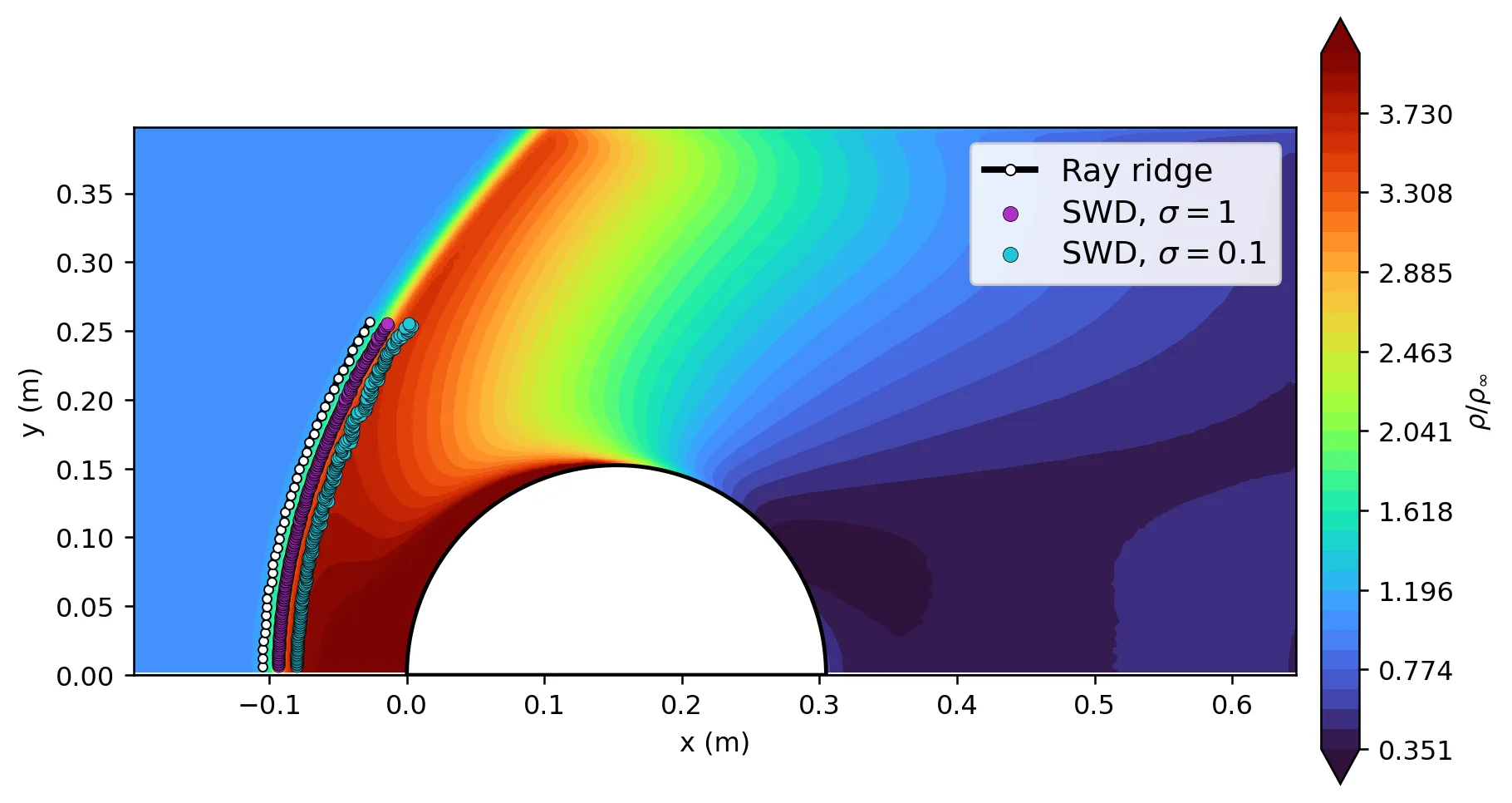
A cylinder slams into the air at enormous speed, and a shock wave is born around it — a sharp boundary where the air is instantly compressed and heated. Ernst Mach was the first to photograph these jumps, and since then we've thought of them as thin, almost invisible walls.
But if the air is very rarefied, like at an altitude of 80 kilometers, molecules fly alone, barely colliding with each other. In the new work, scientists simulated such flow on a computer, tracking the fate of millions of particles step by step. It turned out that at high rarefaction, the sharp boundary disappears. Instead of a sudden jump, a wide, "puffy" transition layer forms, where the gas compresses gradually. This isn't just a swelling of the familiar picture: it's a change in the very mechanism of compression.
The key role here is played by the mean free path — the distance a molecule travels between collisions. In a dense medium, it's microscopic, and the wave is thin. In a rarefied one, the mean free path is comparable to the size of the body itself, and compression smears over tens of centimeters. The authors showed that the growth of the compression layer's thickness is determined by this parameter, not just by the degree of gas compression.
This result is important for designing reentry vehicles and hypersonic aircraft. When a spacecraft enters the atmosphere at Mach 10, an error in shock wave calculations can lead to overheating or an incorrect trajectory. Understanding how the wave "swells" in rarefied air helps make heat shields safer.
At an altitude of 100 km, there are so few molecules that sound barely propagates, a shock wave cannot form in the usual way.
In Andy Weir's "The Martian," the hero uses Mars's thin atmosphere for braking, but without a precise calculation of the "puffy" shock wave, he'd be smeared across the sky.