Ocean Planet Under a Hydrogen Blanket express
Light takes 124 years to reach us. That's how long it takes for the star's rays to bring news of K2-18b — a planet entirely covered by an ocean but wrapped in a thick hydrogen blanket. It's about two and a half times the size of Earth. For a long time, scientists debated: a water world with a dense atmosphere, or a scaled-down Neptune without a solid surface? New research based on data from the James Webb Space Telescope tips the scales toward the ocean.
Astronomers started with a simple recipe: hydrogen, methane, and water vapor above a vast sea. Using computer models, they calculated how this mixture absorbs starlight when the planet transits its star. Then they compared this 'fingerprint' with actual spectra from the NIRISS and NIRSpec instruments on the Webb telescope. The model with one bar of hydrogen (pressure like at sea level on Earth), a few percent methane and carbon monoxide, and carbon dioxide in thousandths of a percent matches the observations beautifully across the 0.8 to 5.2 micrometer range. They didn't even need to invoke dimethyl sulfide — a substance that on Earth is produced only by living organisms and that they had hoped to find.
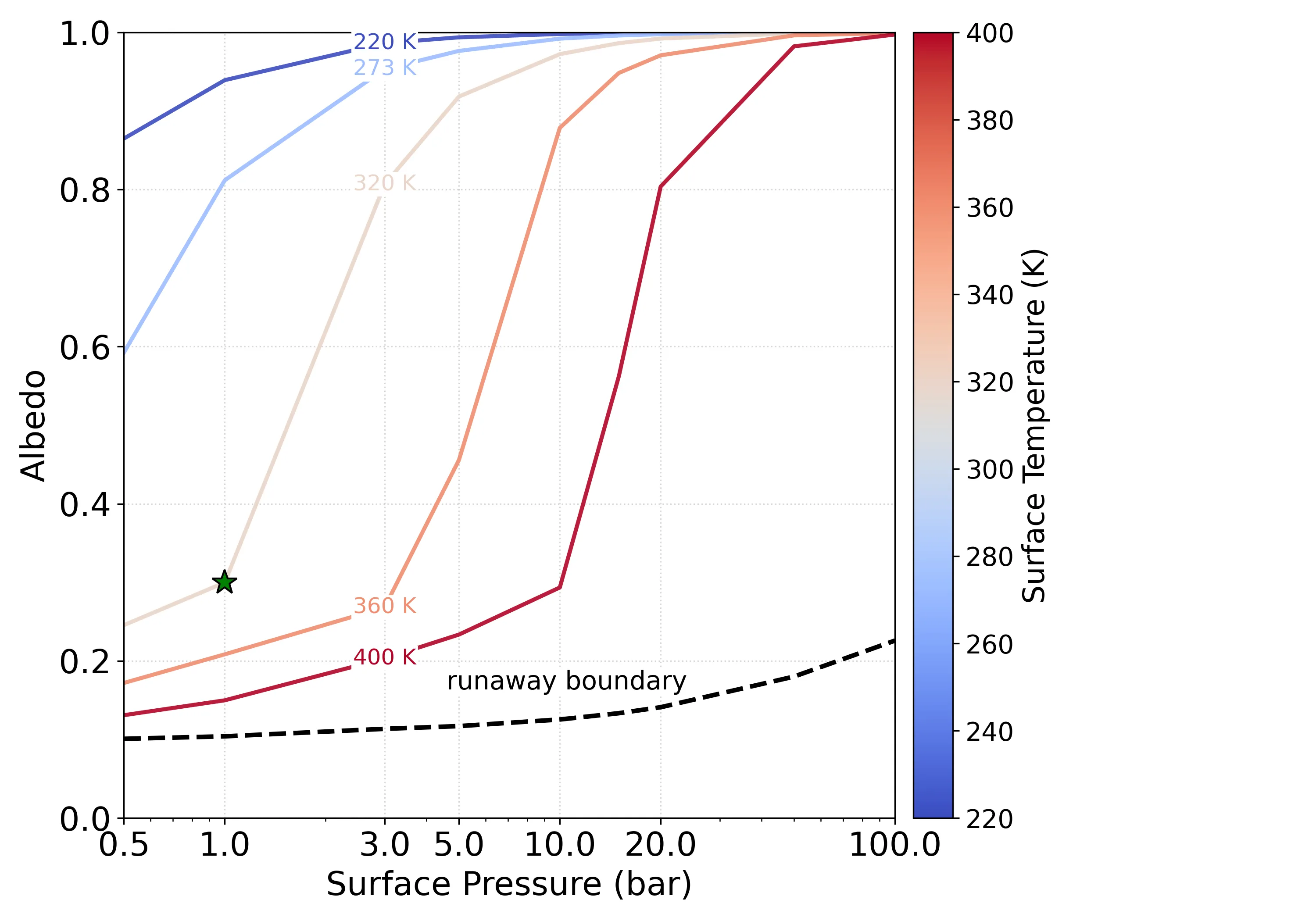
The most interesting part is that an ocean under such a blanket could be stable. Climate calculations show that over a wide range of temperatures and pressures, water remains liquid, not boiling away into a runaway greenhouse hell. However, to maintain high methane levels, the planet needs an internal source. Perhaps it's replenished from the interior over billions of years, like a slow leak from a gas cylinder that keeps the atmosphere from 'running out of breath.'
So K2-18b remains a mystery, but not as murky as before. It doesn't rule out either the water world scenario or the mini-Neptune. But now it's clear: a simple mix of gases, an ocean, and internal heat is a sufficient recipe to explain everything Webb sees. And who knows, maybe in that dark, warm sea, alien life forms are splashing around? The light from there is still on its way, and each new wave tells us a little more.
Original abstract
as written by the authors arXiv:2605.17803
The nature of the sub-Neptune K2-18b is debated between Hycean and mini-Neptune interpretations. We test whether self-consistent Hycean atmospheres are compatible with current JWST transmission spectra by combining one-dimensional photochemical modelling, radiative--convective equilibrium calculations, and forward modelling of transmission spectra. We assume H2-CH4-H2O atmospheres over a liquid ocean, compute altitude-dependent abundances with a 1D photochemical model, and couple them to P-T profiles that avoid runaway greenhouse states. Using the CH4-dominated 2.8-4.0 $$\mu$$m band, we constrain wavelength-independent offsets between NIRISS SOSS and NIRSpec G395H for multiple reductions, and then scan grids of CO and CO2 scaling factors, weighted by the CH4-band offset posteriors, to evaluate oxidised-carbon abundances consistent with the 4-5 $$\mu$$m region. Radiative--convective calculations further map pressures and albedos that yield non-runaway climates. Over a wide range of temperatures and pressures, liquid oceans can exist, and Hycean models with a 1 bar H2 envelope, percent-level CH4 and CO, and CO2 buffered at $$\sim 10^{-3}$$-$$10^{-2}$$ reproduce the NIRISS and NIRSpec spectra from 0.8 to 5.2 $$\mu$$m without invoking DMS or other additional species. Our photochemical simulations show that H2-CH4-H2O networks generically drive CO to mixing ratios of order 1-2 %. Mass-balance arguments imply that a $$\sim$$1 bar H2 envelope with percent-level CH4 requires interior replenishment on gigayear timescales, and the resulting vertical gradients naturally generate flat, CH4-dominated plateaux in transmission. While mini-Neptune scenarios remain viable, our results show that Hycean configurations are likewise consistent with the data, and current CO and CO2 constraints alone are not yet sufficient to rule out Hycean interpretations of K2-18b.
Light from K2-18b takes 124 years to reach us, so we see the planet as it was in 1900—around the same time the Wright brothers made their first flight.
In Stanislaw Lem's novel 'Solaris', a sentient ocean covered an entire planet, but there it was alone against space, while here it's hidden under a thick layer of gases.