Transit spectroscopy is a technique for studying the atmospheres of exoplanets — planets orbiting stars other than the Sun. When a planet passes directly between its host star and an observer on Earth, a small fraction of the starlight is filtered through the planet's atmosphere before reaching our telescopes. By analyzing this filtered light, astronomers can identify which molecules are present in the atmosphere, because different chemicals absorb light at specific, characteristic wavelengths.
History
The first detection of an exoplanet atmosphere using transit spectroscopy was reported in 2001 by David Charbonneau and collaborators, who observed the star HD 209458 and found sodium absorption in the atmosphere of its hot Jupiter planet.
How it works
During a transit, the planet blocks a tiny portion of the star's light, causing a slight dip in brightness. But the atmosphere itself also absorbs some additional light at particular wavelengths, creating subtle variations in the depth of that dip depending on the wavelength. By comparing the spectrum of the star during the transit with its spectrum outside the transit, scientists can isolate the atmospheric absorption signature. This reveals the chemical composition, temperature structure, and even the presence of clouds or hazes in the planet's atmosphere.
In practice
Transit spectroscopy is the primary method used to characterize exoplanet atmospheres, including the search for potential biosignature gases like oxygen and methane in Earth-like planets, and it is a key observational mode for space telescopes like Hubble, James Webb, and future missions such as Ariel.
Fun fact
The same technique has been used to detect sulfur compounds in exoplanet atmospheres, which can reveal information about the planet's formation history and internal processes.
A telescope stares at a star for many nights in a row. Somewhere in the stream of light hides a tiny dip in brightness — an Earth-sized planet briefly blocking part of the star. Such a dip lasts a few hours and repeats once a year or less. Catching it is like hearing a single quiet click in a noisy hall.
Photographing an exoplanet orbiting another star is like trying to spot a firefly in front of a spotlight. Earth's atmosphere is constantly churning, which makes stars appear as dancing speckles through a telescope.
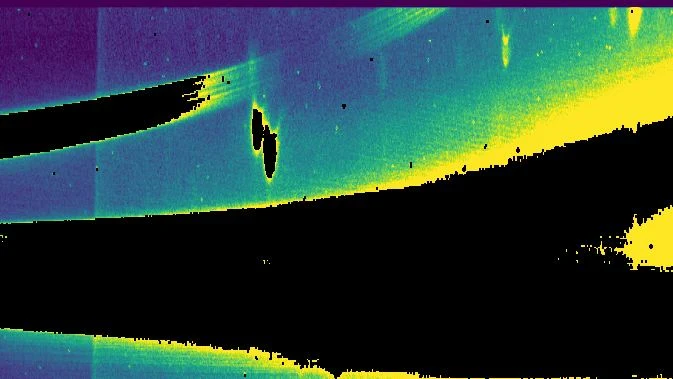
In 2024, the team led by David Charbonneau pointed the Magellan telescope with the WINERED spectrograph at LHS 1140. During transit, high-resolution spectroscopy caught the absorption line of metastable helium at 10833 Å.
The light of a distant star carries within it the silent hum of the atmospheres of planets orbiting it. For a long time, capturing it was like trying to make out a whisper over a roaring waterfall. But with the advent of the 39-meter Extremely Large Telescope (ELT) and the ANDES spectrograph with a resolution of 100,000, this task is no longer hopeless.
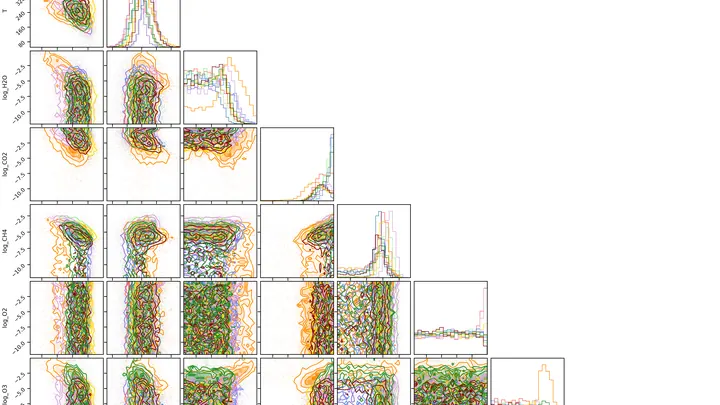
A spotlight blazes straight into your eyes, and a few steps away a tiny firefly flickers. That's roughly what it's like hunting for an Earth-like planet around a neighboring star: the planet is a hundred million to ten billion times fainter than its star, and in the sky they almost merge into a single point.
Some 158 light-years away, around the dim star TOI-6894, a red dwarf, a planet moves leisurely. Its year lasts less than two Earth days, yet it is a cool world with an equilibrium temperature around 420 K, just a bit warmer than a sauna.
The planet WASP-121 b is a gas giant, heated to 2500°C. It always faces its star with one side, like a globe frozen under a lamp. But as it passes in front of the star's disk, its rotation reveals different facets to us — as if that globe were slowly turned, letting us peer into every corner.
When a planet slips behind the edge of its star, the star backlights the planet's atmosphere, just as a setting sun illuminates clouds on the horizon. This brief moment, lasting only minutes, carries the imprint of the gases through which the starlight has passed.
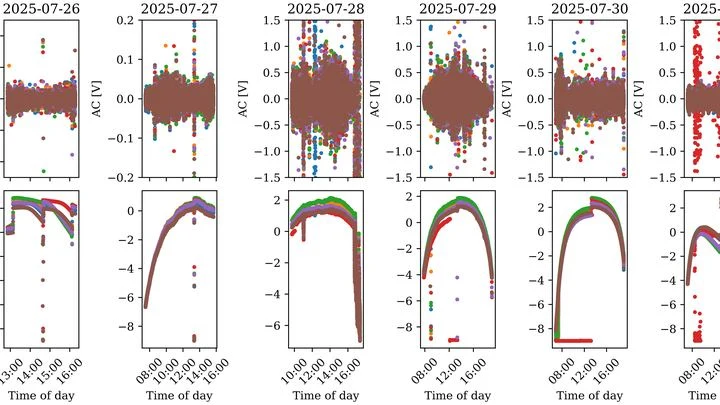
By day in Chile's Atacama Desert, the air shimmers with heat like the haze above a hot skillet. Sunlight passing through this shimmer begins to dance and flicker. Astronomers call this airy trembling "seeing" — and it keeps telescopes from getting a sharp view of the stars.
To fight this nuisance, engineers have built a special instrument — a solar seeing monitor.
When an exoplanet briefly eclipses its star, starlight passes through its air and absorbs its chemical taste. This technique, the transit method, is the core of how the James Webb telescope works.
When a planet passes in front of a star, the light pierces its atmosphere and absorbs the flavor of gases. Each gas leaves its color fingerprint in the light — a bitter or sweet stroke. Scientists try to read this recipe: what substances and in what proportions are mixed in the air of an alien world.
A quiet flute melody gets lost in the roar of drums. That's what astronomers face when trying to catch the faint light that has passed through a distant planet's atmosphere while its star blazes nearby.
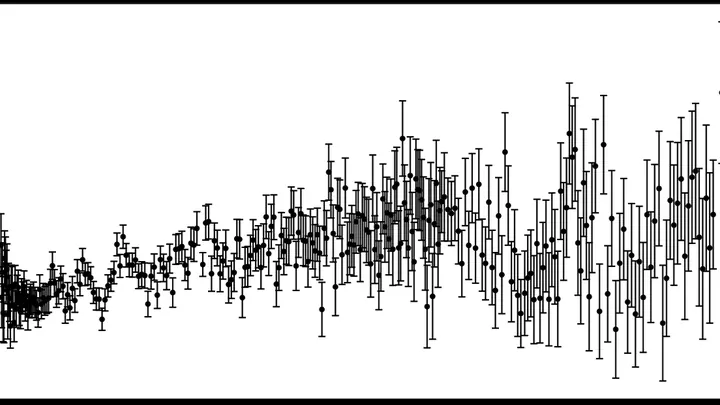
A team of scientists observed WASP-31 b — a hot Jupiter, a gas giant orbiting very close to its star.
When an X-ray burst erupts on a neutron star, its atmosphere heats up to millions of degrees. The light we catch with telescopes passes through this dense layer of gas, and gets dramatically altered along the way. The spectrum no longer looks like that of an ideal radiator: some colors get amplified, others dim.
The night sky is dotted with stars, and many of them have planets. But how do you spot a tiny dark disk against the glare of a distant sun? The Kepler telescope spent nine years watching hundreds of thousands of stars, waiting for a planet to pass in front of its star and briefly dim it. That 'wink' is the only way to find worlds like ours.
Eavesdropping on a distant planet's atmosphere is hampered by the star's noise. In the TRAPPIST-1 system, astronomers used a planet-"bug": TRAPPIST-1 b — an airless neighbor that records only the interference.
Every few hours, narrow beams of radio waves leave the Mojave Desert, near Madrid, and near Canberra, heading into the sky. This is NASA's Deep Space Network: three antenna complexes that keep in touch with spacecraft across the solar system.