Water vapor is the gaseous phase of water, present whenever liquid water or ice evaporates or sublimates. In exoplanetary science, its detection in an atmosphere is a major event: water is a key ingredient for life as we know it, and its presence tells astronomers about the planet's formation history, temperature structure, and atmospheric dynamics. The articles in this corpus show water vapor in a variety of exotic settings — from scorching hot Jupiters like WASP-121b, where it coexists with mineral clouds and escaping atmospheres, to warm, salty ocean worlds where it might be the dominant atmospheric constituent.
History
The first definitive detection of water vapor in an exoplanet atmosphere was reported in 2007 by a team led by Carl Grillmair, using the Spitzer Space Telescope to observe HD 189733b. Earlier claims existed but were less secure.
How it works
Water molecules absorb and emit infrared radiation at specific wavelengths, creating a unique spectral fingerprint. When a planet passes in front of its star (transit), starlight filters through the atmosphere, and water vapor imprints its signature on the transmitted light. By analyzing this spectrum, astronomers can infer the abundance of water vapor and even its vertical distribution. In hotter planets, water vapor can be dissociated by ultraviolet radiation or lost entirely through hydrodynamic escape, so its presence also constrains the planet's thermal and chemical evolution.
In practice
Water vapor detection is a primary tool for characterizing exoplanet atmospheres, guiding the selection of targets for the James Webb Space Telescope and future missions searching for habitable worlds.
Fun fact
On WASP-121b, water vapor is literally torn apart by the planet's extreme heat, and the hydrogen escapes into space, leaving the planet with a comet-like tail.
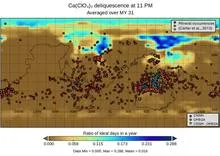
Every Martian night, salt crystals on the planet's surface soak up moisture from the thin air, much like a sponge draws water from a damp cloth. By morning, a microscopic brine accumulates inside them, and during the day, as temperatures rise, that brine finds itself trapped in tiny cavities.
Water comes in different varieties. Not just fresh or salty, but also "heavy"—when one of its hydrogen atoms is replaced by deuterium, its heavier cousin. Such water is called HDO, and it's a true cosmic passport: the amount of deuterium in water reveals where and when that water was born.
In 2024, the team led by David Charbonneau pointed the Magellan telescope with the WINERED spectrograph at LHS 1140. During transit, high-resolution spectroscopy caught the absorption line of metastable helium at 10833 Å.
Inside planets and stars, in rotating oceans of plasma, turbulent flows, Coriolis forces, and magnetic tension collide. The central question is how the energy of this chaos crystallizes into a stable magnetic framework that can last billions of years.
When a star dies, it turns into a white dwarf — a dense ball of carbon and oxygen the size of Earth. Predicted by Subrahmanyan Chandrasekhar, these objects were long thought to be lifeless graveyards.
A world where a year lasts just one and a half Earth days, and the star in its sky is hundreds of times larger than our Sun. This is KELT-9 b — a gas giant heated to temperatures at which iron vaporizes. Its atmosphere is not just hot; it is literally boiling away into space, like steam rising from a giant cauldron.
WASP-121 b is not just a hot ball. It's a world where iron vaporizes and the sky glows with its own heat. A fresh look at it has revealed what 'ingredients' went into making it.
The James Webb Space Telescope has for the first time clearly detected vaporized silicon monoxide in its atmosphere — a refractory substance usually locked inside dust grains.
When astronomers peer at distant worlds, they often don't see crisp lines of water vapor or methane, but a blurry silhouette, as if the planet has thrown on a thick veil. This veil, a haze of organic particles, behaves like a temperamental photographic plate: it darkens under harsh ultraviolet light, revealing hidden chemical patterns.
When a planet slips behind the edge of its star, the star backlights the planet's atmosphere, just as a setting sun illuminates clouds on the horizon. This brief moment, lasting only minutes, carries the imprint of the gases through which the starlight has passed.
Planet WASP-121 b always shows the same face to its star, like a rock in a campfire. The dayside is so hot that ordinary hydrogen, the very stuff most of the universe is made of, can't take it: its molecules tear apart into individual atoms, and the temperature flips upside down: the higher you go, the hotter it gets.
A giant planet hangs in space in complete solitude, separated from its star by a distance 160 times greater than the path from the Sun to Pluto. The light from its parent star arrives so faintly that the surface temperature barely exceeds 200 degrees Celsius — about as warm as a well-heated sauna.
The smell of fresh bread unmistakably signals a nearby bakery. But to know if baking is happening right now, it's better to catch not the aroma itself but its intensification — the continuous stream of hot air from the oven. This everyday analogy helps grasp a revolution in the search for extraterrestrial life on exoplanets — planets beyond our solar system.
Around small, cool, but extremely restless red dwarfs, planets the size of Earth often orbit. Such a star is like a temperamental stove that intermittently erupts flares: powerful streams of light and particles batter the planet's atmosphere, as if someone splashed fire into a simmering soup pot.
In a dense cloud of gas and dust where giant stars are born, the ALMA telescope has spotted something familiar. Four thin gas jets shoot out from the same region, each leaving behind a chain of bright knots, like a dashed line.
A water molecule, finding itself near a carbon ring, starts to vibrate, and immediately falls under the sway of an invisible conductor. The ring's electron cloud, like a maestro, dampens some vibrations while amplifying others.
In the cold outer reaches of the Solar System, water is considered the main building material for ices. But some comets and distant icy bodies have an unusually high ratio of carbon monoxide (CO) to water, as if a scoop of ice cream suddenly had too much syrup. The authors of a new study set out to find where this imbalance comes from.
At the dawn of Earth, about four billion years ago, the planet was a harsh place: a dim sun, frequent asteroid impacts, and air without oxygen. Under such conditions, the first steps of life seem almost impossible.
The Kepler telescope William Borucki's caught the faint twinkling of distant stars and discovered thousands of planets around other suns. Among them gapes a gap: almost no worlds sized between rocky balls and puffy water giants.
Rogue planets, ejected from star systems, may harbor life on their moons. A moon of such a planet can preserve heat and liquid water for billions of years. The whole secret lies in a reliable "blanket" and an internal "stove."
The stove is tidal forces: they squeeze and stretch the moon's interior, heating it up like kneading clay.
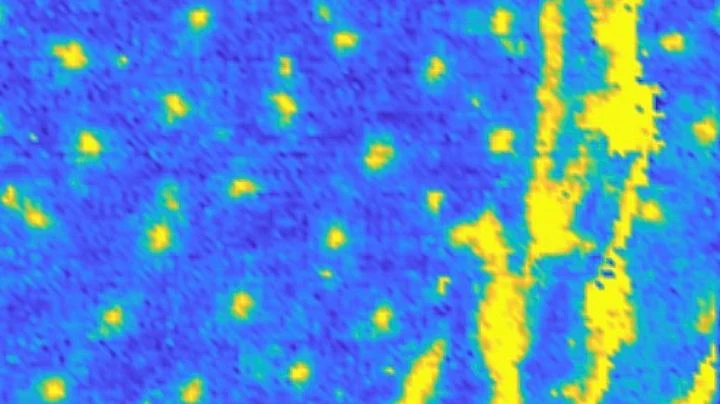
In a superconductor, electric current flows without loss, like water through a perfectly smooth pipe. But if you place such a material in a magnetic field, vortices appear inside — tiny whirlpools where superconductivity is destroyed. As long as these whirlpools stay put, current flows freely.
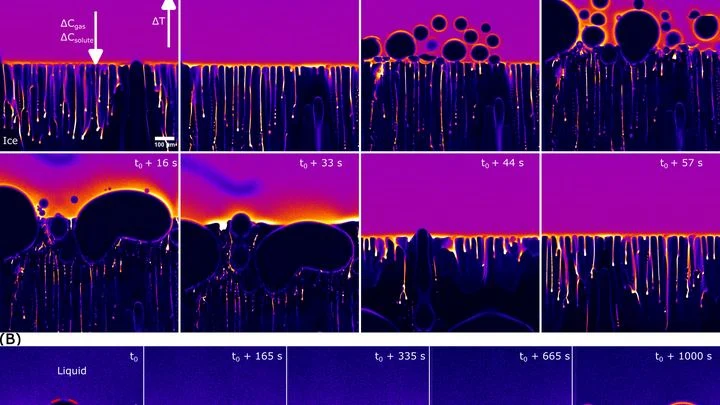
In a glass of soda, bubbles merrily rise to the top. But if you freeze the water, some bubbles end up trapped in the ice. How do they get there? After all, ice grows, pushing gas aside, but it doesn't always manage to.
A young star is surrounded by a flat, rotating disk of gas and dust — the construction site for future planets. The disk lives its own life: gas flows toward the star, dust clumps together, and from outside, harsh ultraviolet light from neighboring hot stars presses down on it all, like wind blowing leaves off a path.
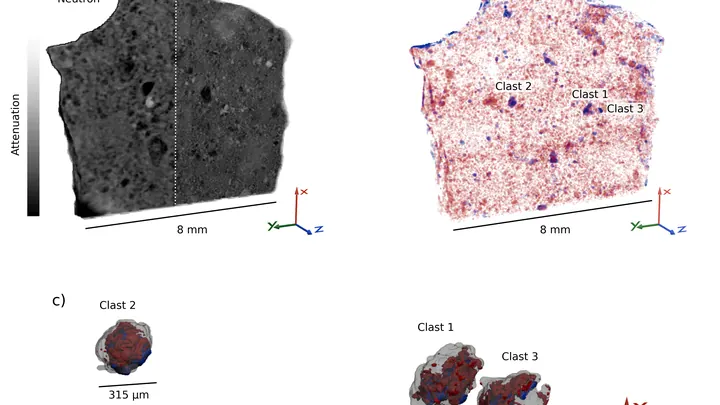
To find out if a Mars rock holds water without smashing it, scientists used neutron and X-ray scanning — similar to medical imaging. Neutrons pick up hydrogen, the foundation of water, allowing them to map moisture inside the sample.
In superfluid helium, a state where liquid flows without friction, quantized vortices spontaneously arise: microscopic funnels resembling whirlpools in ordinary Water, but governed by quantum mechanics.
Planet WASP-121b orbits so near its star that the fierce heat boils its atmosphere away, streaming like a comet's tails. With the James Webb Space Telescope, astronomers continuously watched this process for the first time.
Many planets around other stars — exoplanets — have elongated orbits. With each close approach, the star’s gravity squeezes and stretches them, like kneading dough. Friction heats up the interior to the point where rock melts, creating underground oceans of magma.
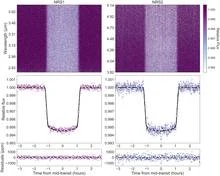
In 2023, the James Webb Space Telescope turned its gaze toward a distant star in the constellation Virgo. Orbiting it is HAT-P-26 b, a warm Neptune, a world with a mass of 18.6 Earths and a radius of 6.33 Earths. The planet transited across the star's disk, and at that moment its atmosphere became briefly visible.
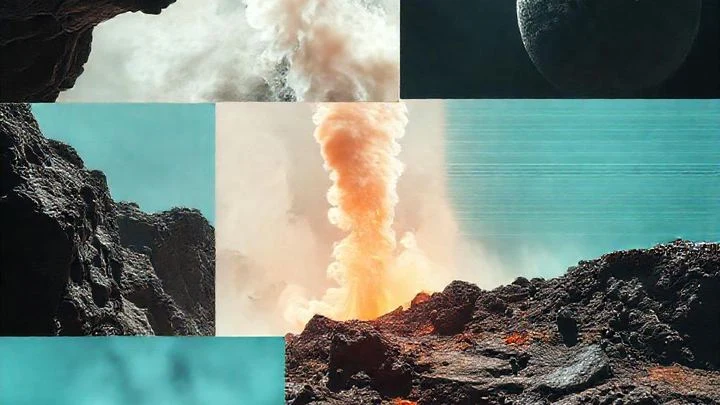
The dayside of WASP-121b is scorching at 2358 kelvins, hotter than the surface of many stars. Here, in perpetual light, the atmosphere does not just boil: it melts rock and turns it into gas. But not all gas stays gaseous. Some condenses into clouds, and those clouds hide titanium the way a trap hides its prey.
Water is the gold standard for life. We search for its traces on Mars, in icy moons, and in the atmospheres of distant planets. But what if life doesn't need water? On a warm rocky exoplanet with a thin atmosphere, water would evaporate within hours.