A hydrogenatmosphere is a gaseous envelope composed primarily of molecular hydrogen (H₂), often surrounding young planets or gas giants. In the context of rocky exoplanets, a thick hydrogen atmosphere can interact with a molten magma ocean on the surface, leading to chemical reactions that generate water and other volatiles. This process is crucial for understanding how planets acquire their initial water inventories and evolve into habitable worlds.
History
The idea that hydrogenatmospheres could generate water on rocky planets gained traction in the 2010s, driven by exoplanet observations and theoretical models of planet formation. Studies of sub-Neptunes and super-Earths highlighted the importance of such interactions in shaping planetary compositions.
How it works
When a planet forms with a magma ocean, the overlying hydrogenatmosphere dissolves into the molten rock at the interface. Hydrogen reacts with metal oxides in the magma, reducing them and releasing water vapor, which then outgasses into the atmosphere. Over time, this can produce substantial amounts of water, potentially forming surface oceans once the planet cools. The efficiency depends on pressure, temperature, and the composition of both the atmosphere and magma.
In practice
This mechanism informs models of exoplanet habitability and helps interpret observations of young, hot planets with hydrogen-richatmospheres, guiding the search for water-rich worlds.
Fun fact
A hydrogenatmosphere can make a planet appear larger than its solid core alone, which is why some sub-Neptunes are thought to be rocky worlds with thick hydrogen envelopes rather than gas dwarfs.
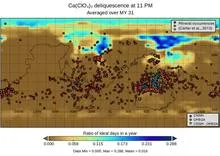
Every Martian night, salt crystals on the planet's surface soak up moisture from the thin air, much like a sponge draws water from a damp cloth. By morning, a microscopic brine accumulates inside them, and during the day, as temperatures rise, that brine finds itself trapped in tiny cavities.
In the depths of sub-Neptunes, the most common type of planet in the Galaxy, though not one you could stand on, silicate magma and hydrogen mix into a single supercritical cocktail. Previously, it was thought that beneath the dense hydrogen atmosphere lay a sharp boundary with molten silicate, like oil on water.
Deep inside a sub-Neptune, where pressures reach a hundred thousand bars and temperatures hit four thousand degrees, rock behaves like boiling soup. Heavy vapors of silicon and magnesium rise, cool, and fall back as a rain of solid particles.
The JWST space telescope aimed its lens at the scorching rocky world 55 Cancri e, and spotted a dense gas envelope. But the cooler TRAPPIST-1 b, which orbits a dim red dwarf, showed no envelope: just bare rock. The picture came out upside down: hot planets hold onto atmospheres, while cooler ones lose them.
Water comes in different varieties. Not just fresh or salty, but also "heavy"—when one of its hydrogen atoms is replaced by deuterium, its heavier cousin. Such water is called HDO, and it's a true cosmic passport: the amount of deuterium in water reveals where and when that water was born.
In a single star system, two teams of planets orbit. Some follow neat paths, like figure skaters on an ice rink, avoiding collisions. Others crowd together, their trajectories cross, and sooner or later a cosmic accident occurs — a giant impact.
Among the scorching exoplanets that circle perilously close to their stars lies the secret of their birth. Nearly three decades ago, Michel Mayor and Didier Queloz discovered the first such world, and since then astronomers have been tormented by the question: how does a gas giant end up pressed against…
When the JWST telescope breaks the light of a distant exoplanet into a spectrum, it reads a chemical chronicle. But this chronicle is not a monolithic truth; it's an atmosphere constantly rewritten by the star's radiation.
The mystery of the radius valley — a sharp drop in the number of exoplanets with radii ~1.8 Earth — haunts astronomers. JWST, transit surveys like Kepler and TESS draw a clear gap: rocky super-Earths and gaseous sub-Neptunes are separated by almost a chasm.
In 2024, the team led by David Charbonneau pointed the Magellan telescope with the WINERED spectrograph at LHS 1140. During transit, high-resolution spectroscopy caught the absorption line of metastable helium at 10833 Å.
When a star dies, it turns into a white dwarf — a dense ball of carbon and oxygen the size of Earth. Predicted by Subrahmanyan Chandrasekhar, these objects were long thought to be lifeless graveyards.
A sub-Neptune is a planet that falls between Earth and Neptune in size. These worlds are abundant in our galaxy, but their internal structure has been hotly debated. New research shows that in their youth, these planets behave like a sponge soaked with water.
The Martian surface is a place where anything alive quickly dies. Cosmic rays and ubiquitous oxidizers sterilize the top layer of soil. But dig a little deeper, and the picture changes. There, beyond the reach of ultraviolet light, a zone suitable for life may lurk.
This zone runs on a strange fuel — radiation.
A world where a year lasts just one and a half Earth days, and the star in its sky is hundreds of times larger than our Sun. This is KELT-9 b — a gas giant heated to temperatures at which iron vaporizes. Its atmosphere is not just hot; it is literally boiling away into space, like steam rising from a giant cauldron.
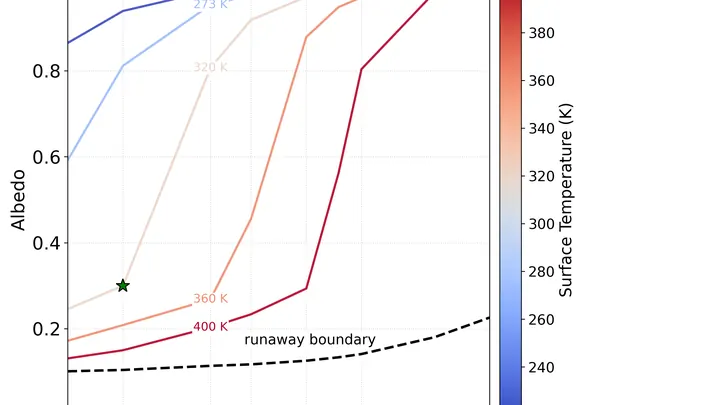
A scorching rocky planet is like a pot of boiling soup, except its lid is the atmosphere. Gases escape from the magma, wrap the world in a thick blanket, and in turn influence how quickly the celestial body cools. For GJ 1132 b, which orbits so close to its star that a year lasts just one and a half Earth days, this connection is especially important.
Young Earth was a boiling sphere of liquid rock, while Theia, which crashed into it, had had time to cool and solidify. It’s like dropping a chunk of cold butter into a pot of soup: the soup splashes out, but the butter barely moves. Similarly, Earth’s interior spewed into space, forming a cloud of cosmic dust and debris.
Previously, Uranus and Neptune were considered ice giants because of assumed thick layers of frozen water, methane, and ammonia. New calculations paint a different picture: deep inside them hides an ocean of hot magma, which under immense pressure has absorbed a colossal amount of hydrogen.
A planet the size of Neptune, but glowing white-hot. Beneath the clouds lies an ocean of magma capable of absorbing an entire hydrogen atmosphere. The new SEAMIST model is the first to trace how such dissolution changes a planet's fate from birth to old age.
The big surprise is the mechanism of catastrophic boiling.
When astronomers peer at distant worlds, they often don't see crisp lines of water vapor or methane, but a blurry silhouette, as if the planet has thrown on a thick veil. This veil, a haze of organic particles, behaves like a temperamental photographic plate: it darkens under harsh ultraviolet light, revealing hidden chemical patterns.
In the orchestra of interstellar life search, every note counts. And the score here is dictated not by man, but by a distant star. For the planet TRAPPIST-1 e, one of seven in the system of an ultracool red dwarf, the conductor's baton is harsh ultraviolet light.
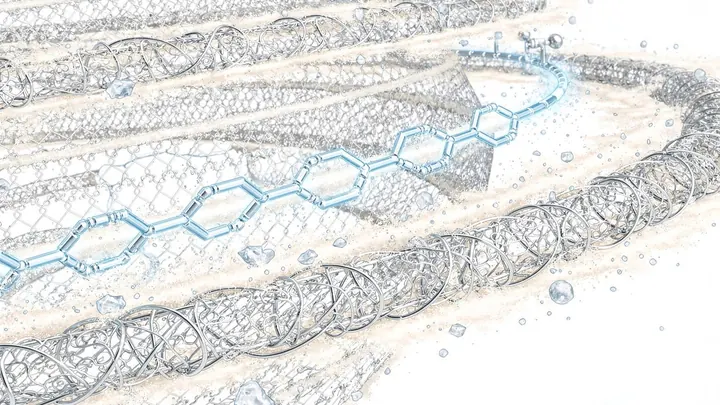
The birth of planets is a cosmic forge: gas and dust compress, shock waves and harsh radiation burn away all complexity. It was thought that fragile organic threads like cyanopolyynes couldn't survive this hell.
A kindergarten where some kids are busy making sandcastles while others are already assembling building blocks. That's roughly what the V1298 Tau system looks like: it's only 20 million years old — by cosmic standards, it just left the nursery. Several planets orbit it, and two of them, b and e, turned out to be surprisingly different.
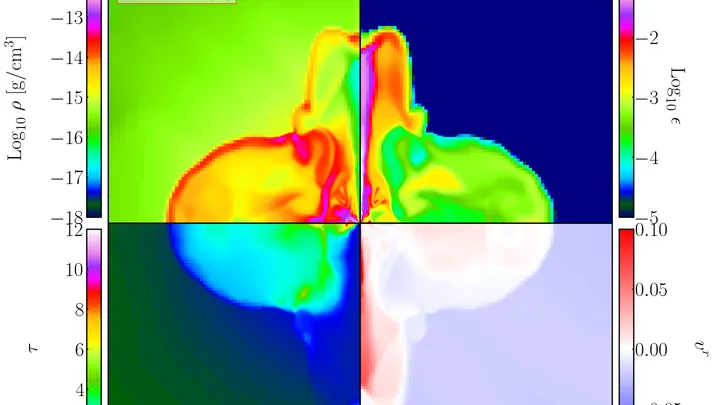
Water plunges into an abyss, but part of it shoots back up — churning and foaming at the very edge. That's roughly how gas behaves as it flows onto a supermassive black hole when its stream becomes too dense. In a new study, scientists traced this picture using computer simulations.
Throw a ball almost parallel to a wall — it will slide along it before bouncing off. The same happens with a light beam: when reflected at a shallow angle, it shifts by microns. This Goos–Hänchen shift was long considered a mere amusing paradox.
Light takes 124 years to reach us. That's how long it takes for the star's rays to bring news of K2-18b — a planet entirely covered by an ocean but wrapped in a thick hydrogen blanket. It's about two and a half times the size of Earth. For a long time, scientists debated: a water world with a dense atmosphere, or a scaled-down Neptune without a solid surface?
A supernova is the final explosion of a massive star, scattering its material over light-years. Inside the expanding shell, a neutron star remains, and the shell itself continues to plow through interstellar gas for thousands of years.
A pot of boiling lava, sealed with a thick lid of gas. That's roughly what sub-Neptunes look like — planets that are common around other stars but absent in our own solar system. Beneath a thick hydrogen atmosphere sloshes a molten magma ocean.
If you don’t stir a layered cocktail, the heavy syrup sinks to the bottom. A young planet is much the same — a seething ocean of molten rock. As it cools, minerals crystallize: some, like iron, get heavy and sink, while others float. You’d think a dense layer would pile up at the core.
Chondrules look like frozen raindrops made of stone. They're about the size of a grain of sand, but they record the history of the first few million years of the Solar System. Once, these droplets floated in the scorching gas around the young Sun, then clumped into asteroids and fell to Earth as meteorites.
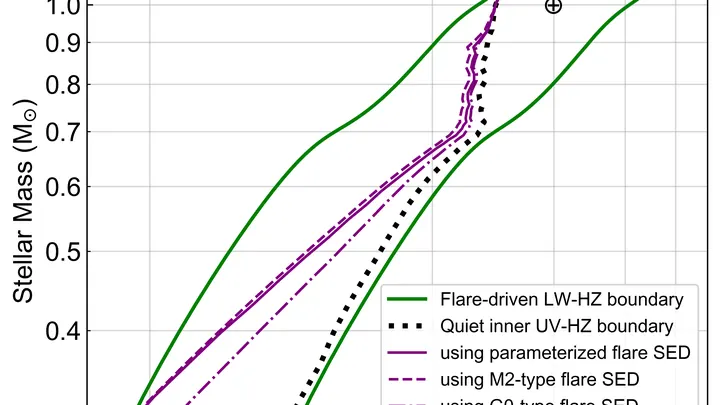
Around small, cool, but extremely restless red dwarfs, planets the size of Earth often orbit. Such a star is like a temperamental stove that intermittently erupts flares: powerful streams of light and particles batter the planet's atmosphere, as if someone splashed fire into a simmering soup pot.
Titan is a cold world with methane lakes and a dense orange atmosphere. But beneath the icy crust, warm puddles may hide, formed after meteorite impacts. In such a puddle, like a chemical flask the size of Selk Crater, simple gases from the air, hydrogen cyanide and acetylene, mix.
At the Large Hadron Collider, not only nuclei but also individual protons collide. Even in such small systems, collective behavior resembling the flow of a liquid is observed. But the proton is a quantum object; its state is described by a wave function, not by temperature and pressure.
Around young stars, flat clouds of gas and dust swirl, like pizza dough from which planets will eventually be shaped. This cloud contains various chemical elements, and sulfur is one of the most elusive: it's hard to catch with telescopes because it hides in solid grains or escapes as gas.
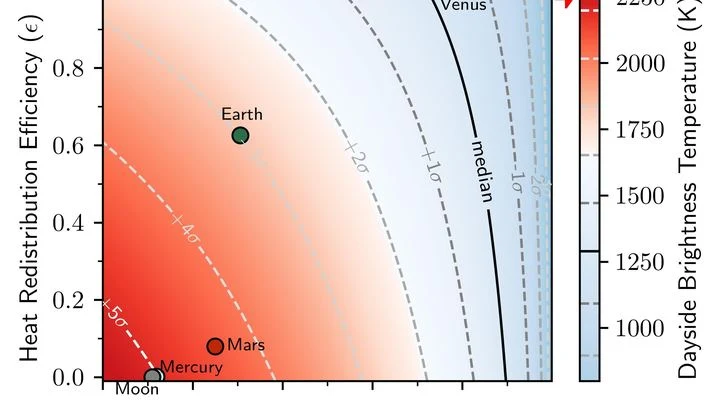
A hot skillet on the stove glows in the dark, but if you cover it with a lid, the heat escapes more slowly and the surface doesn't look as bright. That's roughly the situation on planet HD 3167 b: it always shows the same face to its star, and the dayside is heated to temperatures that melt rock.
The James Webb Space Telescope is gazing more and more at exoplanets — worlds orbiting alien stars. Some of them are scorching rocky spheres, tidally locked with one side forever facing their star. There, rock melts into oceans of liquid lava. How does this lava move?
Water isn't the only thing life needs. To assemble the first RNA-like chains from simple molecules, you need ultraviolet light, like the sunlight that helps plants, but harsher and with shorter wavelengths. Big stars like the Sun emit plenty of this light. Small, dim stars, however, have almost none: they shine mostly in red and infrared, like a glowing ember.
Simple equations that describe fox and rabbit cycles have been turned to bacteria on distant exoplanets, like K2-18 b. These worlds hold deep oceans under thick hydrogen skies. Like duckweed on a pond, light-eating microbes cover the sunlit water surface, stealing light from those below.
Comet 3I/ATLAS was spotted when it entered the Solar System from interstellar space. The James Webb Telescope split the light from its gas cloud into a rainbow, a spectrum, and in this pattern, the lines of rare molecules with deuterium (heavy hydrogen) appeared.
At the dawn of Earth, about four billion years ago, the planet was a harsh place: a dim sun, frequent asteroid impacts, and air without oxygen. Under such conditions, the first steps of life seem almost impossible.