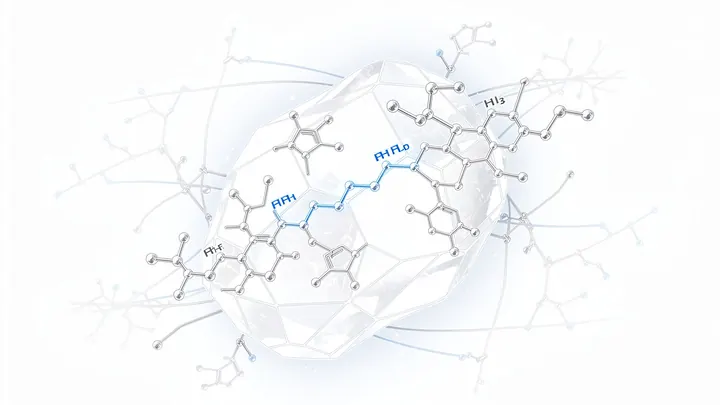
Hydrogen cyanide (HCN) is a simple molecule consisting of one hydrogen, one carbon, and one nitrogenatom. In space, it is surprisingly abundant and acts as a key building block for more complex organic molecules, including amino acids and nucleobases, which are essential for life as we know it. Its presence in interstellar clouds and comets suggests that the raw ingredients for life may be widespread across the universe.
History
Hydrogen cyanide was first detected in the interstellar medium in 1970 by L. E. Snyder and D. Buhl using radio astronomy. Its role as a precursor to prebiotic molecules was recognized soon after.
How it works
In the cold, low-density environment of space, hydrogen cyanide forms through gas-phase reactions involving carbon and nitrogenatoms, or on the surfaces of dust grains coated with ice. Once formed, it can participate in further reactions, such as with ammonia or water, to produce larger molecules. The icy grains act as catalysts, concentrating reactants and providing a surface for chemical reactions to occur more efficiently.
In practice
In astrochemistry, hydrogen cyanide is used as a tracer for dense gas in star-forming regions and as a key input in models of prebiotic chemistry.
Fun fact
On Earth, hydrogen cyanide is a deadly poison, but in space it is a vital ingredient for the chemistry that could lead to life.
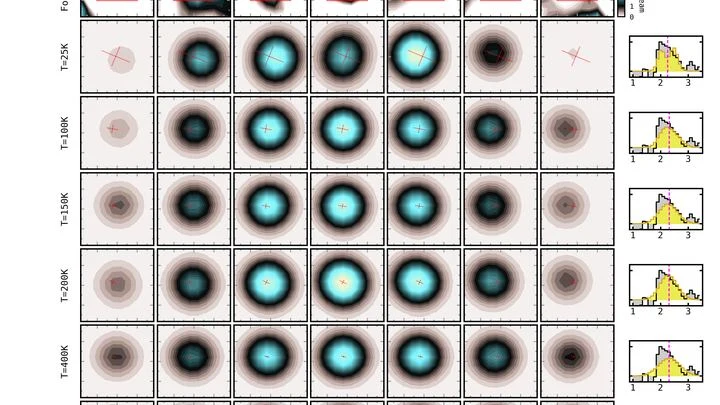
In the cold cloud TMC-1, where the temperature never rises above ten degrees above absolute zero, molecules rarely encounter one another. But every so often a helium atom whizzes past, and that brief touch is enough to alter the molecule's rotation. Such collisions dictate what radiation we see from Earth.
Imagine three witnesses who saw the same event. Two tell the same story, the third tells a different one. Whom do you believe? This is exactly the situation in astronomy when measuring carbon in the star J0815+4729, an ancient object with a record-low iron abundance (carbon is one of the key elements used to infer the properties of the…
Deep inside a sub-Neptune, where pressures reach a hundred thousand bars and temperatures hit four thousand degrees, rock behaves like boiling soup. Heavy vapors of silicon and magnesium rise, cool, and fall back as a rain of solid particles.
In the cold Taurus cloud, where stars are born, telescopes have detected molecules with the smell of bitter almonds — aromatic nitriles. On Earth, you can find them in peach pits, but in space they hang in icy dust. What happens to them under the harsh ultraviolet light of young stars? Chemists recreated this process in the lab.
Around young stars, flat clouds of gas and dust swirl: these are future planetary systems. Inside some of them, a void gapes: the dust and gas have been swept away, as if someone thinned out the middle of a vinyl record.
The lifetime of the entangled triplet pair in the protein is about 60 picoseconds, which is eight times longer than in solution.
Sunlight is like a continuous stream of balls flying at a wall.
In dark interstellar clouds where new stars are born, chemistry starts with a tiny particle — the trihydrogen ion (H₃⁺). It collides with other atoms and sets off a cascade of reactions that build ever more complex molecules. For a long time, it was thought that the main reaction producing it, H₂⁺ colliding with H₂, only happens in the gas phase.
In the black depths of space, on the surfaces of tiny icy dust grains, a quiet construction is underway. There, where temperatures drop to near absolute zero and harsh radiation abounds, the ordinary amino acid glycine, the simplest protein building block, links up with itself.
Two guitar strings are stretched on the same neck. They are almost identical, but one is slightly shorter — and they sound different. That's roughly how the two isomers of ethanimine work: molecules with the same set of atoms but rotated differently in space. Astronomers spotted this molecule in the dense clouds near the center of our Galaxy.
In the heart of the Milky Way, in the cloud G+0.693, astronomers caught a sweet signal — emission lines of erythrulose, a simple sugar with four carbon atoms and four oxygen atoms.
The birth of planets is a cosmic forge: gas and dust compress, shock waves and harsh radiation burn away all complexity. It was thought that fragile organic threads like cyanopolyynes couldn't survive this hell.
Light takes 124 years to reach us. That's how long it takes for the star's rays to bring news of K2-18b — a planet entirely covered by an ocean but wrapped in a thick hydrogen blanket. It's about two and a half times the size of Earth. For a long time, scientists debated: a water world with a dense atmosphere, or a scaled-down Neptune without a solid surface?
A supernova is the final explosion of a massive star, scattering its material over light-years. Inside the expanding shell, a neutron star remains, and the shell itself continues to plow through interstellar gas for thousands of years.
For nearly half a century, astronomers have been searching for glycine, the simplest amino acid and one of the fundamental building blocks of proteins, in the interstellar medium.
In the dense gaseous cocoon around a young massive star, streams of matter collide as if in a giant chemical flask. One stream moves relative to us at about 11 kilometers per second, the other at about 5. The telescope at Onsala (Sweden) caught their radio voices and resolved them into hundreds of spectral lines — molecular fingerprints.
In a crystal of water and caustic cesium, oxygen and cesium atoms sit in place like beads in a rigid lattice. Hydrogen atoms behave differently: they are like passengers constantly changing seats. In this layered material, each oxygen is linked to three neighbors via hydrogen bridges, forming a honeycomb-like pattern.
In dark, cold clouds of interstellar gas, astronomers have for several years been spotting aromatic molecules — compounds built around a benzene ring (a hexagon of carbon atoms), like the benzene we know. One such substance, benzonitrile (benzene with a cyano group attached), had only been found in very calm and cold places, like the Taurus cloud.
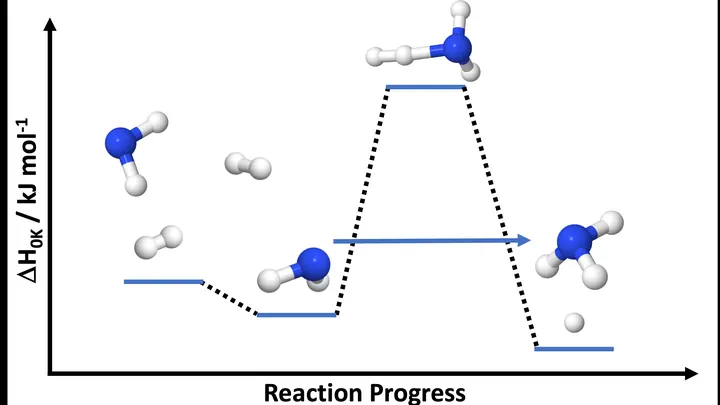
A ball rolls up a hill, but it doesn't have enough energy, so it rolls back down. That's classical mechanics for you. But in the quantum world, a tiny particle can sometimes pass right through the hill, as if the barrier weren't there. This trick, tunneling, is business as usual for a light atom like hydrogen.
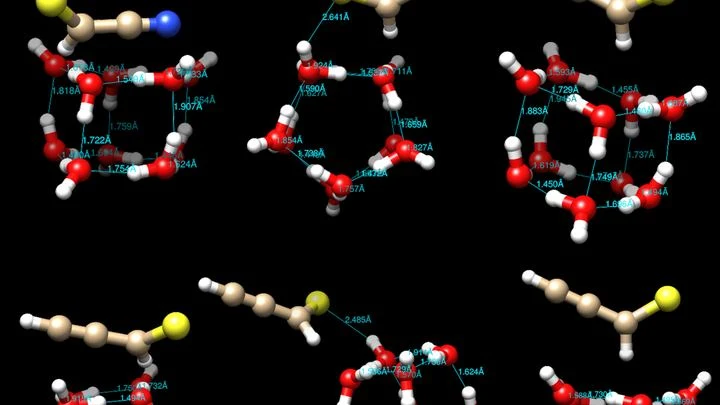
In a cold cloud of gas and dust that astronomers call TMC-1, two sulfur-bearing compounds were recently found: one smells like bitter almonds, the other like rotten eggs. But such a cloud contains less sulfur than it should. Where does it go? It seems to hide in tiny icy pockets on the surface of dust grains.
Space ice is not like a skating rink. It is fluffy, like snow, and full of crevices and hollows.
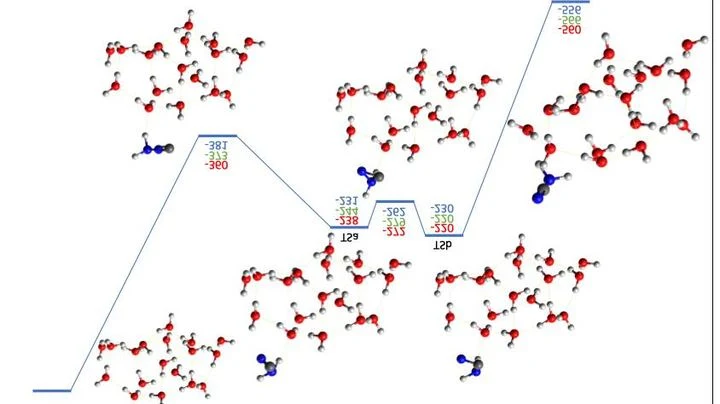
In cold clouds between the stars, dust grains are coated with ice, like windows covered with frost in winter. On this icy crust, chemical reactions take place that do not occur in gas. One such reaction is the encounter between a carbon atom and a nitrogen molecule.
Titan is a cold world with methane lakes and a dense orange atmosphere. But beneath the icy crust, warm puddles may hide, formed after meteorite impacts. In such a puddle, like a chemical flask the size of Selk Crater, simple gases from the air, hydrogen cyanide and acetylene, mix.
Nitrogen, the very gas we breathe, behaves like a finicky metal under a million atmospheres of pressure. In a diamond anvil cell, it is squeezed to 78–98 gigapascals and heated with a laser to 1800–2500 kelvin. Under these conditions, N₂ molecules rearrange into crystals that can store energy more densely than explosives.
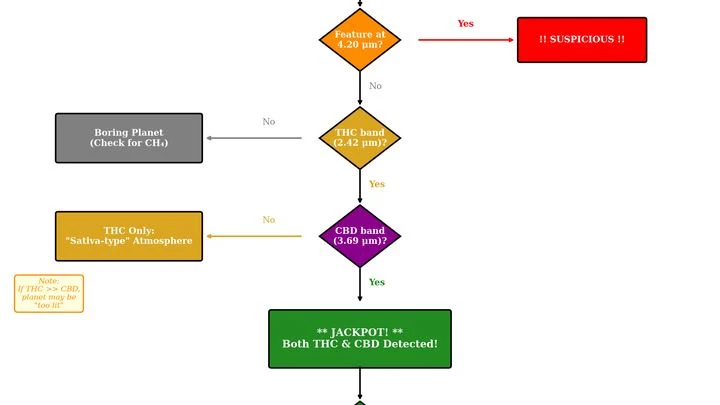
Light from a distant star, passing through the atmosphere of planet K2-18b, left unusual "fingerprints" in its spectrum. Astronomers spent 420 hours collecting this light with the James Webb Space Telescope and split it into colors, like a rainbow.
A chemical detective searches for life on other planets. Its tool is a mass spectrometer that identifies molecules by weight (the same device earthly forensic scientists use to analyze clues).
Radio telescopes detected emissions from the celestial object G358.93-0.03 MM1 — a hot cocoon inside which a massive star is igniting. Within that glow, lines of glycolamide appeared, a delicate carbon molecule.
At the dawn of Earth, about four billion years ago, the planet was a harsh place: a dim sun, frequent asteroid impacts, and air without oxygen. Under such conditions, the first steps of life seem almost impossible.
Life may be hiding in the oceans beneath the ice of Europa, Ganymede, and Callisto. Its carbon-based building blocks perhaps baked before the moons were born — in a disk of gas and dust around a young Jupiter. This giant cosmic oven ran on slow frictional heating, not harsh ultraviolet light.
In a cloud where massive stars are being born, there is a hot, dense core. Like a crowded kitchen where the heat of the stove makes smells evaporate, here the warmth from young stars evaporates molecules from the surface of cosmic dust grains.
In the dark, cold clouds where stars are born, dust grains are covered with an icy crust. Across this crust, like on a winter road, individual atoms wander slowly. Calculations show that it is precisely these wandering oxygen and nitrogen atoms that kick off the assembly of the HNSO molecule — a compound of hydrogen, nitrogen, sulfur, and oxygen.
Deep beneath our feet, at the very center of Earth, lies a solid iron core. But it's not pure iron — there are lighter elements too, such as hydrogen. Exactly how hydrogen is distributed within the core has long been a mystery.
Cometary ice slams into the young Earth. The pressure at the impact point is like stacking six aircraft carriers on your thumbnail. In the lab, such conditions are reproduced by squeezing a tiny sample between two rotating anvils.
This time, adenosine monophosphate — one of the letters of future RNA — was placed under the anvils.
In stellar nurseries, massive stars are not born alone but in pairs. Two stars orbit a common center, and the more massive one expands first and begins to shed its outer layers. Some of this material doesn't escape into space but flows onto the companion, like water from an overflowing cup into a cup held beneath.
In the cold cloud TMC-1, where temperatures drop to nine degrees above absolute zero, the QUIJOTE radio telescope picked up a faint 'song' — 22 emission lines from the molecule cyclopent[c,d]indene.
Dissolve a few salts and formaldehyde in a glass of water. After a while, the liquid spontaneously separates: droplets with membranes appear, like tiny bubbles. Inside each droplet, chemical transformations occur, and the droplet itself grows, absorbing material from the surrounding solution.
These droplets are not just bubbles.
Around the star HD 163296, 330 light-years away, a dense ring of gas and dust is swirling. Astronomers have spotted a small but bright patch of hydrogen cyanide and ethynyl molecules within it. It hangs at a distance of 88 astronomical units from the star — farther than Pluto is from the Sun.
The heat from a forming planet hidden in that patch melts the icy dust.
In a cold gas cloud right at the center of our Galaxy, designated G+0.693-0.027, hides a true chemical laboratory. There, far from stars, on the surfaces of tiny dust grains, about the size of smoke particles, atoms stick together into molecules, like dough on a kitchen counter.