How to Tell a Dangerous Mutation from a Harmless One express
In a vast library where each book is a gene, you need to find a single typo. The error might be harmless, or it might completely change the meaning of the sentence. That's roughly what geneticists do when they hunt for harmful mutations among millions of harmless differences.
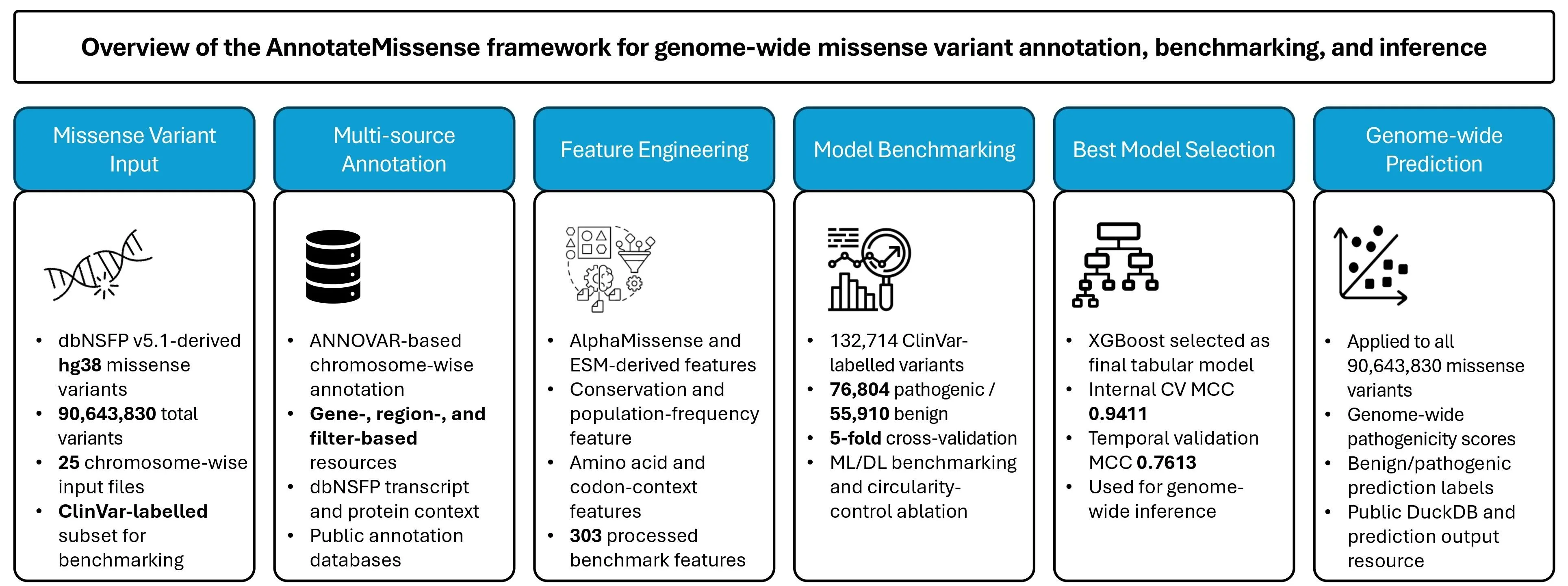
The program, named AnnotateMissense, works like a meticulous proofreader. It doesn't just look at the letter substitution itself; it gathers every possible clue: how often this substitution occurs in healthy people, how much the protein's shape changes, what other prediction programs say, and even what evolution's 'handwriting' looks like — whether this region has remained unchanged across species. In total, 303 such clues were collected.
The most interesting part came when the program was stripped of clues. Without data on mutation frequency in the population and without hints from other predictors, accuracy plummeted, like a proofreader losing their dictionary and grammar guide. But removing trendy assessments from protein language models barely affected the results. The final version was tested on fresh data that appeared after training: accuracy remained high at 88%. After that, the program scanned the entire human genome and assigned danger scores to 90 million mutations.
Original abstract
as written by the authors arXiv:2605.24520
Missense variant interpretation remains challenging because pathogenicity depends on heterogeneous evidence from population frequency, evolutionary conservation, transcript context, amino acid substitution severity, prior pathogenicity predictors and protein-language-model-derived features. We present AnnotateMissense, a scalable annotation, benchmarking and genome-wide prediction framework for missense variant interpretation. AnnotateMissense integrates hg38 missense variants derived from dbNSFP v5.1 with ANNOVAR annotations, dbNSFP transcript/protein descriptors, AlphaMissense scores, ESM-derived features, conservation metrics, population-frequency variables, established pathogenicity predictors and engineered amino acid/codon-context features. Using 132,714 ClinVar-labelled missense variants, we benchmarked machine-learning and deep-learning models under controlled feature configurations. The full 303-feature benchmark set achieved the strongest performance with XGBoost, reaching mean MCC = 0.9411 and ROC-AUC = 0.9950 across stratified five-fold cross-validation. Restricted naive and location-oriented feature sets achieved lower best MCC values of 0.4989 and 0.5113, respectively. Circularity-controlled ablations showed that removing prior-predictor, population-frequency and clinically overlapping evidence reduced performance, whereas excluding AlphaMissense and ESM-derived features alone had minimal effect. Temporal ClinVar validation on newly observed pathogenic/benign variants achieved MCC = 0.7613, accuracy = 0.8798 and F1-score = 0.8750. The final model was applied to 90,643,830 hg38 missense variants to generate AnnotateMissense pathogenicity scores and binary prediction labels. Code and outputs are available at https://github.com/MuhammadMuneeb007/CAGI7_Annotate_All_Missense and https://doi.org/10.5281/zenodo.19981867.
The word 'missense' in the name means the mutation changes just one amino acid in the protein, like swapping one letter in a word. But even such a small change can turn 'house' into 'horse'.
In the movie Gattaca, society was divided into 'valid' and 'invalid' based on genetic predictions — programs like this bring that scenario a little closer to reality.