How to Weigh a Neutron Star Without Tricks express
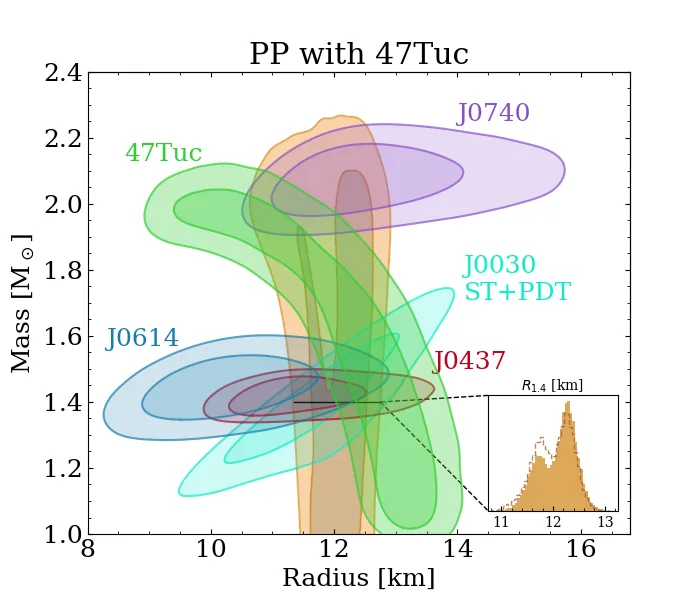
A neutron star is a city the size of Manhattan, compressed to such a density that a teaspoon of its material weighs as much as Mount Everest. To understand what it's made of inside, scientists measure its radius. But there's a catch: many measurements suffer from systematic errors, like trying to measure the height of someone who keeps fidgeting and bending over. This was especially true for quiescent X-ray binaries — systems where a neutron star quietly siphons matter from a companion without producing bright flares.
The authors took such a star, X7, in the cluster 47 Tucanae, and applied the X-PSI program. It honestly models the rotation and possible hot spots on the surface: those "fidgets and bends." The result: the radius of a star with a mass of 1.4 solar masses is 12.9 ± 0.4 km. That's like measuring the width of a hair to within a couple of microns while the hair is spinning in your fingers.
The big surprise: accounting for rotation and spots barely shifted the radius estimate (less than a percent) and didn't blur the uncertainty. So for X7, these effects are not critical, likely due to the long observations. This is good news: quiescent binaries, once considered finicky, can again become reliable rulers for measuring neutron stars. And a precise radius is the key to the equation of state, the central mystery: how does matter behave when squeezed harder than in an atomic nucleus?
So the old ruler is back in business. Now, by combining data from different sources, physicists can more accurately sketch the portrait of the densest matter in the universe.
Original abstract
as written by the authors arXiv:2605.28411
Neutron star (NS) radius measurements provide precious information to constrain the dense matter equation of state (EOS). Quiescent low-mass X-ray binaries (qLMXBs) have been used for this purpose, but a number of sources of systematic biases were uncovered, making other sources more favored for EOS studies. We aim to reintroduce qLMXBs as reliable sources of NS mass and radius measurements with a new method, free of systematic biases. We test our implementation on the qLMXB X7 in the globular cluster 47 Tucanae. We used X-PSI to perform the spectral analysis of the 47Tuc X7 observations. X-PSI accurately models the effects of the unknown NS rotation and possible surface anisotropies (two sources of biases in qLMXBs) on the NS spectra. The most significant source of bias on the radius is usually the chemical composition of the NS atmosphere, which, in the case of 47Tuc X7, is known to be hydrogen-rich. A broad range of masses and radii was explored. We obtain a NS radius at 1.4 $$M_\odot$$ of $$R_{1.4} = 12.9\pm0.4$$ km (68% credible interval). A shift of the radius by less than a % is measured compared to the model where these sources of systematic uncertainties are neglected. More importantly, including rotation and surface anisotropies in the modeling does not significantly broaden the radius posteriors. We also place strong constraints on the X-ray pulsed fraction (upper limit of 6.0% at a 99.97% credible level) caused by the possible presence of a hot spot. This suggests that, for 47Tuc X7, robust radius constraints can be obtained even without considering systematics, likely because of the deep exposures. We use the resulting M-R constraints from this NS to quantify the improvement on an EOS inference when combined with other measurements. We show that, using recently developed tools, qLMXBs can be exploited to infer reliable NS masses and radii, which can in turn constrain the EOS.
A teaspoon of neutron star material weighs about 4 billion tons — roughly the weight of all humans on Earth packed into a thimble.