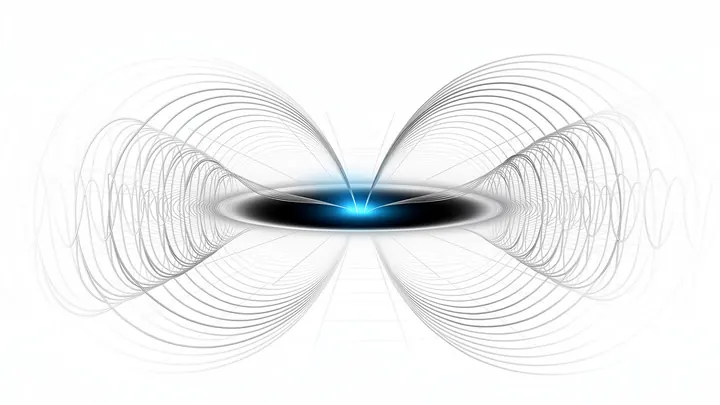
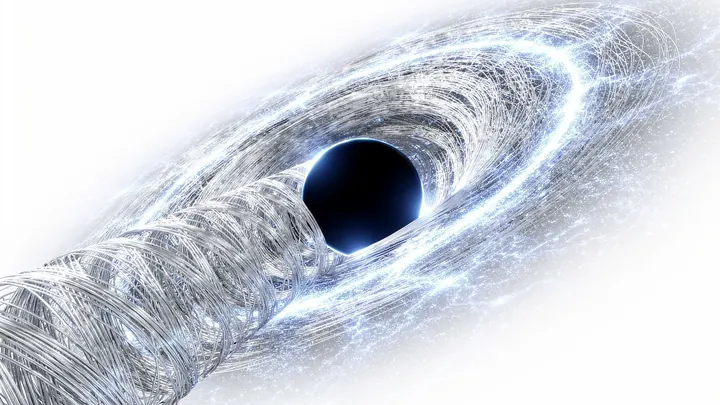
Radius is the distance from the center of a spherical object to its surface or boundary. In physics, the concept of radius appears in countless contexts: from the radius of an atom (about 0.1 nanometers) to the radius of a black hole's event horizon (the Schwarzschild radius). It is a fundamental geometric parameter that determines properties like volume, surface area, and gravitational pull. In the given titles, no specific use is mentioned, but the concept is ubiquitous in describing the size of particles, orbits, lenses, and detectors.
History
The concept of radius dates back to ancient geometry, with Euclid defining the circle by its radius around 300 BCE. The Bohr radius was introduced by Niels Bohr in 1913 in his model of the hydrogen atom. The Schwarzschild radius was derived by Karl Schwarzschild in 1916 from Einstein's field equations.
How it works
The radius is defined as half the diameter of a sphere or circle. In physics, it often enters formulas through geometric relationships: for a sphere, volume = (4/3)πr³ and surface area = 4πr². In dynamics, the radius of curvature describes how sharply a path bends. In quantum mechanics, the Bohr radius (about 0.053 nm) sets the scale for hydrogen-like atoms. In relativity, the Schwarzschild radius r_s = 2GM/c² defines the size of a black hole for a given mass M.
In practice
Radius is used in designing optical lenses, particle accelerators (bending radius of magnets), and in medical imaging to characterize tumors or blood vessels.
Fun fact
The Earth's radius is not constant: it is about 22 kilometers larger at the equator than at the poles due to the planet's rotation, making it an oblate spheroid rather than a perfect sphere.
Universal constant of gravitation, determining the strength of gravitational force. — gravitational constant= 6.67430e-11cubic metre per kilogram per second squared
$$r_H \propto \frac{\dot{M}}{\rho c_s}$$
Horizon radius scales with accretion rate over density and sound speed.
A black hole is not an absolutely black bag. In 1974, Stephen Hawking showed that it glows — faintly, but continuously. This radiation is born not inside, but outside, right at the boundary from which even light cannot escape.
A new study sharpens the picture.
The merger of two black holes is not just a silent dance, but a grand act after which spacetime itself vibrates for a long time. These damped oscillations — quasi-normal modes — are like the ringing of a gigantic bell. But there is another echo: barely perceptible, almost ghostly.
An ordinary black hole is surrounded by a thin photon sphere — a place where light can loop around before falling in or escaping. In the new work, this region has puffed up into a whole layer packed with massless particles that zip around at nearly the speed of light and don't press against the walls.
A textbook black hole resembles a perfectly smooth sphere: everything outside it calmly flies off to infinity. However, quantum gravity paints a different picture. Recently, within loop quantum gravity, a solution was found — a 'Kruskal' black hole where spacetime beyond the horizon behaves differently.
A black hole is like a dark ball in space onto which luminous matter falls. A black hole has a shadow — a region from which rays cannot escape. But due to light bending, the shadow appears larger than the hole itself: just like a ball's shadow on a wall grows bigger when the lamp is far away.