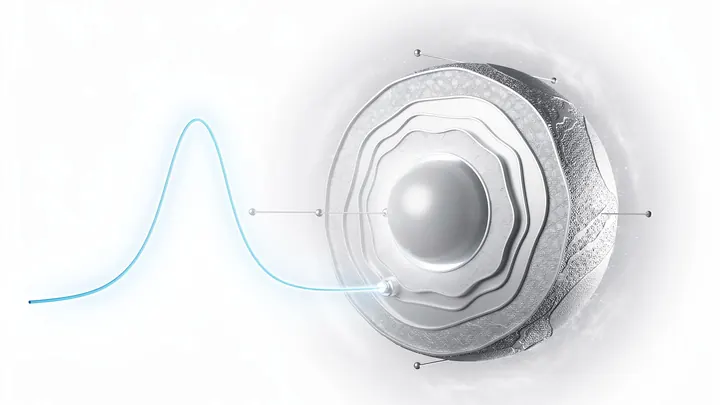
An equation of state is a mathematical relationship that connects the macroscopic properties of matter — typically pressure, density, and temperature — in a way that describes how the material behaves under different conditions. For ordinary gases, the ideal gas law PV = nRT is a simple equation of state. For the extreme matter found inside neutron stars, the equation of state is far more complex and is one of the great unsolved problems in astrophysics: it determines how much mass a neutron star can support before collapsing into a black hole, and how its radius changes with mass.
History
The concept of an equation of state dates back to the 17th century with Boyle's law, but its application to neutron stars began with the work of J. Robert Oppenheimer and George Volkoff in 1939, who used a simple equation of state for a degenerate neutron gas to calculate the first neutron star models.
How it works
The equation of state encodes the microscopic physics of the material: for a neutron star, it must account for the strong nuclear force, the possibility of exotic particles like hyperons or quarks, and the effects of superfluidity. By measuring the masses and radii of neutron stars, astronomers can constrain the equation of state — each measurement rules out some theoretical models and supports others. The stiffness of the equation of state (how much pressure resists compression) directly sets the maximum possible neutron star mass, a key prediction that observations are now testing.
In practice
Beyond astrophysics, equations of state are essential in engineering for modeling the behavior of materials under high pressure, such as in explosives design, planetary science (interior models of Earth and other planets), and in the design of inertial confinement fusion experiments.
Fun fact
The equation of state of neutron star matter is so uncertain that a single precise measurement of a neutron star's radius — accurate to a few hundred meters — would immediately rule out about half of all proposed theoretical models.
In the depths of sub-Neptunes, the most common type of planet in the Galaxy, though not one you could stand on, silicate magma and hydrogen mix into a single supercritical cocktail. Previously, it was thought that beneath the dense hydrogen atmosphere lay a sharp boundary with molten silicate, like oil on water.
At the center of a neutron star, matter is compressed so tightly that a teaspoon weighs a billion tons. You'd think there's no better place to look for signs of quantum gravity. But between the laboratory and the fundamental scale lies a chasm of 10⁸⁰ in density.
Three doors lead into this room.
An interpreter gets distracted by every rustle in the hall, and a one-hour meeting stretches into two. A neutron star compresses a solar mass into a sphere the size of a city, and the matter in its core is denser than an atomic nucleus. Physicists cannot probe its structure in the lab: the required pressures are unattainable.
A chef tastes tiny morsels from different edges of the plate and tries to reconstruct the recipe of a complex dish. Each morsel offers only a hint of flavor, and the samples are a bit blurred — too much salt here, not enough sugar there. That's roughly how nuclear physicists study the matter inside neutron stars — the densest objects in the universe after black holes.
The merger of two neutron stars is not just a collision. Even before they touch, they deform each other through tidal forces, and this deformation depends on how 'soft' or 'stiff' the matter inside is. Stiff matter resists more; soft matter changes shape more easily.
A neutron star is the ultra-dense remnant of a supernova: the mass of the Sun packed into a sphere the size of a city. For billions of years, it travels through space, gathering around itself invisible matter, dark matter, which emits no light but pulls with gravity.
An invisible scaffold holds galaxies together, keeping them from flying apart. This is dark matter — matter that doesn't shine and barely interacts with ordinary stuff. Astrophysicists have long debated what it's made of.
A cosmic "caliper" will soon measure a neutron star to within a hundred meters. For an object a couple dozen kilometers across, that's like measuring the thickness of a human hair from a kilometer away.
A neutron star is the remnant of an exploded supernova.
A heaping teaspoon, and the scale reads a billion tons. That's roughly what a teaspoon of neutron star matter would weigh if you could scoop it up and put it on a scale. Such objects are born after a supernova explosion: the star's core collapses into a sphere the size of a city, and the density exceeds that of an atomic nucleus.
Neutron stars — remnants of supernovae — are among the densest objects in the Universe. Their central density exceeds nuclear density many times over, and gravity is surpassed only by black holes.
In the first moments after the Big Bang, the universe was filled with a hot, nearly uniform plasma. But in some places, the density could randomly be slightly higher. If such a clump gained critical mass, it collapsed into a black hole: this is how primordial black holes were born.
Neutron stars are the final chord in the evolution of massive suns. Born in the cataclysm of a supernova, they pack a mass comparable to the Sun's into a sphere the size of an earthly metropolis.
At the center of many galaxies lurks an invisible halo of dark matter: it holds the stars at the edges, keeping them from flying apart. For a long time, it was described as a dilute gas of particles, but new work offers a different view: dark matter might gather into a quantum droplet.
A figure skater pulls their arms in, and their spin suddenly accelerates. When a massive star exhausts its fuel and its core collapses, something similar happens, but on a cosmic scale. The core shrinks to a city-sized sphere, and if it is spinning rapidly, a peculiar instability can arise.
When a massive star runs out of fuel, its core collapses under its own weight. A black hole forms — a region where gravity is so strong that even light can't escape. For a long time, it was thought that a point of infinite density, a singularity, lurks at the very center.
Physicists have mastered an elegant mathematical trick that lets them translate gravitational equations into the language of electricity. This method — double copy — works like a kind of dictionary: it replaces the complex geometry of curved spacetime, described by high-dimensional tensor fields, with the simpler rules of…
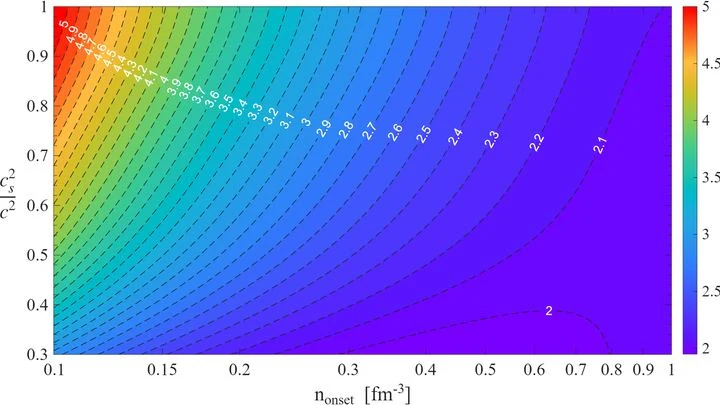
The core of a neutron star can be likened to a taut string of super-nuclear density. Sound traveling along it is the oscillation of pressure, whose speed $$c_s$$ betrays the stiffness of matter. New research shows that this cosmic string does not hum monotonically.
A neutron star is what remains after a massive star explodes. Its matter is squeezed so tightly that a teaspoon would weigh as much as a mountain. But what exactly happens in the deepest interior, where protons and neutrons may break apart into quarks, remains a mystery.
If you squeeze a handful of sand in your fist, it first compacts, but then starts to resist — the grains have nowhere left to go. In the depths of a neutron star, something similar happens, except instead of sand grains, you have elementary particles, and instead of your hand, you have monstrous gravity.
Imagine a spring being compressed with tremendous force. The harder you press, the denser it gets, but at some point the compression stops being uniform — some parts give way more easily, others are stiffer. That's roughly how the matter inside a neutron star behaves — an object born in the flames of a supernova.
An atomic nucleus is like a droplet with a thin coating — a neutron 'skin.' Inside the droplet, protons and neutrons are mixed evenly, but on the outside, like the froth on milk, a layer forms where neutrons are noticeably more abundant.
The outer crust of a neutron star is like a layered cake, where each layer is a strictly defined filling. It's a crystalline lattice of atomic nuclei immersed in a sea of electrons. The deeper you go, the stronger the pressure, and the heavier the nuclei that can exist there without falling apart.
A balloon in your hand springs back equally in all directions. But a bottle of soda behaves differently: along the neck it is stiff, while across it is easily squeezed. This is roughly how pressure works inside some stars: it can be unequal in different directions. Such stars are called anisotropic, and their behavior has so far been described by disparate methods.
The density at the center of a neutron star is so extreme that a teaspoon of its material would weigh as much as a mountain. Physicists have long tried to figure out how massive such a star can get before it collapses into a black hole.
When a massive star dies and collapses into a supernova, a neutron star is born — a city-sized sphere with the Sun's mass. Its matter is so compressed that a teaspoon weighs more than Mount Everest. Physicists are trying to learn the "recipe" of this matter — the equation of state that explains how matter behaves under extreme pressure.
A neutron star is the ultra-dense remnant of a supernova explosion, whose existence was predicted by Fritz Zwicky back in the 1930s. Later, Jocelyn Bell Burnell detected them as pulsars — rotating sources of strictly periodic radio signals.
Light from a distant source passing near a neutron star bends like a flashlight beam in a funhouse mirror. Astrophysicists ran a numerical experiment: they traced rays backward from the observer to the star and looked at what picture a telescope would see.
Inside a neutron star, matter is compressed to unimaginable densities. Previously, scientists speculated about its exact makeup, cycling through possible equations linking pressure and density. The new method tosses out guesswork: it directly ties the measurable mass and radius to the internal structure.
Just as in a crowded room each new person sharply increases the pressure on the walls, in a neutron star increasing density leads to a rise in internal resistance. But even this resistance has an absolute ceiling.