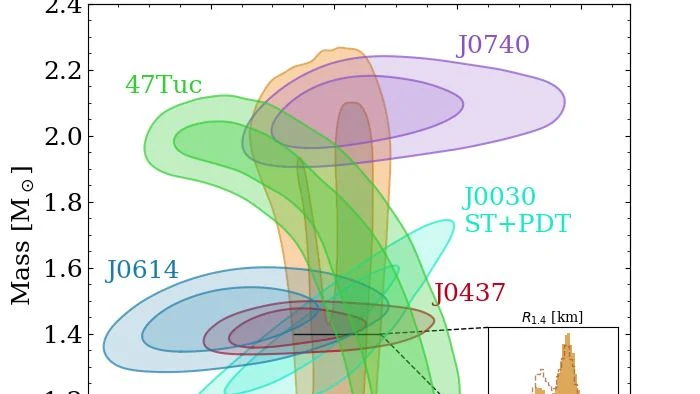
Neutron stars are the collapsed cores of massive stars that exploded as supernovae. They pack more mass than the Sun into a sphere only about 20 kilometers across, making them the densest visible objects in the universe. Their internal structure — the arrangement of neutrons, protons, and possibly exotic particles like hyperons or quark matter — determines how mass and radius relate, which is a key observable constraint for nuclear physics at extreme densities.
History
The concept of neutron stars was proposed by Walter Baade and Fritz Zwicky in 1934, shortly after the discovery of the neutron. The first confirmed detection came in 1967 with the discovery of pulsars by Jocelyn Bell Burnell and Antony Hewish.
How it works
The structure is governed by the equation of state (EoS), which describes how pressure and density relate inside the star. Gravity compresses the star until neutron degeneracy pressure and strong nuclear forces halt collapse. Measuring the mass and radius of neutron stars — for example, via X-ray observations or gravitational waves — allows astronomers to infer the EoS and test models of dense matter.
In practice
Neutron star structure studies inform nuclear physics models used in heavy-ion collision experiments and help calibrate theories of dense matter that apply to atomic nuclei.
Fun fact
A teaspoon of neutron star material would weigh about a billion tons on Earth.
A neutron star is what remains after a massive star explodes. Its matter is compressed so tightly that a teaspoonful would weigh billions of tons. Under such conditions, protons and neutrons can rearrange, and new particles (hyperons, similar to neutrons but containing a 'strange' quark) can appear.
Two nuclei with the same number of particles but different neutron skin shapes collide at speeds close to the speed of light. Ruthenium-96 and zirconium-96 are like twins, one with a slightly thicker coat. This difference changes how particles carry charge in the fireball of the collision.
The atomic nucleus is usually pictured as a dense ball where protons and neutrons are mixed together. But in some isotopes, neutrons can stick out far beyond this ball, forming a diffuse shell — a neutron halo. This is especially common in nuclei with many more neutrons than protons.
The calm surface of a lake suddenly ripples — somewhere in the depths, an underwater cliff has collapsed. The water trembles almost imperceptibly, and the circles spread wider and wider until they reach a bobber near the shore.
At the end of a massive star's life, its core collapses in a fraction of a second, giving birth to a supernova flash. This cataclysm shakes spacetime itself, emitting gravitational waves — ripples that race across the Universe.
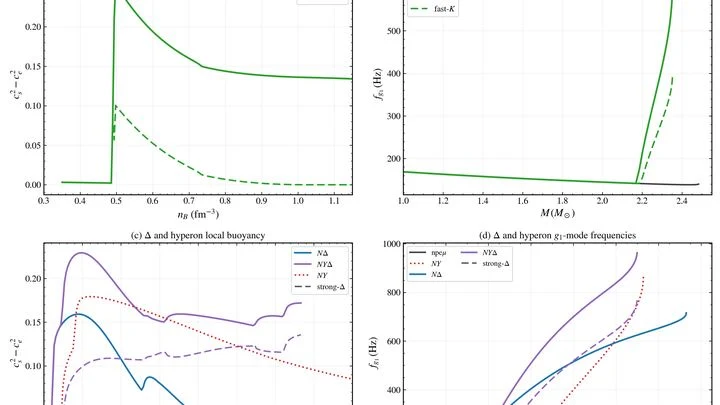
A neutron star is a boiling cauldron the size of a city but with the mass of one and a half Suns. Deep inside, matter is squeezed so hard that atomic nuclei lose their meaning. Strange forms of matter are born there: a kaon condensate (similar to a superfluid) and neutron stars with hyperons (heavy particles).
A neutron star is the collapsed core of a massive star, squeezed to the size of a city. A teaspoon of its material weighs as much as a mountain. But inside this superdense sphere, a surprise may lurk: under unimaginable pressure, neutrons break apart into quarks, giving the star a new, more compact core.
Neutron stars are the last clumps of visible matter before collapsing into a black hole. In their interiors, matter is squeezed to trillion-fold densities. Here, nuclear forces and gravity weave into an exotic substance inaccessible to any earthly particle accelerator.
The James Webb Space Telescope JWST has peered into the heart of supernova remnant SNR 0540-69.3 — what remains after a massive star died in a neighboring galaxy. Inside, amid the flying debris, astronomers saw a clear pattern: glowing clumps and voids arranged in a symmetric design.
A hot infant and a cold adult — the same neutron star looks different. Just born in a supernova explosion, it is scorching hot at tens of billions of degrees. But as time passes, it cools, contracting like cooling metal. For the star PSR J1012+5307, this transition means an almost twofold reduction in radius.
Neutron stars are the final chord in the evolution of massive suns. Born in the cataclysm of a supernova, they pack a mass comparable to the Sun's into a sphere the size of an earthly metropolis.
Somewhere in the galactic bulge, a massive star lies dormant, ready to trade quiet burning for collapse. Its core will exhaust its fuel, and in a fraction of a second, a neutron star or black hole will be born, releasing 10⁵⁸ neutrinos — almost all the energy of the explosion.
A neutron star is a city the size of Manhattan, compressed to such a density that a teaspoon of its material weighs as much as Mount Everest. To understand what it's made of inside, scientists measure its radius. But there's a catch: many measurements suffer from systematic errors, like trying to measure the height of someone who keeps fidgeting and bending over.
Tiny invisible bullets pass straight through the Sun, barely noticing its matter. These are axions — hypothetical particles so light and elusive that they are often compared to ghosts.
In the searing plasma of the newborn Universe, when space itself still rang with the echo of the Big Bang, objects may have emerged that challenge gravity itself. Not ordinary black holes — but electrically charged giants, astrons.
Every second, invisible projectiles from the depths of space pierce through us. These are cosmic rays — atomic nuclei accelerated to speeds nearly indistinguishable from the speed of light. Their energy is hundreds of millions of times greater than what our most powerful accelerators can achieve. Where does this monstrous force come from?
If an atomic nucleus is a family, then in an ordinary helium house live two protons and two neutrons, holding hands tightly. Now imagine that one family member is an oddball who loves to wander far from home.
When a massive star explodes, its remnants fly apart like fragments of fireworks. But how do we know how far away such an explosion occurred? Astronomers have found a way: they look at the gas clouds that these remnants collide with.
The idea is simple. Supernova remnants are often surrounded by clouds of cold molecular gas.
An atomic nucleus isn't always round. It can stretch out like a melon or flatten like a pumpkin. And its size depends on this shape — just as the size of a pie depends on the shape of the dough.
Scientists calculated the shapes and sizes of nuclei of berkelium isotopes — a heavy element produced in reactors.
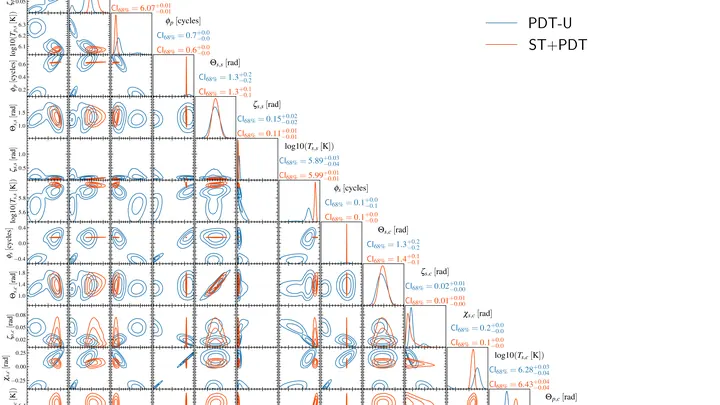
A neutron star is a sphere the size of a city but with the mass of the Sun. A single teaspoon of its material would weigh as much as a mountain. The star PSR J0030+0451 spins hundreds of times per second and emits narrow beams of X-rays. When a beam sweeps past Earth, we see a brief flash, like the light from a lighthouse.
When a massive star dies and explodes, it releases not only light but also invisible lightweight particles. They fly out in all directions at nearly the speed of light. Only a small fraction reaches Earth, but each explosion sends its own clump. These clumps stretch along the way: fast particles overtake slow ones, and by the time they arrive, a clump can be spread over tens of thousands of years.
In the binary system 4U 1700-37, the massive supergiant star HD 153919 sheds a powerful stellar wind. This wind, like an invisible stream, rushes toward its compact companion — likely a neutron star. As it falls, the matter heats to millions of degrees and flares in X-rays.
Inside a neutron star, matter is squeezed so tightly that a single teaspoon weighs as much as a mountain. Under such pressure, ordinary particles, protons and neutrons, can transform into exotic particles known as hyperons. These particles resemble neutrons but contain strange quarks.
When a massive star explodes as a supernova, its material slams into the surrounding shell of cosmic dust and gas, like an invisible fur coat. The impact spawns myriads of neutrinos, ghostly particles that zip through planets without swerving.
When a massive star runs out of fuel, it collapses and explodes as a supernova. An instant before the catastrophe, neutrinos — ghostly particles — burst from the core. They rush through the star and interstellar space like the smell of smoke, heralding a fire that will only ignite minutes or even days later.
A massive galaxy cluster acts as a giant lens. Its gravity warps the fabric of space, and the light of distant objects, bending around this curvature, is amplified and split into multiple images.
Inside a neutron star, matter is compressed to unimaginable densities. Previously, scientists speculated about its exact makeup, cycling through possible equations linking pressure and density. The new method tosses out guesswork: it directly ties the measurable mass and radius to the internal structure.
As early as Vera Rubin found that stars on the outskirts of galaxies move too fast — as if held by an invisible web. And Fritz Zwicky was the first to suspect that clusters of galaxies hide enormous invisible mass. Today we call it dark matter and try to understand what it's made of.