How to Weigh a Neutron Star Without Tricks express
A neutron star is a city the size of Manhattan, compressed to such a density that a teaspoon of its material weighs as much as Mount Everest. To understand what it's made of inside, scientists measure its radius. But there's a catch: many measurements suffer from systematic errors, like trying to measure the height of someone who keeps fidgeting and bending over. This was especially true for quiescent X-ray binaries — systems where a neutron star quietly siphons matter from a companion without producing bright flares.
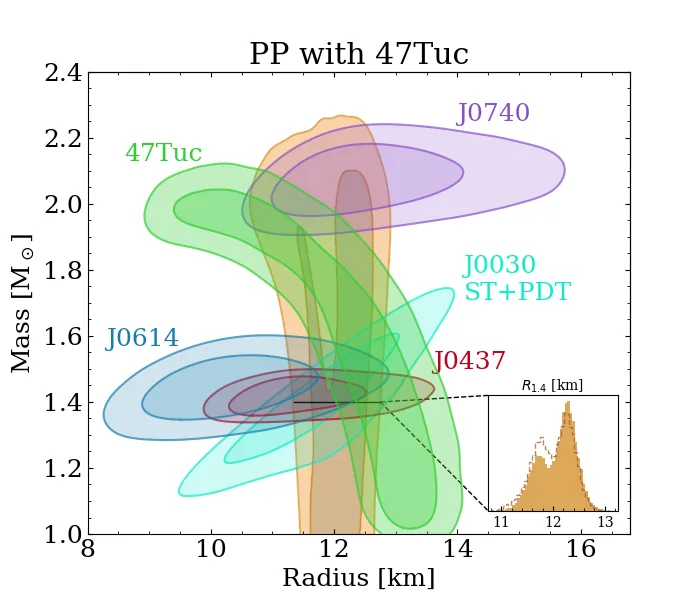
The authors took such a star, X7, in the cluster 47 Tucanae, and applied the X-PSI program. It honestly models the rotation and possible hot spots on the surface: those "fidgets and bends." The result: the radius of a star with a mass of 1.4 solar masses is 12.9 ± 0.4 km. That's like measuring the width of a hair to within a couple of microns while the hair is spinning in your fingers.
The big surprise: accounting for rotation and spots barely shifted the radius estimate (less than a percent) and didn't blur the uncertainty. So for X7, these effects are not critical, likely due to the long observations. This is good news: quiescent binaries, once considered finicky, can again become reliable rulers for measuring neutron stars. And a precise radius is the key to the equation of state, the central mystery: how does matter behave when squeezed harder than in an atomic nucleus?
So the old ruler is back in business. Now, by combining data from different sources, physicists can more accurately sketch the portrait of the densest matter in the universe.
A teaspoon of neutron star material weighs about 4 billion tons — roughly the weight of all humans on Earth packed into a thimble.