The solar radius is a standard unit of distance in astronomy, defined as the radius of the Sun. It is used to express the sizes of other stars, the distances of close solar approaches (such as comets or spacecraft), and the scale of solar system features. Because the Sun is not a solid body, its radius is defined as the distance from its center to the edge of its photosphere, the visible surface.
History
The concept of using the Sun's radius as a unit dates back to early telescopic observations in the 17th century, but the precise modern value was established through space-based measurements in the late 20th century.
How it works
The solar radius is measured by observing the Sun's angular diameter from Earth and combining it with the known Earth-Sun distance. The value is approximately 696,340 kilometers, or about 109 times Earth's radius. In practice, astronomers use this unit to compare stellar sizes and to describe how close objects come to the Sun's surface.
In practice
It is used in astrophysics to classify stars, model stellar structure, and plan spacecraft trajectories for solar missions.
Fun fact
The solar radius is not constant; it varies slightly over the Sun's 11-year activity cycle by a few kilometers.
Systems:SIA non-SI unit of length equal to the mean radius of the Sun, approximately 6.957e8 meters.
A light ray passing by a massive body slightly changes its direction, like a stream of water bending around a rock in a creek. In the solar system, there are many such "rocks": planets, their moons, asteroids. And each one, with its own gravity, bends the path of light coming from distant stars.
Cosmic rays aren't rays in the usual sense: they're fast particles bombarding Earth from all directions. Mostly they're protons and atomic nuclei. Their energies vary widely, from modest to fantastically huge. When such a particle heads our way and the Moon or Sun gets in its path, it gets absorbed.
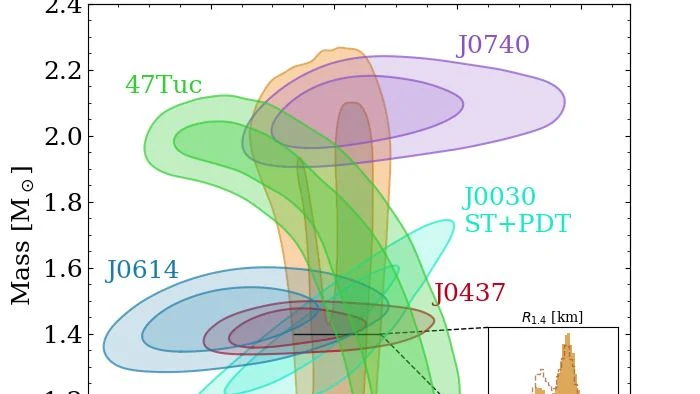
A cosmic "caliper" will soon measure a neutron star to within a hundred meters. For an object a couple dozen kilometers across, that's like measuring the thickness of a human hair from a kilometer away.
A neutron star is the remnant of an exploded supernova.
A neutron star is the collapsed core of a massive star, squeezed to the size of a city. A teaspoon of its material weighs as much as a mountain. But inside this superdense sphere, a surprise may lurk: under unimaginable pressure, neutrons break apart into quarks, giving the star a new, more compact core.
The cosmological debate is like two craftsmen measuring the same wall but getting different lengths. One uses a tape measure, applying it to nearby landmarks — Cepheids (pulsating beacon stars) and Type Ia supernovae (flashes of dying stars). He finds the wall is stretching at 73.5 arbitrary units.
Neutron stars are the final chord in the evolution of massive suns. Born in the cataclysm of a supernova, they pack a mass comparable to the Sun's into a sphere the size of an earthly metropolis.
Among the icy chunks hurtling through the void, there are special travelers — interstellar comets. They were born around distant stars and happened to wander into our neighborhood. One of them, 3I/ATLAS, came under the gaze of telescopes as it approached the Sun. Its material, frozen gases and refractory dust, began to evaporate, leaving a glowing tail behind.
A regular rangefinder sends a single light pulse and waits for it to return — like a person shouting into the void and listening for an echo. But if you use multiple sources that glow in unison, and analyze not the volume but the rhythm of the echo of reflected flashes, the picture becomes sharper.
A neutron star is a city the size of Manhattan, compressed to such a density that a teaspoon of its material weighs as much as Mount Everest. To understand what it's made of inside, scientists measure its radius. But there's a catch: many measurements suffer from systematic errors, like trying to measure the height of someone who keeps fidgeting and bending over.
Hydrogen is the most common element. Its atoms are like antennas: they emit and absorb light at very specific frequencies. Einstein predicted that spacetime can ripple: these are gravitational waves.
A stone falls into a pond — near the shore, the ripples are barely visible, while the water churns at the point of impact. The electric field around a charge behaves similarly: close in, it's sharp and tangled, but at a distance it stretches into a smooth wave that carries energy away. Physicists call this distant region the radiation zone.
Imagine a dark room with dust floating in the air. A bright flashlight goes off, and the dust particles light up, revealing their positions. Astronomers have applied a similar trick to our Galaxy. The flashlights were gamma-ray bursts, the most powerful explosions in distant galaxies, and the dust particles were interstellar clouds.
A galaxy is like a glowing pancake studded with stars. If you look at it face-on, you see everything at once — both the bright spiral arms and the dark dust lanes. But tilt the pancake, and the picture changes: layers overlap, light blends together. This very effect, it turns out, creates the illusion of a tight link between radio and gamma-ray emission in distant star systems.
The Sun is not a perfectly steady lightbulb. Its brightness quivers slightly: it dims a bit, then brightens. For Earth's climate, even slow variations stretched over thousands and millions of years matter. They could have left their mark in the geological record of the last 540 million years.
Astronomer [scientist:A. M.
Scientists search for planets around distant stars by detecting a slight wobble in the star's motion: the planet tugs on the star, making its light shift slightly toward the blue and then toward the red. But stars have their own ripples — dark spots and bright faculae on their surfaces. These also shift the light, making it hard to tell them apart from a planet.
Two spotlights placed side by side: from a distance, their light blends into one patch, and it seems there's a single source. The same happens in space: about 10–20% of faint stars are actually close pairs of identical stars. Individually, they can't be resolved, but together they shine noticeably brighter than a single star with the same parameters.
At night, the sky is never completely black. Even far from cities, the upper atmosphere glows faintly: sunlight makes hydrogen atoms emit a reddish glow that astronomers call geocoronal emission. For a telescope, it's like a fogged-up window: it adds extra light and hinders seeing distant galaxies.
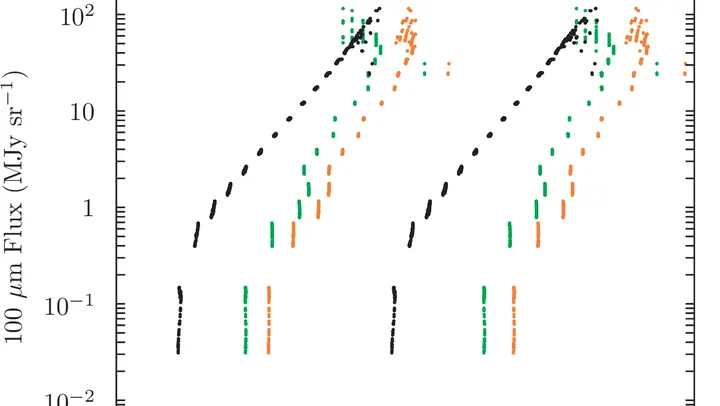
Dust in space is not just grime: it's the raw material for future stars and planets. But how it is distributed in our galaxy has long been a puzzle: dust is hard to measure directly, and it blocks the light of distant stars. Now astronomers have peered through this veil using data on five million stars: their brightness, color, and precise positions in the sky.
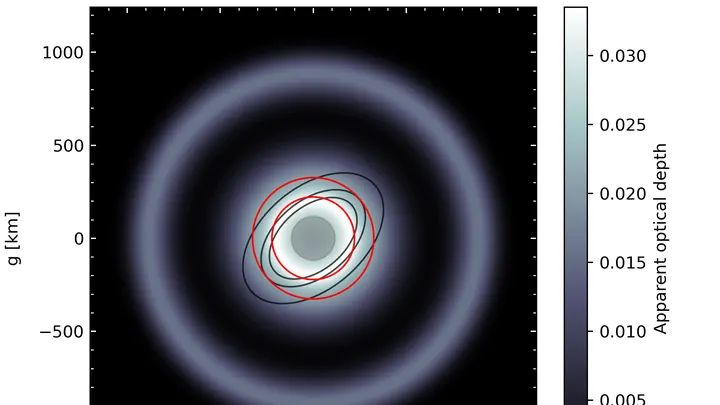
Only by passing in front of a star did Chiron reveal its secret. Three icy hoops encircle the 200-kilometer body — a hybrid of comet and asteroid. Previously, they were only hinted at by spectra of reflected light and brightness fluctuations.
The galaxy NGC 1560 is a modest island of stars and gas ten million light-years away. Its rotation curve, first measured in 1991, became an icon for those seeking an alternative to dark matter. The plot of rotation speed versus radius shows bends that seem to exactly mirror the bends in the distribution of ordinary matter.
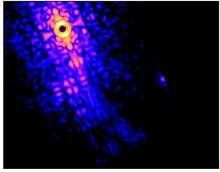
In August 2024, the MIRI coronagraph on the James Webb Space Telescope stared at Alpha Centauri A, the nearest Sun-like star to our Sun. At 1.5 arcseconds from the star, a point source, S1, blinked into view. Flux: 3.5 mJy, contrast: 5.5×10⁻⁵. Four to six sigma. A lighthouse flashing in the fog.
The Solar System takes 210 million years to complete one orbit around the center of the Milky Way. The last time we were on this same side of the Galaxy, early dinosaurs were roaming the Earth. That number, 243.72 km/s, has now been refined thanks to rare stars that streak through the Galaxy like cannonballs.
In the quiet harbor of the Local Bubble, a rarefied cavity of hot gas around the Sun, an explosion recently thundered. A supernova went off tens of parsecs away, and its echo still lingers in the neighborhood, reshaping the cosmic-ray landscape.