The neutron mass is the rest mass of the neutron, a neutral subatomic particle found in atomic nuclei. It is approximately 1.67492749804 × 10⁻²⁷ kilograms, slightly heavier than the proton. This small difference—about 1.29 MeV/c²—is crucial because it allows free neutrons to decay into protons, electrons, and antineutrinos, a process that powers beta decay and influences the stability of atomic nuclei.
History
James Chadwick discovered the neutron in 1932, and its mass was first estimated from nuclear reactions shortly thereafter. Modern precision measurements have refined the value to better than one part in a billion.
How it works
The mass is measured through precision experiments, often using Penning traps or time-of-flight techniques on cold neutrons. In nuclear physics, the neutron mass sets the energy scale for nuclear binding: the mass defect between a nucleus and its constituent protons and neutrons determines the energy released in fission or fusion. Its precise value is also a key input for the Standard Model, as it helps test the equivalence of inertial and gravitational mass.
In practice
The neutron mass is used to calibrate mass spectrometers, in neutron scattering experiments for materials science, and in nuclear reactor design to calculate criticality and energy output.
Fun fact
The neutron is about 0.1% heavier than the proton, and that tiny excess mass is what makes hydrogen atoms stable—if the proton were heavier, free protons would decay and atoms couldn't exist.
A neutron confined in a nucleus behaves differently from a free one. Its gluon cloud, which holds quarks together, compresses like a spring under load. Previously, this could only be assumed, but now physicists have directly observed the effect for the first time.
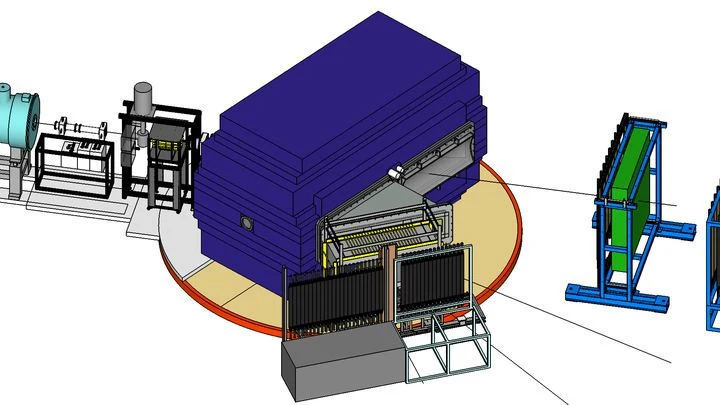
At Jefferson Lab, an electron beam struck liquid deuterium, knocking photons out of the nuclei.
The neutron is a particle that usually sits in the atomic nucleus and doesn't disappear. But some theories suggest that occasionally it might transform into its invisible twin — a particle that ordinary detectors can't catch.
Inside an atomic nucleus, protons and neutrons don't sit still like peas in a pod. Each particle occupies its own orbit — a region of space where it can be found. The larger the orbit, the more 'smeared out' the particle is.
Atomic batteries powered by plutonium decay have been running pacemakers and space probes for over sixty years. But the raw material is scarce: worldwide, only a few kilograms of plutonium-238 are produced each year, barely enough for the most critical missions.
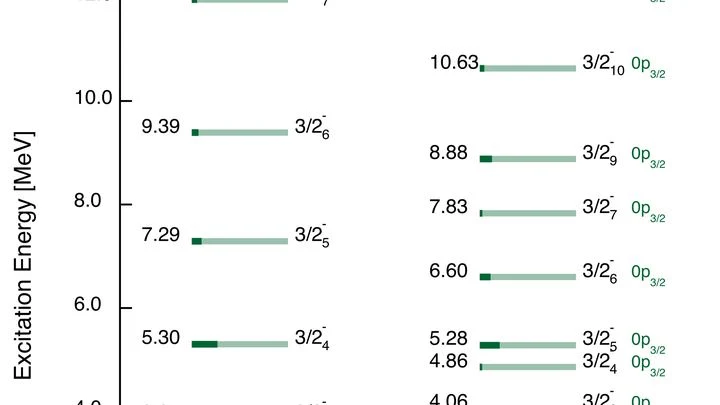
The atomic nucleus is not a bag of marbles but an ordered structure where protons and neutrons fill shells, much like electrons in an atom. When a shell is filled, the nucleus becomes especially stable, and the number of particles is called magic. For calcium with 20 protons, the classic magic neutron numbers are 20 and 28.
The atomic nucleus isn't always round like a billiard ball. Some nuclei stretch out like a rugby ball, while others become pear-shaped — with one end thicker than the other.
The atomic nucleus is usually pictured as a dense ball where protons and neutrons are mixed together. But in some isotopes, neutrons can stick out far beyond this ball, forming a diffuse shell — a neutron halo. This is especially common in nuclei with many more neutrons than protons.
A white dwarf is the former core of a star like the Sun, squeezed down to the size of Earth. A teaspoon of its material would weigh several tons. A neutron star is an even denser remnant: a city the size of Manhattan, but with more mass than the Sun.
In nuclear physics, a puzzle has long been nagging: why among elements lighter than bismuth, only technetium (No. 43) and promethium (No. 61) have no stable isotope at all? All their neighbors in the periodic table can boast at least one long-lived variant, but these two seem to fall out of the general pattern.
Through three minutes after the Big Bang, the Universe played its first symphony. It was the big bang nucleosynthesis — the formation of light nuclei, where each element sounded its own note, and the tempo was set by the expansion of space.
In a quiet room, you can hear the faintest whisper. Likewise, in the hydrogen atom, the lightest of all, an uninvited guest is easier to spot. That guest could be the Z' boson, a mediator particle of a new force predicted by many unification theories. The Standard Model already has its own mediator — the Z boson.
The neutron is one of the most neutral particles in nature. But if you add a special parameter to the laws of physics, called the theta term Standard Model, a tiny charge imbalance appears inside the neutron. One edge becomes slightly positive, the other slightly negative.
At the center of every atom lies a nucleus — a dense ball of protons and neutrons. These particles don't just crowd together randomly; they fill strict energy levels, much like floors in a skyscraper. When a floor is completely filled, the nucleus becomes especially stable — physicists call this a magic number.
In 2021, the LHAASO observatory registered gamma quanta with energies above a petaelectronvolt from sources like the Crab Nebula — a supernova remnant with a pulsating neutron star at its heart.
An electron flying through a heavy nucleus behaves like a tennis ball sent through a picket fence. If the pickets are unevenly spaced (denser here, sparser there) the ball will deflect differently.
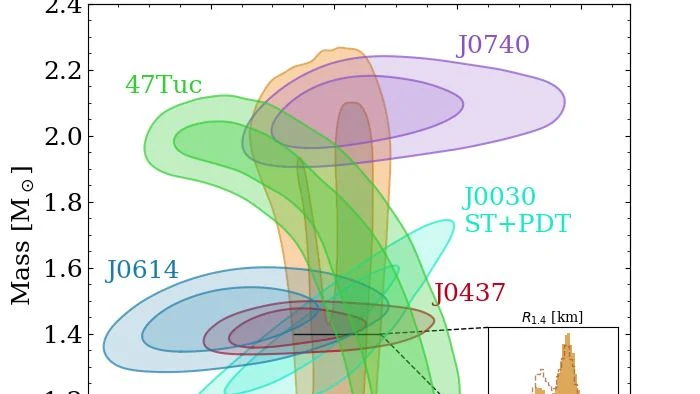
A neutron star is the core left behind after a massive star explodes. Its matter is so compressed that a teaspoonful would weigh billions of tons. But the exact size and mass of such objects remain debated. A team of astronomers studied the system EXO 0748-676, where a neutron star pulls matter from a normal companion star. It occasionally flares up and then quiets down.
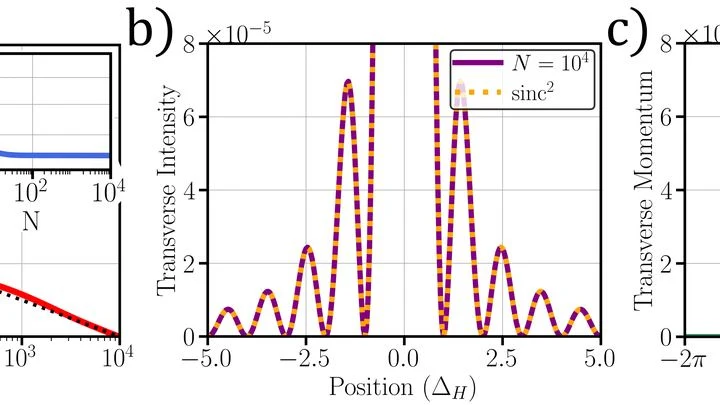
A stone falls into water, and ripples spread in all directions. Throw a handful of stones at once, and the ripples overlap: you can no longer tell which ripple came from which stone. A neutron beam hitting a detector looks much the same: a bright spot blurred by many causes.
In the depths of a neutron star, the remnant of an exploded star, matter is compressed so tightly that a teaspoon would weigh billions of tons. Within this superdense material, a special kind of force might be at work, one that affects only muon and tau neutrinos.
The Universe is a genius chef, and the Big Bang is its perfect recipe. Hydrogen rose fluffy, helium melted tender, but lithium-7 seems oversalted: theory predicts three times more than astronomers find in the oldest stars. This imbalance, the 'lithium problem,' has spoiled cosmologists' appetite for decades.
A neutron star is a city the size of Manhattan, compressed to such a density that a teaspoon of its material weighs as much as Mount Everest. To understand what it's made of inside, scientists measure its radius. But there's a catch: many measurements suffer from systematic errors, like trying to measure the height of someone who keeps fidgeting and bending over.
Light from a distant star seeps through a planet's gaseous envelope, and astronomers try to guess what that envelope is made of. That's how we study the atmospheres of worlds we can never touch. When a planet passes in front of its sun's disk, its gaseous veil briefly intercepts some of the rays.
The atomic nucleus is not a solid ball but a dense swarm of tiny particles called quarks, glued together by a special glue (the strong force). In light nuclei, such as calcium, this swarm is simply arranged: the numbers of the two quark types, up and down, are almost equal, like the white and black keys in an octave.
Hydrogen is the simplest atom: one proton and one electron. You'd think there's nothing left to study. But it's precisely on hydrogen that physicists test the most delicate laws of the microcosm. The electron in an atom can occupy different energy levels, like steps on a ladder.
Two tin nuclei collide at about two-thirds the speed of light. For an instant, a hot, dense cloud forms, and protons fly out in all directions. If you catch pairs of protons and measure how often they fly off in the same direction, you can work out the size of that cloud. This method is called femtoscopy: it works like a microscope for nuclear scales.
Inside the detector, which resembles a large thermos filled with germanium, faint flashes are born. Neutrinos, tiny particles that barely interact with matter, occasionally bump into germanium nuclei. The nucleus recoils, and the detector registers the jolt. But to distinguish a real signal from noise, the instrument needs precise calibration.
Imagine a multi-story building where protons and neutrons live on each floor. The floors are energy levels, and usually there's a stairwell of a certain height between the sixth floor and the one above — the so-called gap. In the oxygen-20 nucleus, this gap acts as a barrier that particles find hard to cross.
In the LHCb detector, where protons collide, one unusual track was found among billions of decays. The particle, named $$D_{s1}$$(2933)^+, appears for a moment and immediately decays into other particles. Its lifetime is so short that it cannot be observed directly — only through its decay products can its existence be reconstructed.
Nitrogen, the very gas we breathe, behaves like a finicky metal under a million atmospheres of pressure. In a diamond anvil cell, it is squeezed to 78–98 gigapascals and heated with a laser to 1800–2500 kelvin. Under these conditions, N₂ molecules rearrange into crystals that can store energy more densely than explosives.
Light twisted in one direction hits a proton. The particle can absorb the photon or deflect it — depending on how its own spin, a tiny internal top, is oriented. In the experiment at the MAMI accelerator in Mainz, a beam of polarized photons struck targets of polarized protons and deuterons (nuclei of heavy hydrogen).
Neutrinos are tiny particles that pass through the planet's bulk like light through a windowpane. Every second, billions of them fly through your pinky fingernail, but catching even one is no easy feat. To do it, scientists dug a two-kilometer-deep mine in Canada and installed the SNO+ detector.
Colliding two lead nuclei at the Large Hadron Collider is like throwing two hefty bags of marbles at each other. Usually, the marbles scatter in all directions, but sometimes one bag passes so close that the marbles don't collide: they just exchange glances.
In the basement of a laboratory in Jyväskylä, a trap holds a single atom aloft, like a magician balancing a ball on a fingertip. The tin-113 atom is unstable: sooner or later it captures one of its own electrons and becomes indium-113, emitting an elusive particle — the neutrino. How much energy is released in the process was previously known only approximately.
The neutron is a particle with no electric charge, making it tricky to catch: it slips through instruments like a bullet through fog. In typical experiments, it gets just one pass through a crystal, and all measurements must fit into that instant.
A new idea is to make the neutron loop inside a trap, like a ball bouncing between two walls.
A neutron star is the dead core of a star that once exploded, compressed to the size of a city. If a normal star is nearby, the neutron star siphons matter from it like a vacuum cleaner. This matter falls onto the surface and forms a crust — a solid layer of neutron-rich atomic nuclei.
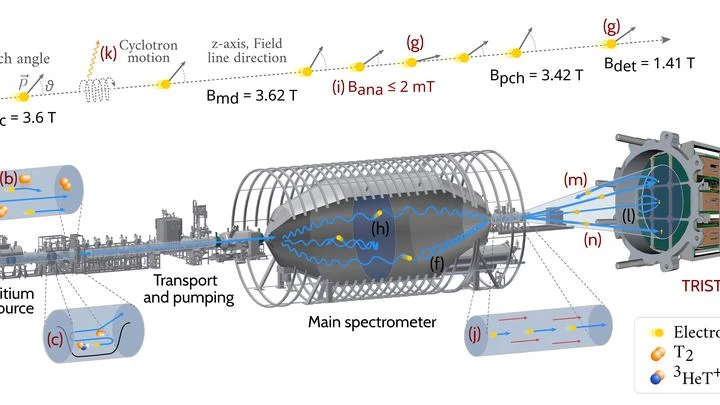
Radioactive tritium decays, emitting an electron. Its energy is almost always the same, but sometimes, just a little less. This shortfall could mean that alongside the ordinary neutrino, another, hidden particle was born.
The Standard Model describes three types of neutrinos, but scientists suspect there is a fourth — the sterile one.
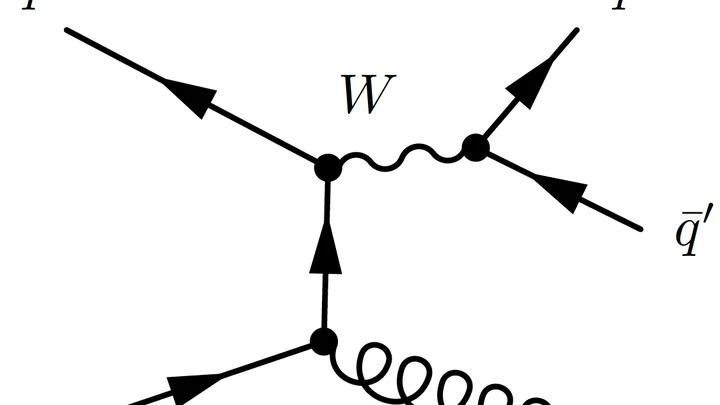
When a W boson, the particle that carries the weak force, decays into a quark and an antiquark, these two fragments fly off in nearly the same direction at the collider's immense speeds.
A tiny ghostly particle zips through a piece of germanium. Usually it leaves no trace, but sometimes, like a billiard ball, it smacks into an atom's nucleus. The nucleus recoils, and that jolt can be detected. At Oak Ridge National Laboratory, the Ge-Mini detector caught such recoils for two years.
Neutrinos are the most elusive of known particles.
Two dim stars whirl so close together that one siphons material off the other, like a spoon delicately skimming foam from broth. Astronomers have for the first time calculated the fate of such pairs — ultracool and brown dwarfs, the coldest and dimmest inhabitants of the galaxy. Previously, it was thought that mass exchange between them was impossible: they were too fragile.
A high-speed collision knocked a neutron out of a helium-8 nucleus, and for an instant a helium-7 nucleus appeared, like an overloaded shelf shedding three books at once. This fleeting 'sound' of decay was captured for the first time: three neutrons flew apart, leaving behind an ordinary helium-4 nucleus.
Scientists peered into a two-dimensional magnet made of nickel atoms arranged in triangles using a method created by Isidor Isaac Rabi — nuclear magnetic resonance (similar to MRI). Inside, they found magnetic arrows that, in a strong field, froze into an 'up-up-down' pattern, like a formation of soldiers: two steps forward, one step back.