Why the B-Meson Decay Behaves Strangely express
A basketball player almost always sinks the shot, but when he throws from the left corner, the ball flies wide. That's roughly how the B-meson behaves — a short-lived particle that sometimes decays into lighter ones. One of its decay channels — into a kaon (K) and a pair of muons (ll) — has long drawn attention: measurements show that one parameter, C9, is noticeably shifted negative, while its neighbor C10 stays put. It's like an invisible hand that adjusts only one color on a painting, leaving the rest untouched.
The authors took a model that extends the Standard Model (our best guide to particles) by adding new heavy neutrinos and a charged scalar particle — a kind of "pusher" that interacts with quarks. In this model, a special diagram emerges — a closed loop where quarks transform into each other via the new particles. The trick is that the contribution to C9 does not decouple even if the new neutrinos are very massive — that's the non-decoupling effect. Meanwhile, the contribution to C10 automatically vanishes thanks to a clever interplay of left- and right-handed interactions. That gives exactly what experimenters see: a shift in one place and silence in another.
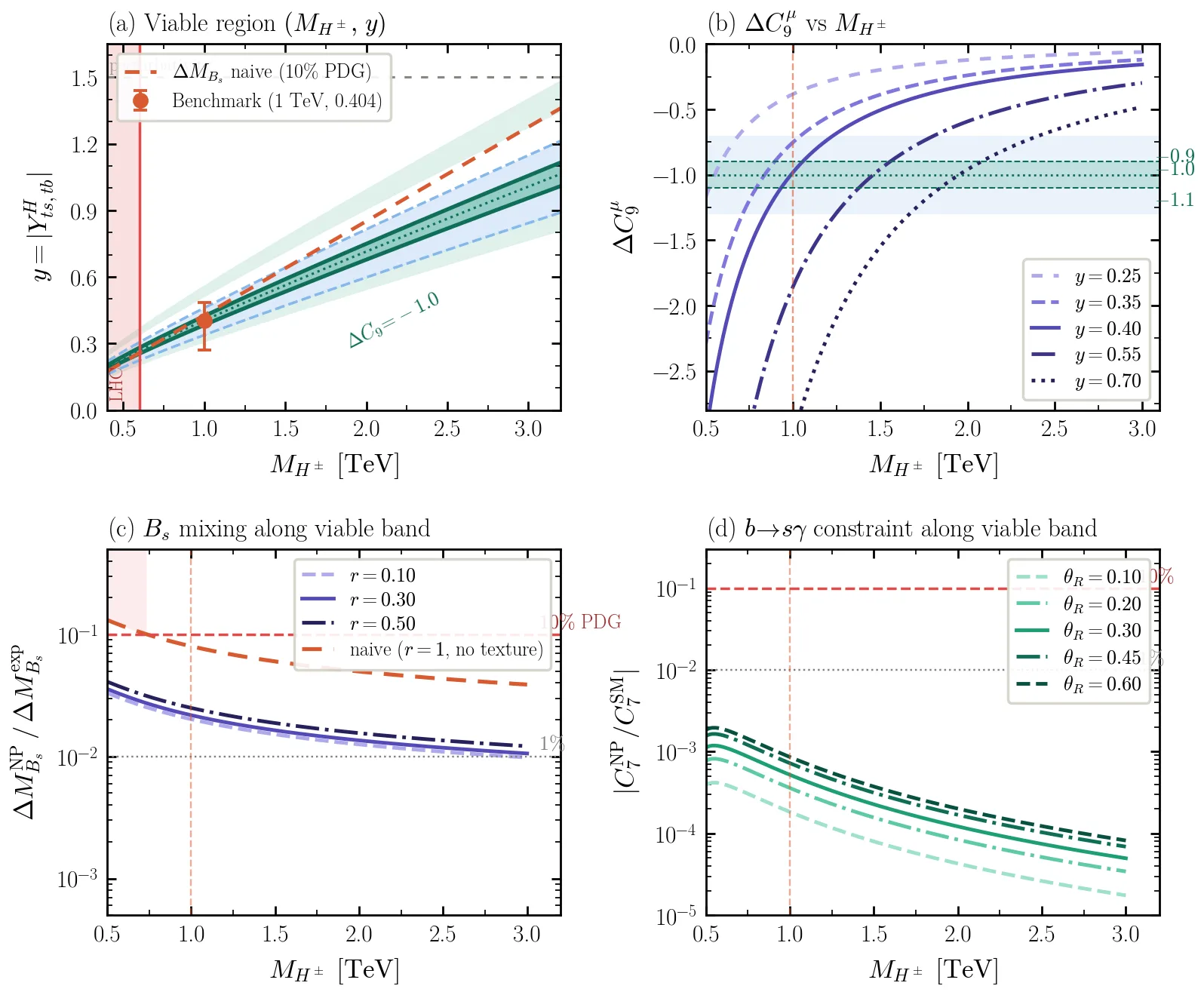
The calculations show that such a picture is possible over a wide range of parameters and does not contradict other measurements, including the b → sγ decay. Moreover, the new particles should be light enough to be caught at the Large Hadron Collider. If the searches succeed, the strange behavior of the B-meson will cease to be an anomaly and become a key to a new chapter in physics.
So one stubborn throw from the left corner can reveal the hidden rules of the game.
B-mesons live only about 1.5 picoseconds — in that time, light travels less than half a millimeter.
In the novel "The Three-Body Problem," subatomic particles behave unnaturally due to the intervention of an alien civilization — what a plot for an anomaly in B-meson decay!