A decay channel is a specific route by which an unstable atomic nucleus transforms into a different configuration, emitting particles or radiation along the way. For example, a nucleus might undergo alpha decay, beta decay, or gamma emission — each of these is a distinct channel. The concept is central to nuclear physics because it determines the products, energies, and timescales of radioactive processes, and it governs how matter evolves in stars, reactors, and detectors.
History
The term emerged in the early 20th century as physicists like Ernest Rutherford and Frederick Soddy classified radioactive emissions into alpha, beta, and gamma types. The modern understanding of multiple competing channels developed with quantum theory in the 1920s–1930s.
How it works
An unstable nucleus has multiple possible ways to shed excess energy or adjust its neutron-to-proton ratio. Each decay channel corresponds to a particular set of final particles and a characteristic probability, called the branching ratio. The nucleus effectively 'chooses' among channels based on quantum mechanical probabilities, which depend on energy barriers, angular momentum, and the available energy release. Once a channel is selected, the decay proceeds with a characteristic half-life, and the emitted particles carry specific energies that can be measured.
In practice
Decay channels are used in nuclear medicine (choosing isotopes with favorable decay paths for imaging or therapy), in nuclear power (predicting fission product yields), and in particle physics (identifying rare decay modes to test fundamental theories).
Fun fact
Some nuclei have decay channels that are so rare they have never been observed, with predicted branching ratios below one in a billion.
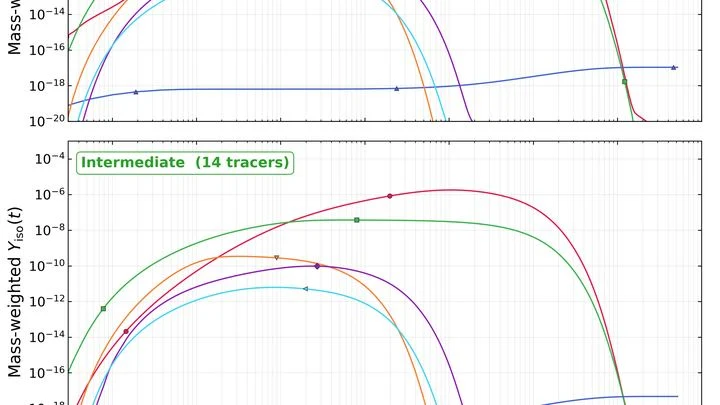
A collision of two neutron stars is a cosmic forge where the heaviest elements of the periodic table are hammered out in seconds. In 2017, detectors picked up gravitational waves from such a merger, and telescopes saw a flash — a kilonova.
The universe is like a vast warehouse where a strict inventory was taken long ago. The cosmic microwave background is an ancient record of everything in stock 380,000 years after the big bang. According to it, the fraction of matter in the cosmic 'budget' (the parameter Omega_m) is known with high precision.
When many excited atoms are gathered together, they often fire light in concert, like a crowd clapping in rhythm. This well-known phenomenon is called Dicke superradiance. But the authors of the new study asked: what happens if the atoms are not identical and each one feels its neighbors?
When hot soup cools, clumps form on the surface — similarly, as the early universe cooled, it gave birth to threadlike clumps of energy: cosmic strings. Some of them are like a stretched rubber band: as long as it's intact, it's stable. But if you nick the band, it snaps.
In a molecule resembling chlorophyll and built from carbon, a metal atom at the center acts as a toggle. Shifting it by fractions of a nanometer can make the molecule glow, quench, or boost its brightness a hundredfold.
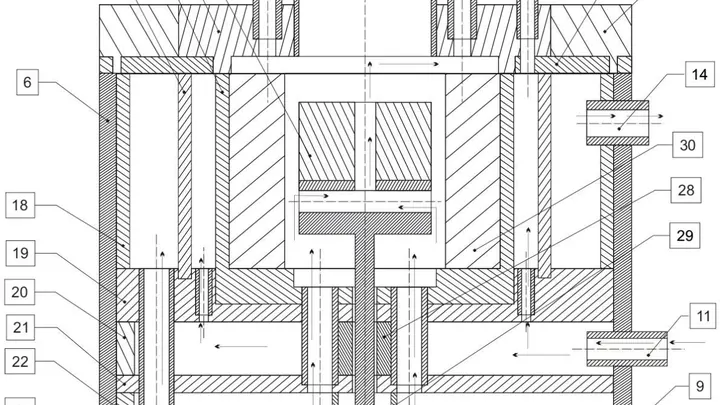
An ordinary nuclear reactor is like a boiler where fuel burns evenly throughout the volume. Here the picture is different: a fission wave, a narrow zone where atoms split and release heat, slowly creeps along a cylindrical rod of uranium carbide. Ahead of the wave, the fuel is untouched; behind, it is already spent. So fire runs along a candle wick, leaving wax behind.
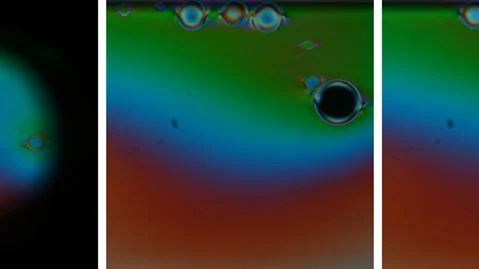
Molecules in a solution behave like a crowd in a square: they can jostle randomly or line up in neat rows. An aqueous solution of disodium cromoglycate is a well-known model for chromonic liquid crystals, where such 'rows' form spontaneously. But if you shine ultraviolet light on the solution, order collapses: molecules start breaking apart.
A neutron star is a city the size of a metropolis squeezed into a small asteroid. Around it, plasma, a gas of charged particles, seethes, and waves ripple through it like ripples on a pond. There are three kinds of waves: Alfvén (A), ordinary (O), and extraordinary (X).
In a metal crystal, atoms line up in neat rows like bricks in a wall. Knock out a single brick, and you're left with a void — what scientists call a vacancy. Under irradiation, these voids multiply and start merging into large holes, sapping the metal's strength. It's like holes in a brick wall joining up into a gaping breach.
In the air we breathe, invisible chemical events are constantly unfolding. One of them is the birth and instant death of a particle with the formula H₂COO. Known as an 'intermediate,' it appears for a split second when ozone molecules collide with organic compounds, then immediately shatters into simpler fragments.
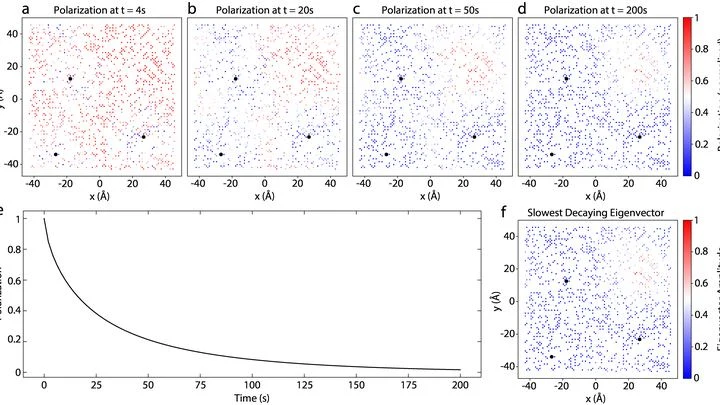
In the everyday world, order preserves and disorder destroys. But in quantum computing, this logic is turned on its head. Consider a diamond: carbon atoms with their nuclei and electrons behave like tiny magnets capable of storing a quantum "whisper"—information encoded in the orientation of their spins.
A quantum system, once born, does not forget it. Even after dozens of lifetimes, a trace of the initial state remains in its decay: a slowly decreasing power-law tail. For two fluorescent dyes, erythrosine B and eosin Y, this tail has been observed for the first time in two spectral channels simultaneously.