A B meson is a subatomic particle composed of a bottom quark and an antiquark, held together by the strong nuclear force. It is extremely short-lived, decaying within about 1.5 picoseconds (1.5 × 10⁻¹² seconds) into lighter particles. B mesons are studied extensively in particle physics because their decay patterns are sensitive to the subtle differences between matter and antimatter, known as CP violation, which may explain why the universe contains more matter than antimatter.
History
The B meson was discovered in 1977 at Fermilab by the E288 experiment, led by Leon Lederman, which found the upsilon particle, a bound state of a bottom quark and its antiquark.
How it works
B mesons are produced in high-energy particle collisions, such as those at the Large Hadron Collider, where protons smash together at near-light speeds. The bottom quark inside a B meson is heavy, about four times the mass of a proton, so it decays through the weak nuclear force into lighter quarks and leptons. By measuring the products of these decays, physicists can infer the properties of the B meson and test the predictions of the Standard Model of particle physics.
In practice
B mesons are used in particle physics experiments to study CP violation, search for new physics beyond the Standard Model, and measure fundamental parameters like the mass of the W boson.
Fun fact
B mesons can oscillate between their particle and antiparticle states billions of times per second before decaying, a phenomenon that provides a sensitive probe of quantum mechanics.
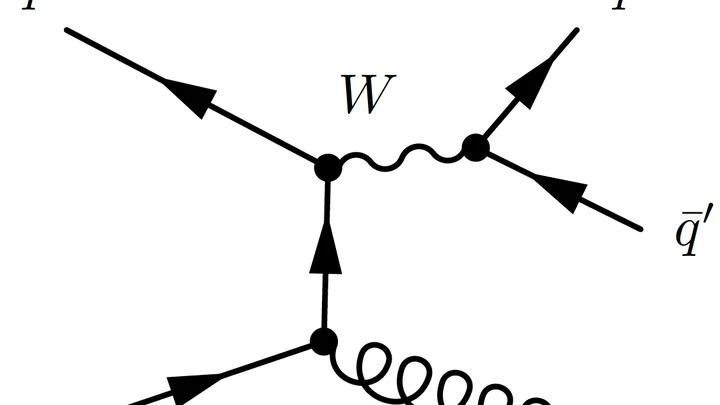
In the CMS detector at the Large Hadron Collider, protons accelerated to nearly the speed of light collided. Among billions of such collisions, physicists searched for a rare signature: the production of a single heavy particle that immediately decays into a W boson and a b quark.
Colliding two lead nuclei at the Large Hadron Collider is like throwing two hefty bags of marbles at each other. Usually, the marbles scatter in all directions, but sometimes one bag passes so close that the marbles don't collide: they just exchange glances.
When a W boson, the particle that carries the weak force, decays into a quark and an antiquark, these two fragments fly off in nearly the same direction at the collider's immense speeds.
Two twins look identical, but one is left-handed and the other right-handed. In the world of elementary particles, there are similar pairs: Ξ- and its antiparticle Ξ+. They are born together in the decay of the J/ψ particle and, like entangled twins, maintain a connection even at a distance.
In 2018, the Large Hadron Collider ran a special data-taking campaign: the CMS detector captured proton collisions at breakneck speed to collect ten billion particles containing a beauty quark.
In a particle accelerator, the anti-lambda particle is a rare guest. It is born on the fly, lives for a tiny fraction of a second, and usually decays on its own. But sometimes it manages to collide with an ordinary proton, and then a whole shower of light particles is born: kaons, pions.
In the LHCb detector at the Large Hadron Collider, protons collide, and for a fleeting moment, particles that don't exist in ordinary matter are born. One of them is the neutral B meson. It lives for less than a billionth of a second and decays into two other particles: the narrow resonance J/ψ and the broader ρ(770).
In the thirties, Pauli realized: without tiny ghost-like particles, the energy of stars doesn't add up. Thus neutrinos were born — intangible wanderers that permeate everything.