Right-handed neutrinos are hypothetical neutrino states that would interact with matter only through gravity, not through the weak nuclear force, making them extremely difficult to detect. In the Standard Model of particle physics, neutrinos are assumed to be massless and only left-handed, but the observation of neutrino oscillations implies they have mass, which requires the existence of right-handed neutrinos. These particles could be extremely heavy, explaining why they are not observed at low energies, or they could be light and sterile, interacting even more weakly than ordinary neutrinos.
History
The concept was introduced in the 1970s by several theorists, including Peter Minkowski, Murray Gell-Mann, Pierre Ramond, and Richard Slansky, as a natural explanation for neutrino masses via the seesaw mechanism.
How it works
In the theory of neutrino mass, right-handed neutrinos are introduced as partners to the observed left-handed ones. They can mix with left-handed neutrinos through a mass matrix, and in the seesaw mechanism, their heavy mass suppresses the mass of the left-handed neutrinos, explaining why neutrinos are so light. If right-handed neutrinos are light, they would be sterile, meaning they do not participate in weak interactions, and could only be detected through their gravitational effects or through oscillations with active neutrinos.
In practice
They are a candidate for dark matter and could explain the matter-antimatter asymmetry of the universe through leptogenesis, where their decays generate a lepton asymmetry that is converted to a baryon asymmetry.
Fun fact
If right-handed neutrinos are very heavy, they could have existed in the early universe and decayed, potentially creating the observed excess of matter over antimatter.
In nature's workshop, there is a strange lathe: it cuts threads on screws but forbids left-handed ones. You can tighten a screw as much as you like, in any clockwise direction, but counterclockwise is not allowed. This lathe is not a fantasy but an exact quantum rule that physicists have just built for magnetic materials.
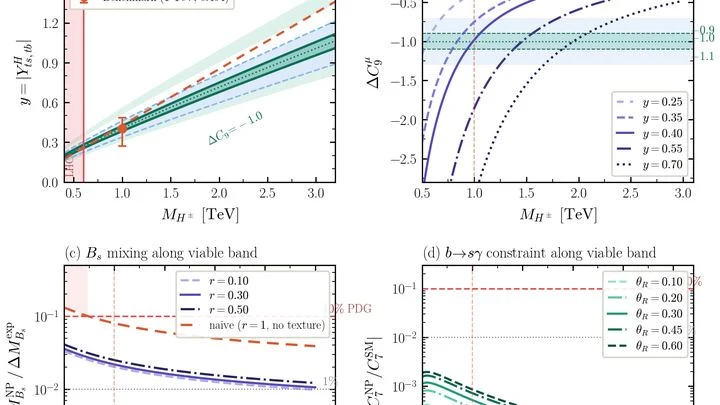
A basketball player almost always sinks the shot, but when he throws from the left corner, the ball flies wide. That's roughly how the B-meson behaves — a short-lived particle that sometimes decays into lighter ones.
Toss a handful of coins on a table: each one lands heads or tails on its own. Now imagine the coins start flipping over, nudging each other. That's roughly how neutrinos behave in a very dense environment.
In the first moments after the Big Bang, matter and antimatter should have been created in equal amounts. But today we see only matter — stars, planets, ourselves. Where did the antimatter go? One clue hides in nearly elusive particles: right-handed neutrinos. The usual story is that their decays create a slight bias in favor of matter.
Imagine the early Universe as a giant balloon, instantly inflated to incredible size. The tiny bumps on its surface are frozen quantum ripples that later became galaxy clusters. This rapid inflation left behind an ancient glow — a map of the sky that astronomers study.
Two ultra-thin sheets, each just one atom thick, are placed on top of each other and slightly rotated. Like two sheets of colored tracing paper: while they lie flat, the picture is one thing, but give them a twist and a moiré pattern appears. Here, though, the pattern isn't visible to the eye, but it completely changes how the material handles light.
The mystery of the missing antimatter has haunted physics since the mid-20th century. The Big Bang should have created equal amounts of matter and antimatter, yet today's world is almost entirely matter. The Standard Model is powerless to explain this baryon asymmetry — we need new particles and mechanisms beyond it.
In the first moments after the Big Bang, space boiled. A superheated substance permeating the world gave rise to giant bubbles of a new phase – much like a liquid produces vapor. Collisions of these bubbles accelerated particles to energies unimaginable in Earthly accelerators.
An electron flies out of a tritium nucleus with an energy of 18.57 keV, leaving behind an invisible partner: a neutrino. If that neutrino has access to a fifth dimension, its mass splits into a whole tower of states, and each one takes its own bite out of the spectrum.