object

scalar particle

A spinless particle, such as a hypothetical scalar, whose radiation is studied from black holes.
40 related articles

Description

A scalar particle is a particle with spin zero, meaning it has no intrinsic angular momentum. In the context of black hole physics, scalar particles are often studied as test fields that propagate in the curved spacetime around a black hole. The study of scalar radiation from black holes is a classic problem in theoretical physics, used to understand how black holes lose energy and angular momentum through the emission of particles, a process known as Hawking radiation.

History

The study of scalar fields in black hole spacetimes dates back to the 1970s, with key contributions by Jacob Bekenstein and Stephen Hawking. Hawking's 1974 derivation of black hole radiation used a scalar field as a simple model, and the subsequent 'greybody factors' for scalar emission were computed by many authors in the following years.

How it works

Scalar fields obey the Klein-Gordon equation, which in the background of a black hole can be separated into radial and angular parts. The radial equation has a potential barrier that partially reflects and partially transmits incoming waves. For a black hole, the event horizon acts as a one-way membrane: particles can fall in but not escape. However, quantum effects near the horizon cause the creation of particle-antiparticle pairs, with one particle escaping to infinity—this is Hawking radiation. The emission rate for scalar particles depends on the black hole's mass, charge, and spin, and the spectrum is nearly thermal.

In practice

Scalar field models are used in theoretical studies of black hole thermodynamics and in searches for new physics, such as ultralight scalar particles (e.g., axions) that could form clouds around rotating black holes and produce observable gravitational wave signatures.

Fun fact

The spectrum of Hawking radiation for a scalar field is not exactly blackbody; it is modified by the 'greybody factor' that depends on the frequency and the black hole's parameters, which is why the radiation is often called 'greybody' radiation.

Concept graph →

Related articles · 40

General Relativity2026-08-071 minarXiv:2608.07182express
Black Hole Cools Down and Freezes
A boiling kettle on the stove eventually boils dry — and so, according to the classical picture, a black hole should gradually vanish in a hiss of radiation. But what if you add a special ingredient to the kettle?
General Relativity2026-08-051 minarXiv:2608.04346express
Tiny Black Holes and Their Charge Jitter
A black hole is not an eternal vacuum cleaner. It slowly loses mass by emitting particles, much like a heated stone cooling as it radiates heat. This process, discovered by Stephen Hawking, is barely noticeable for large holes, but for tiny ones, with masses comparable to a mountain, it becomes a violent evaporation.
General Relativity2026-08-011 minarXiv:2608.00557express
Cauchy Horizon: Why It Survived
A black hole is like a perfectly smooth sphere. It has no features — only mass, charge, and spin. This rule is called "no-hair." But nature loves to complicate things: sometimes a cloud of a scalar field (a special field described by a single number at each point) spontaneously appears around a black hole.
HEP Theory2026-08-011 minarXiv:2608.00590express
Black Holes as Bridges to the Dawn of the Universe
A black hole is not just an abyss. It is a seething cauldron whose temperature rises as it evaporates. The authors of the study found that when the heat reaches a critical threshold, the hole seems to boil. It emits superheavy particles — the very ones that exist on a scale where any theory of gravity collapses.
HEP Theory2026-07-311 minarXiv:2607.29028express
The Thermal Breath of a Black Hole
A black hole is not an absolutely black bag. In 1974, Stephen Hawking showed that it glows — faintly, but continuously. This radiation is born not inside, but outside, right at the boundary from which even light cannot escape. A new study sharpens the picture.
General Relativity2026-07-262 minarXiv:2607.23776express
A Black Hole with a Curved Momentum Space
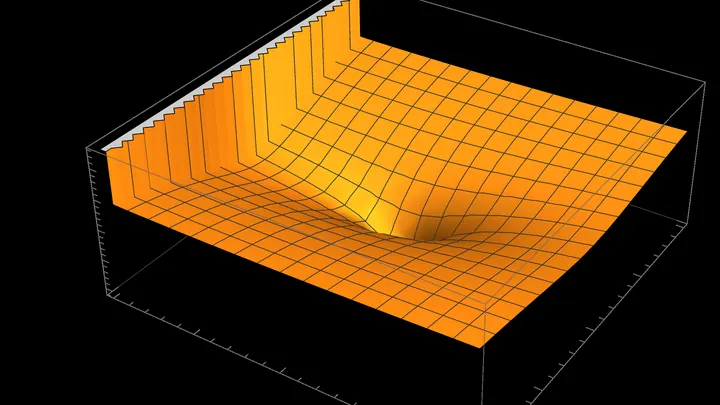
In a two-dimensional universe, a black hole looks like a funnel in spacetime. But the authors of the new work went further: they proposed that the space where particle momenta 'live' is also curved, like a saddle.
General Relativity2026-07-212 minarXiv:2607.18920express
How a Black Hole Steals a Cloud of Dark Matter
A swarm of tiny invisible particles, like a cloud of pollen, drifts through space. A black hole sits in its path. Some particles fall in and vanish forever; others swing around the trap and fly away. The physicists built a map showing exactly how much matter gets swallowed and how much survives.
General Relativity2026-07-201 minarXiv:2607.17520express
How Quantum Black Holes Shed Their Weight
A black hole is not eternal. Even in a perfect vacuum, it slowly loses energy — a process known as Hawking radiation. Quantum effects near the event horizon create pairs of particles, one of which escapes, carrying away some of the black hole's mass.
Polarization Trio: Why Black Holes Sing in Three Voices
The event horizon's edge is never calm. Quantum vacuum boils there, and particles sometimes burst out of this foam: that is how Stephen Hawking in 1974 discovered black hole radiation, forever linking gravity with quantum field theory.
Black Hole Antenna: The Electromagnetic Echo of Evaporation
The agony of a solitary black hole lasts forever. But in its final moments, as its mass evaporates according to the law discovered by Hawking, it manages to send a radio farewell signal. Not a quantum whisper, but a classical hum — if only there's a magnetic field nearby.
A Top on the Abyss's Edge: How Polarized Light Betrays Black Hole Spin
At the hearts of many galaxies, cosmic tops of incredible power spin — supermassive black holes. Their nature was first described by Schwarzschild right after Einstein gifted the world with general relativity.
General Relativity2026-07-122 minarXiv:2607.10658express
A Black Hole in Polarized Glasses
A black hole is not just a dark silhouette against the stars. Its shadow is surrounded by a thin glowing ring of photons that loop around the event horizon before escaping to an observer.
General Relativity2026-07-082 minarXiv:2607.07955express
Cosmic Mirage: How Smearing Mass Changes a Black Hole's Shadow
At the center of an ordinary black hole, according to classical ideas, lurks a singularity — a point of infinite density where the laws of physics break down. But some theories, inspired by the duality idea from string theory, propose replacing the point with a tiny 'smudged' region.
General Relativity2026-07-041 minarXiv:2607.03938express
A Black Hole as a Heat Engine
A black hole's interior is layered like an onion. In the new model, instead of an infinite point at the center, there are three regions: a dense core, a transition layer, and a crust just below the horizon. All arise from a single field that interacts with itself.
General Relativity2026-07-011 minarXiv:2607.01118express
How Black Holes Actually Glow: A Simple Discovery
A black hole is not just a vacuum cleaner. It glows faintly, emitting particles — this idea was proposed by Jacob Bekenstein, who connected the hole's temperature to its degree of disorder. Detecting such radiation in space is incredibly difficult.
HEP Theory2026-06-291 minarXiv:2606.30794express
A Black Hole in a Fluffy Fur Coat
An ordinary black hole is surrounded by a thin photon sphere — a place where light can loop around before falling in or escaping. In the new work, this region has puffed up into a whole layer packed with massless particles that zip around at nearly the speed of light and don't press against the walls.
General Relativity2026-06-281 minarXiv:2606.29307express
Quantum Ripples Around a Black Hole
A textbook black hole resembles a perfectly smooth sphere: everything outside it calmly flies off to infinity. However, quantum gravity paints a different picture. Recently, within loop quantum gravity, a solution was found — a 'Kruskal' black hole where spacetime beyond the horizon behaves differently.
General Relativity2026-06-192 minarXiv:2606.21549express
Charge Turns Bald Black Holes Hairy
Two magnets collide in a dark room, stick together into a clump, and a dull thud echoes. Black holes behave much the same way, except instead of magnets they carry electric charge, and instead of a thud, there's a burst of gravitational waves. But there's a third player in this story — an invisible field that physicists call scalar.
General Relativity2026-06-152 minarXiv:2606.16125express
General Relativity2026-06-151 minarXiv:2606.17178express
How a Pair of Black Holes Creates Particles from the Void
Two black holes circle in a slow dance, gradually drawing closer. Their motion perturbs spacetime itself, like two heavy balls rolling on a stretched sheet, making it tremble. These tremors are what we call gravitational waves.
High Energy2026-06-101 minarXiv:2606.12518express
Black Hole Spin Paints a Polarization Pattern
A spinning top whirling so fast that it forces light around it into spirals: that's a fitting image for what happens near a black hole's horizon. Hot plasma falls in and emits radio waves. Their polarization (the plane in which the wave oscillates) becomes an arrow pointing in the direction of energy flow.
General Relativity2026-06-091 minarXiv:2606.10792express
A Black Hole from Nothing
Emptiness can surprise you. In general relativity, there is a solution where space itself gives birth to a black hole — literally from a point. It all starts at the moment when the event horizon (the surface from which not even light can escape) appears with zero radius and immediately begins to grow.
General Relativity2026-05-251 minarXiv:2605.25671express
Dark Stars as Beacons of an Invisible Field
Drop a stone into a pond, and ripples spread outward. Something similar happens inside compact clumps of dark matter when they encounter a special medium — a scalar field. This field, which pervades everything around us, can spontaneously intensify in the depths of such objects, much like ripples on water growing ever taller and more pronounced.
HEP Theory2026-05-231 minarXiv:2605.24487express
HEP Phenomenology2026-05-201 minarXiv:2605.21474express
Why baby black holes didn't put on a gravitational concert
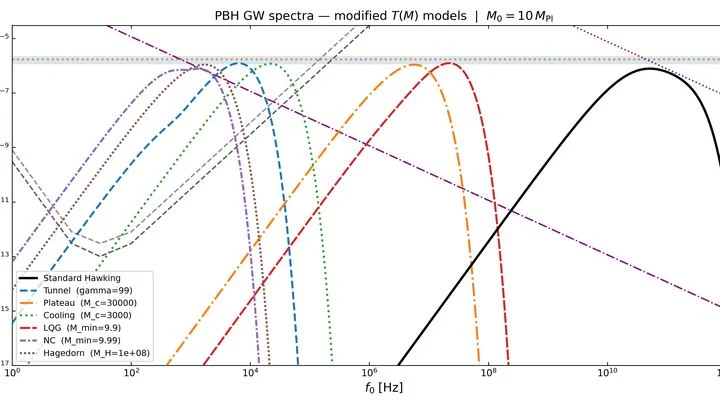
In the early Universe, primordial black holes emerged — objects no larger than an atom but with the mass of a mountain. They gradually evaporate and, before disappearing, should produce gravitational waves — ripples in spacetime. If they were all identical, they would pop simultaneously, like popcorn kernels: the roar would be deafening.
Polarization Echo: Light Catches the Gravitational Ringing of a Black Hole
When two black holes merge, they shake the very fabric of spacetime. The newborn giant doesn't settle instantly (it rings like a cosmic bell, emitting a characteristic pattern of damped gravitational waves) the so-called ringdown.
General Relativity2026-05-102 minarXiv:2605.09756express
Silent Black Holes: Why Geometry Without Einstein Mutes Radiation
If you shrank an ordinary black hole to the size of a grain of sand, it would shine like a tiny star and quickly vanish in a flash. That's Stephen Hawking's prediction: the event horizon acts like a hot surface emitting particles.
HEP Theory2026-05-052 minarXiv:2605.03277express
Black Holes Hum Continuously, Not Just Ring Like Bells
A stone falls into a pond, and ripples spread across the water. If the pond is choppy, with waves coming from all directions, the pattern gets more complicated. That's roughly how spacetime behaves around a black hole when something perturbs it: it vibrates, emitting gravitational waves.
HEP Theory2026-05-042 minarXiv:2605.03015express
Black Holes Born from Nothing, Then Die
Water boils in a pot, and bubbles rise from the bottom. They grow, float up, and pop, and the water remains water. Something similar, physicists have found, can happen to space itself — if it contains dark energy (the mysterious force accelerating the expansion of the universe). In such an eternally inflating universe, black holes are sometimes born.
General Relativity2026-05-032 minarXiv:2605.01934express
A Black Hole with Magnetic Charge
A magnetic field can hold a star against complete collapse: that's the idea behind a new kind of black hole. Instead of the usual point of infinite density, inside there is a field that prevents space from crunching down to zero. It's like a spring: the harder you squeeze, the more it pushes back.
General Relativity2026-04-302 minarXiv:2604.27811express
Black Holes That Grow Scalar 'Hair' from Rapid Spin
A top spun to its limit changes the air flow around it — the air swirls differently than around a barely spinning top. Black holes in some extended theories of gravity behave similarly. When a hole spins fast enough, the curved spacetime near its poles acquires new properties.
Cosmology2026-04-231 minarXiv:2604.21520express
The Rhythm of Black Holes from the Early Universe
Drops from a leaky faucet beat a clear rhythm. A similar rhythm, only on the scale of the universe, has been found by astrophysicists: the formation of primordial black holes — tiny objects born in the first moments after the Big Bang — also proceeds not chaotically, but in a strictly measured way.
High Energy2026-04-061 minarXiv:2604.05085express
Reflected Light from a Black Hole Reveals Its Secrets
Light reflecting off the scorching disk around a black hole can reveal more about it than we ever thought. When the disk emits heat, some of that light bounces back onto the disk and scatters, acquiring an unusual energy distribution, as if a new component, resembling a power law, is added to the ordinary glow.
HEP Phenomenology2026-03-031 minarXiv:2603.02493express
Gravitational Waves Will Unveil Quantum Gravity
Primordial black holes behave like boiling kettles: as they evaporate, they whistle gravitational waves. The character of the whistle, its spectrum, depends on how the hole's temperature relates to its mass.
Statistical Mech2026-02-042 minarXiv:2602.04593express
Hawking Radiation on a Tabletop
A black hole is a place from which even light cannot escape. But quantum theory says it still glows faintly. This glow is called Hawking radiation. In space, it's impossible to spot: it's too faint. So physicists build models of black holes from ordinary materials.
General Relativity2025-12-081 minarXiv:2512.07364express
Vortons: Invisible Rings of Dark Matter
Vortons are invisible cosmic hoops, closed loops of curved spacetime. Thinner than an atom but heavier than stars, these Big Bang relics spin like giant carousels, churning everything around them. Einstein's equations describe how particles dance near such a hoop: paths twist into spirals or dart chaotically.
Fluid Dynamics2025-11-071 minarXiv:2511.05351express
How a Whirlpool in a Cup Becomes a Black Hole Bomb
When liquid is swirled in a cup, a vortex with an empty center forms. In this empty core, waves find a trap: bouncing off the walls, they siphon energy from the vortex and grow like a flame along a fuse — each wave stronger than the last, until a surge breaks loose. Astrophysicists have described the same chain reaction around black holes.
HEP Theory2025-10-291 minarXiv:2510.25852express
A Black Hole Cooks Up Radiation Like a Pot of Soup
The 'double copy' method in physics is a culinary trick: a chef takes a cold soup recipe, doubles the ingredients, and gets a recipe for a hot roast. Likewise, particle interactions via electric forces (the basis of the Standard Model) morph into gravity, which describes spacetime curvature.
Echo Sounder of the Abyss: How the Fall Spectrum Betrays Black Hole Mimickers
A gravitational-wave detector catches not only the roar of mergers but also the quiet splash when a star or gas cloud dives into a supermassive black hole. Such a dive, like a stone falling into a well, generates waves at all frequencies at once—and in that spectrum lies encoded the nature of the well itself.