Comet Spice: How a Late Influx of Matter Reshaped the Outer Solar System ✦
Original: "Late infall of molecular cloud material reshaped the outer Solar System"
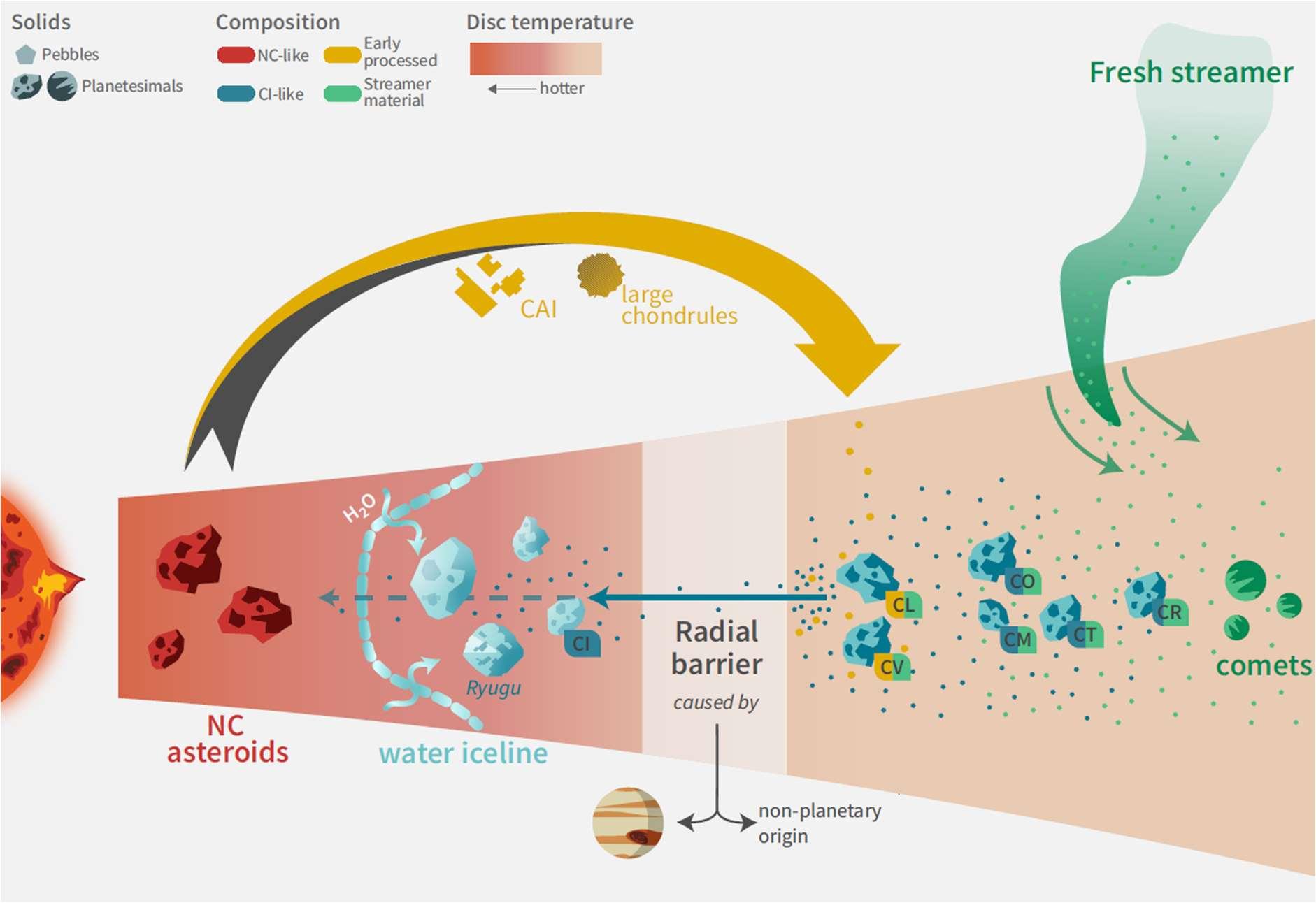
Isotopic analysis of meteorites reveals that the gas giants pulled in more than 30% comet-like material, and that the parent bodies of asteroids like Ryugu took shape right at the water ice line.
Links in the knowledge graph 1
Ryugu and Bennu aren't messengers from the icy abyss. Their isotopic fingerprint says they formed at the snow line, where water turns to ice. Then comet stuff flooded the disk—like a spice that forever changed the dish's flavor. This rewrites the story of Earth's water delivery: maybe it came not from distant cold, but from a local buffet. Samples from Hayabusa2 and OSIRIS-REx will reveal the details.
🎯 CI meteorites are the rarest of space visitors: their porous structure is so delicate that, upon atmospheric entry, they often crumble like dry biscuits. Surviving samples are genuine treasure troves, recounting the birth of planetesimals right at the snow line.
\varepsilon_{\text{sample}}^{54\text{Cr}} = f \cdot \varepsilon_{\text{CI}}^{54\text{Cr}} + (1-f) \cdot \varepsilon_{\text{ODD}}^{54\text{Cr}}
The measured isotopic anomaly is a weighted average of two dust sources: CI-like and cometary (ODD).
t = \frac{1}{\lambda} \ln\left( \frac{(^{26}\text{Al}/^{27}\text{Al})_0}{(^{26}\text{Al}/^{27}\text{Al})_{\text{sample}}} \right)
The accretion age is determined from the decay of short-lived aluminum-26; yields ~2.5 million years after the first solids formed.