Late influx of material from a molecular cloud reshaped the outer Solar System ✛ ✦
Context
Understanding the physico-chemical evolution of the outer protoplanetary disk is critical for explaining the origin of Earth and its reserves of water and organics. Traditionally, it was believed that dust in the disk mixed weakly, and CI-type asteroids formed at large heliocentric distances. However, new data cast doubt on this picture.
Methods
The team used multi-collector inductively coupled plasma mass spectrometry (MC-ICP-MS) — a form of isotopic spectroscopy — to measure variations of Si, Fe, Mg, and Cr isotopes in 14 anomalous and 6 classical carbonaceous chondrites. Samples were crushed, chemically purified, and analyzed with high precision. In parallel, petrographic analysis was performed to assess the chondrule-to-matrix ratio.
Results
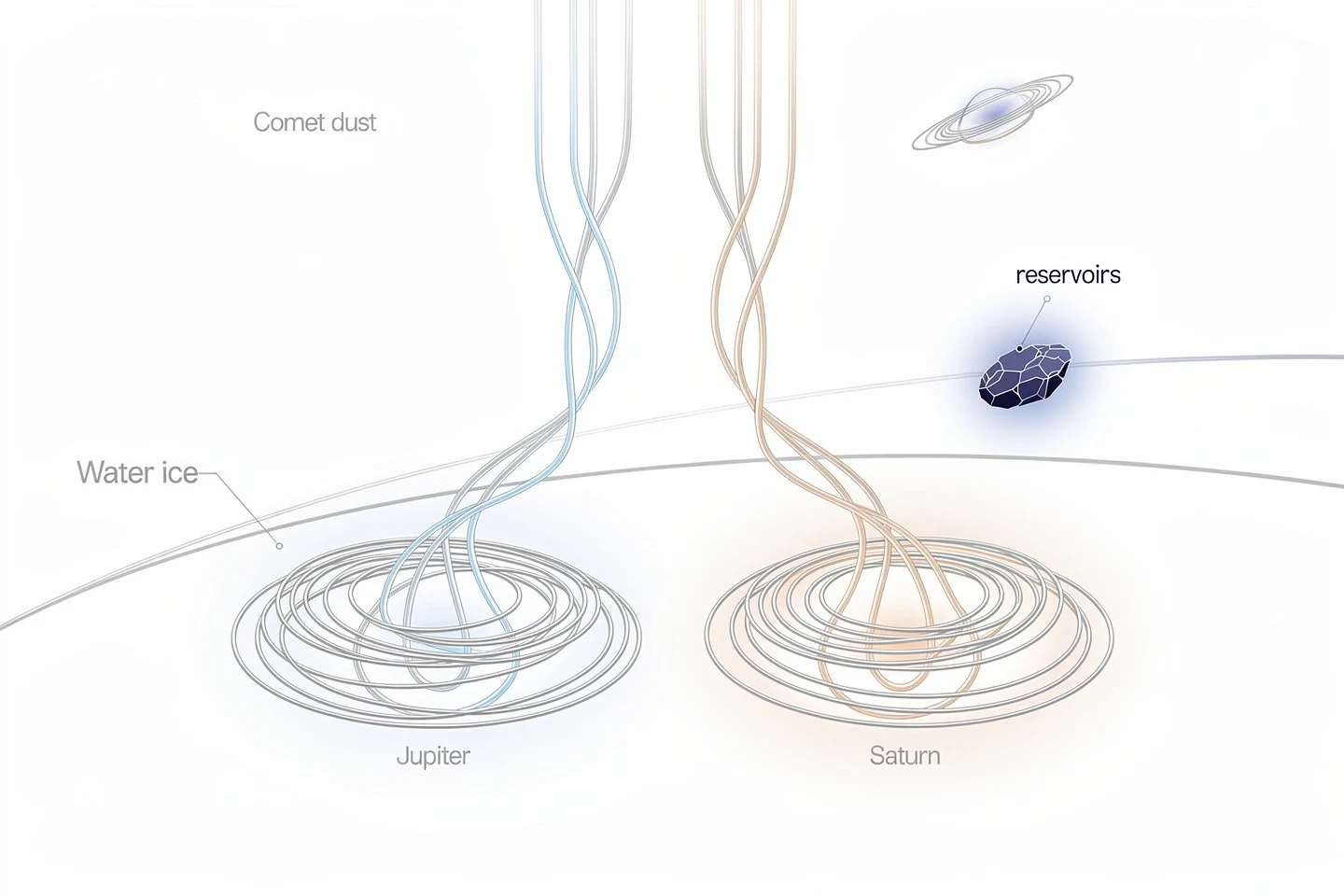
Isotopic compositions aligned along mixing lines between two components: CI-like dust and material close to comets (ODD — cometary dust). The contribution of the latter exceeds 30% for outer disk chondrites. Importantly, the isotopic variation in Cr54 is linked to thermal processing of ices containing ammonia and carbon dioxide, not to different dust origins. CI chondrites, including asteroids Ryugu and Bennu, show partial loss of Cr54-rich ices, indicating formation near the water ice line rather than in distant cold regions. Chondrule transport from the inner to the outer disk was limited to only large objects in CV chondrites.
Implications
The discovery means that water and prebiotic organics delivered to terrestrial planets came not directly from the outer disk, but from a population of planetesimals formed near the ice line. This revises the Earth accretion scenario and requires refinement of exoplanetary system models. The role of cometary material in Earth's atmospheric composition, previously estimated from noble gases, remains limited.
Future development
Further research will focus on isotopic dating of chondrules and analysis of particles from missions to asteroids Hayabusa2 and OSIRIS-REx. Pinpointing the arrival time of the streamer flow from the molecular cloud and modeling ice migration will enable reconstruction of the early Solar System history with unprecedented detail.
Impact
The work impacts theories of planetary system formation, interpretation of spectroscopic observations of protoplanetary disks, and understanding of the chemical inheritance of stellar nurseries. In astrobiology, it clarifies the delivery pathways of volatiles to Earth-like worlds.
Next steps
Improve the temporal resolution of accretion events by analyzing more chondrules with known ages and obtain direct isotopic data on the ice component from returned comet samples.
Key open problems
The results tie into unsolved problems: the nature of nucleosynthetic anomalies, the mechanism of dust reservoir separation in the disk, and the origin of water on Earth. The proposed model reconciles isotopic data with astrophysical observations of accretion filaments.
The knowledge machine's view
This section is addressed to the author of the paper and their colleagues. Neighbouring works were found by meaning-based search across our archive, not by word overlap. We do not review: we show the field around the work.
What the work does
The authors performed high-precision isotopic analysis of Si, Fe, Mg, and Cr in 14 anomalous and 6 classic carbonaceous chondrites using MC-ICP-MS and petrography. They found that the outer disk material consists of more than 30% of a component close to cometary dust (ODD), and that CI chondrites (including Ryugu and Bennu) formed at the ice line, not in the distant cold regions.
Where its strength is
The study combines high-precision isotopic data for multiple elements with petrography, allowing the separation of nucleosynthetic anomalies from thermal processing of ices. This provides a new model for the delivery of water and organics to the inner solar system via planetesimals formed at the snow line.
Where it could go next
- It might be interesting to compare the obtained picture of planetesimal formation at the snow line with models for the origin of hot Jupiters, which, as shown in a neighboring work, also form beyond the snow line and migrate inward. This would test how universal the role of snow line migration is in early planetary systems.based on: Icy Origins: Most Hot Jupiters Come from the Cold arXiv:2607.15144
- A nearby work discusses the effect of late gas infall on the chemical composition of young stars. One could consider how the late influx of material from the molecular cloud, as proposed in your model, affects the chemical evolution of the protoplanetary disk as a whole.based on: Chemical Portrait of a Young Star: When Infalling Gas Paints Patterns arXiv:2607.18683
- Since your results indicate a limited role of cometary material in Earth's atmosphere, it is interesting to compare with data on the isotopic composition of water in exoplanet atmospheres, for example, in the work on heavy water on WASP-39 b, to assess how universal the proposed mechanism of volatile delivery is.based on: Heavy Water on a Hot Jupiter: WASP-39 b Surprises Astronomers arXiv:2607.19579
Worth trying
- Test whether the proposed scenario for CI chondrite formation at the ice line is consistent with the distribution of volatiles in other carbonaceous chondrites.
- Model the migration of the snow line and the accretion of planetesimals in the inner disk within a general model of protoplanetary disk evolution.
- Compare Cr isotopic anomalies with data for other elements in anomalous chondrites to refine the source of the ODD component.
Why this may matter
The proposed model revises the origin of volatiles on Earth and may be useful for interpreting isotopic data in exoplanetary systems, as well as for understanding general patterns of planetary system formation.
Nearby works in our archive
- Icy Origins: Most Hot Jupiters Come from the Coldsimilarity 0.67
- A Nearby Supernova: Recipe for Rocky Planetssimilarity 0.65
- Born Misaligned: Why Planets Don't Dance to Their Star's Tunesimilarity 0.64
- Chemical Portrait of a Young Star: When Infalling Gas Paints Patternssimilarity 0.63
- Heavy Water on a Hot Jupiter: WASP-39 b Surprises Astronomerssimilarity 0.62
- Return of the Galactic Ghosts: Our Own Among Strangerssimilarity 0.62
The closest work in the archive sits at 0.67 by meaning — the usual level for our corpus.
Original abstract
as written by the authors arXiv:2606.04529v1
Understanding the physicochemical evolution of the outer protoplanetary disk is critical because it governed the distribution and delivery of key volatiles such as water and organic compounds to the inner, initially hot and volatile-poor terrestrial planet-forming region. These materials are essential for establishing potentially habitable environments and directly influence the emergence of life on rocky planets. Here, we move beyond the traditional building blocks of the outer disk, the carbonaceous chondrite groups, and examine their ungrouped counterparts, the anomalous chondrites, to constrain a coherent model of disk evolution using Si, Mg, Fe, and Cr nucleosynthetic isotope systematics. Our results show that the outer disk was replenished through the addition of isotopically distinct molecular cloud material that contributed a significant fraction of mass (>30%) to the building blocks of the gas giant accretion region. This late infalling material did not contribute to the main accretion phase of the terrestrial planets, which instead derived their volatile inventory solely from Ivuna-type planetesimals such as Ryugu and Bennu. In our model, these bodies formed at the inward-migrating water ice line. The inferred accretion of these icy planetesimals in the inner disk represents a fundamental shift in our understanding of the evolution of the Solar System.
Asteroids Ryugu and Bennu, often called 'rubble piles', may actually be remnants of planetesimals born near the 'snow line' — the very boundary where water turns to ice, which facilitated their rapid accretion.
Key numbers
- Fraction of cometary material in the outer disk: >30%
- Accretion age of carbonaceous chondrites: ~2.5 Myr after CAI formation
- ⁵⁴Cr anomaly in CI chondrites: up to 156 ppm
- Chondrule size in CM chondrites: ~300 μm
- Heliocentric distance of the water ice line: ~3 AU (standard estimate)