Late Influx of Comet Dust Reshaped the Solar System ✛ ✦
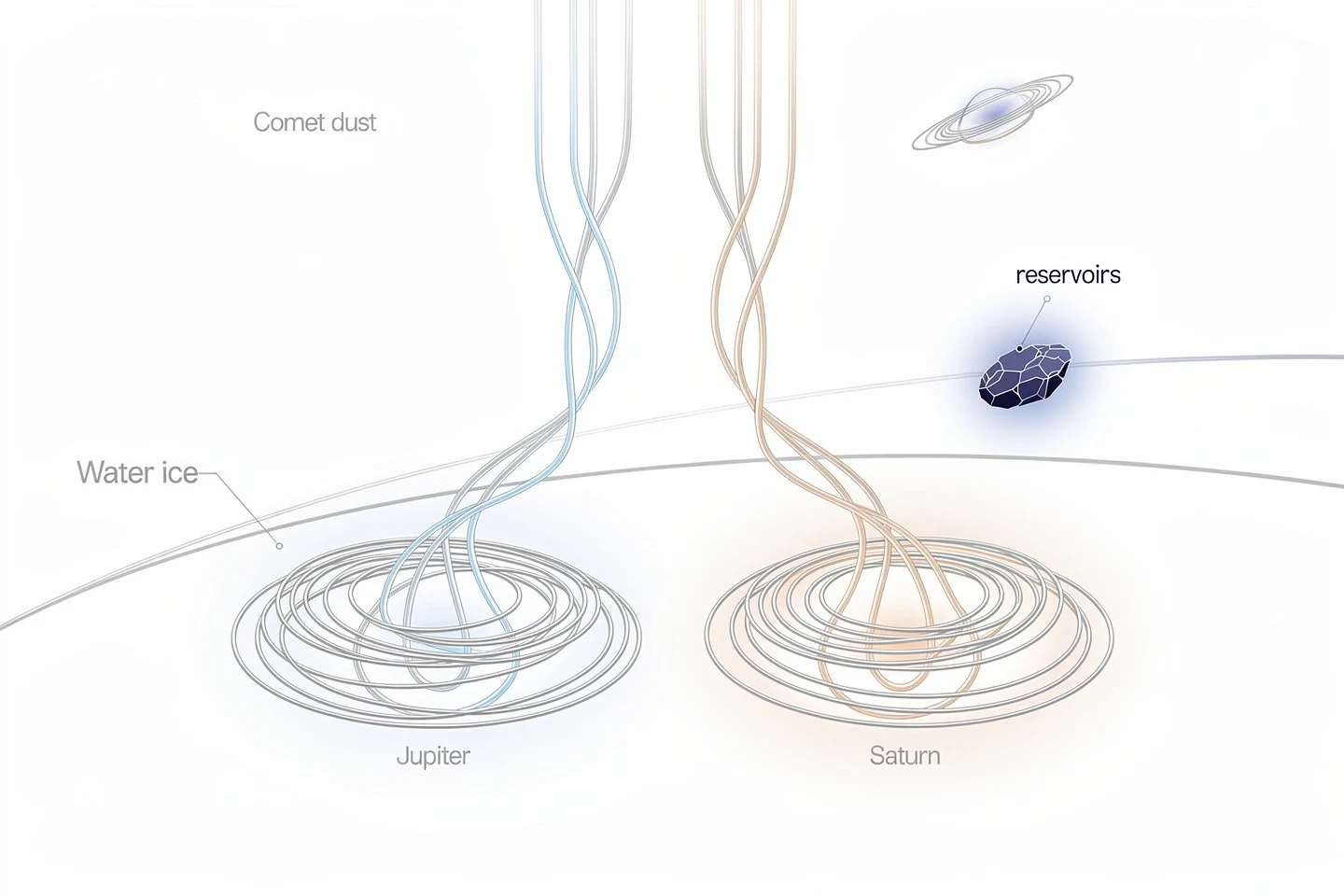
The young Solar System was like a bowl of soft-serve ice cream: ingredients swirled together to build planets. Analysis of asteroids using spectroscopy (splitting light into colors) showed that the outer giants got a late serving of cometary sprinkles — over 30% of their mass. This dust came from the same nebula, but later, when planets were already taking shape.
But the real surprise concerns Ryugu-type asteroids. They seem to have lost part of their 'ice cream' — water and volatile compounds (ammonia, carbon dioxide) — at the boundary where water freezes. That suggests they were born not in deep cold, but near the shifting snow line, where our mixture was only starting to solidify. Likely, these objects, rather than comets, became the main water deliverers for exoplanets and Earth's oceans.
Asteroids Ryugu and Bennu look like piles of rubble, but they're fragments of bodies born at the boundary where water freezes. This very fact let them clump together almost instantly, by cosmic timescales.