Comet Spice: How a Late Influx of Matter Reshaped the Outer Solar System ✛ ✦
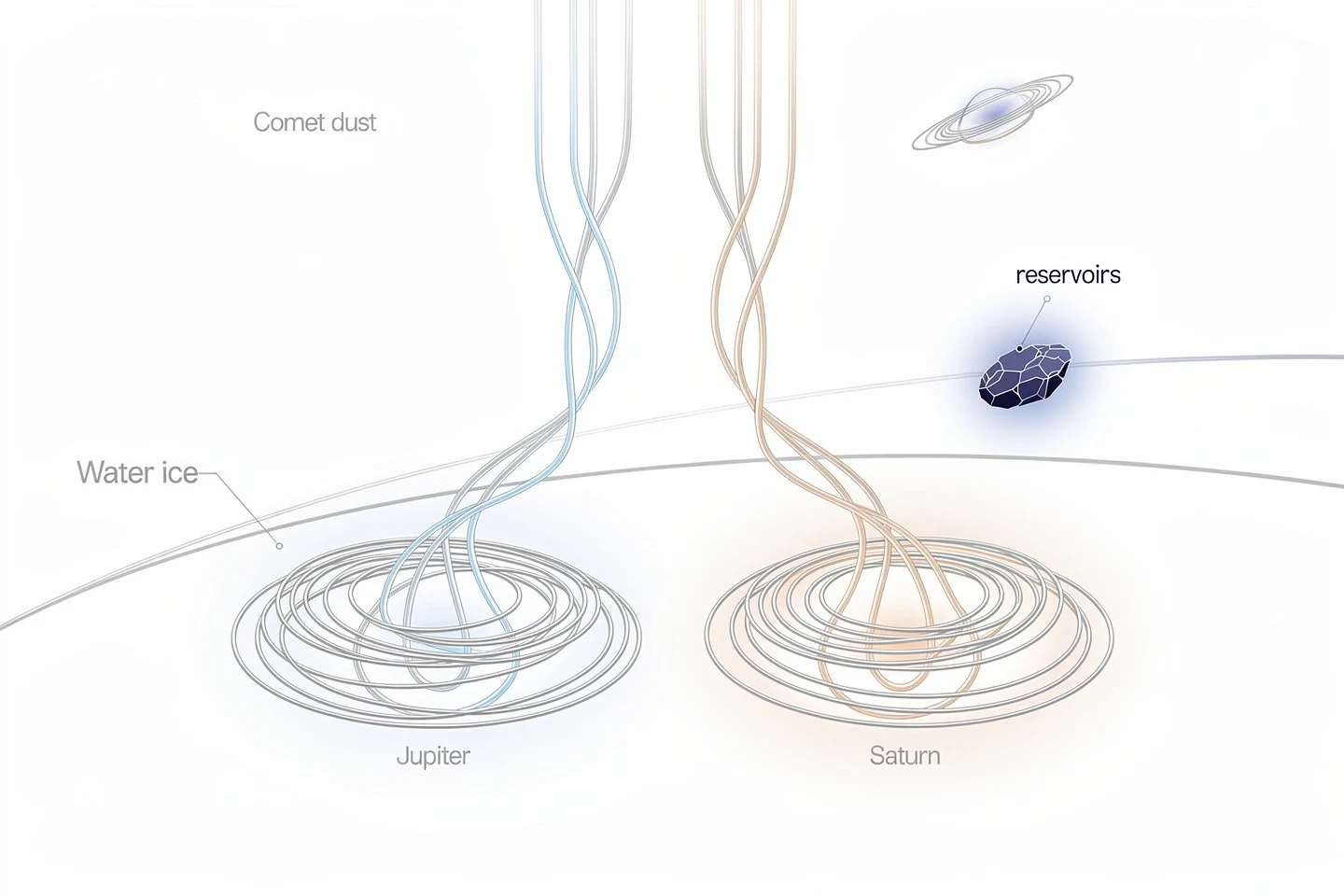
Putting together the Solar System is like crafting a high-end tasting menu: the recipe isn't always set in stone — sometimes the final ingredient is added while the dish is already cooking. For the outer planets, that ingredient was a stream of matter from the molecular cloud, injected into the protoplanetary disk millions of years after accretion began. A new isotopic study of meteorites reveals that over 30% of the mass gobbled up by the Jupiter–Saturn region had a cometary origin. This 'seasoning' permanently altered the chemical signature of the outer Solar System.
How do we know? Carbonaceous chondrites, rocky time capsules, preserve nucleosynthetic anomalies, much like different grinds of flour retain traces of the grain's terroir. Using precision mass spectrometry (a form of isotopic spectroscopy), scientists measured isotopic variations in silicon, iron, magnesium, and chromium. It turns out most outer-disk chondrites are a blend of two dust varieties: one similar to CI chondrite composition, and another, the ODD component, akin to comet dust. The isotope ratios trace a neat mixing line, like a graph of a two-wine blend.
This thermal scenario flips the old picture in which Ryugu and Bennu were wanderers from the outer fringes. Now they emerge as witnesses to the 'snow line waltz': the boundary where water turns to ice shifted during early stages, and planetesimals were born right on that thermal frontier. Large chondrules could still have been ballistically flung into the inner parts of CV chondrites, but for the bulk of the material, the outer disk remained culinarily isolated — mixing was limited.
What does this mean for our home, Earth? Water and prebiotic organics likely didn't arrive directly from icy deep space but came with planetesimals that grew near the snow line and were then scattered inward. We didn't inherit raw stuff from a distant comet cloud; we got reprocessed material, 'cooked' close to the heat. This forces a rethink of habitability models for exoplanets: the chemical starter kit for Earth-like worlds may hinge on local ice-line migration, not on direct imports from the outer reaches.
Ahead lie the decoding of returned samples from asteroids by the Hayabusa2 and OSIRIS-REx probes, and the detailed dating of chondrules. By pinning down when the last molecular plume spilled into the disk, astrophysicists can sync the birth clocks of planets and gauge how typical our path was. It's a story of how a late arrival rewrote the menu of an entire planetary system, and perhaps set the stage for life to emerge on one world. Here's food for thought: if the cometary spice made up a third of the giants' mass, their interiors hold the isotopic flavor of an alien cloud, like a dish steeped in the spices of a distant, now-vanished kitchen.
CI meteorites are the rarest of space visitors: their porous structure is so delicate that, upon atmospheric entry, they often crumble like dry biscuits. Surviving samples are genuine treasure troves, recounting the birth of planetesimals right at the snow line.