Quasar Winds Race at One-Third Light Speed ✛ ✎ ✦
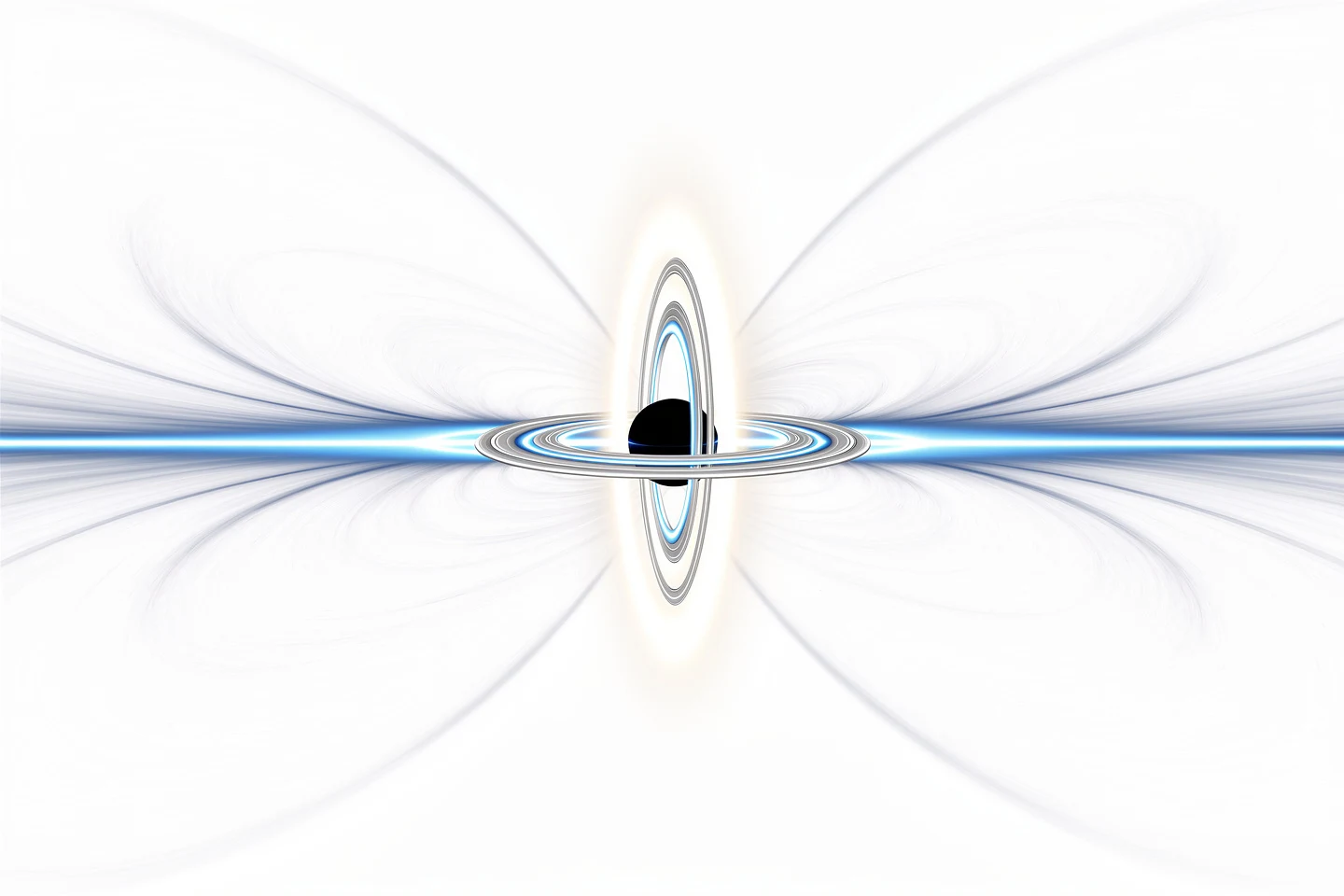
A quasar is a supermassive black hole at the center of a galaxy, consuming gas with a bright glow. In the era of “cosmic noon”, 12 billion years ago, such objects were not rare. Astronomers peered into that time with X-ray telescopes and for the first time saw two hurricane-like winds at quasar WISSH13. One gas stream races at one-third the speed of light — 100,000 km/s. It is not constant: in gusts it ejects as much matter as the black hole consumes. These winds blow out the building material for stars, preventing the galaxy from growing uncontrollably. The flows arise at the very edge of the abyss, near the Schwarzschild radius (the point of no return), and heat the surrounding gas to 200 million degrees, increasing disorder in the system. They also affect the distribution of dark matter — the invisible scaffolding of galaxies. The redshift, discovered by Edwin Hubble, helped measure the distance, and spectral analysis revealed the composition of the winds. This is reminiscent of black hole thermodynamics by Bekenstein.
If the fast wind particles traveled from Earth to the Sun, they would arrive in just over an hour — sunlight needs 8 minutes for the same journey.
The concept of ultra-fast winds steering the fate of a galaxy is reminiscent of the “Star Vortex” from Isaac Asimov’s novels, where the evolution of civilizations depended on global energy flows.