Winds of Cosmic Noon: How Quasar WISSH13 Halts Star Formation ✛ ✎ ✦
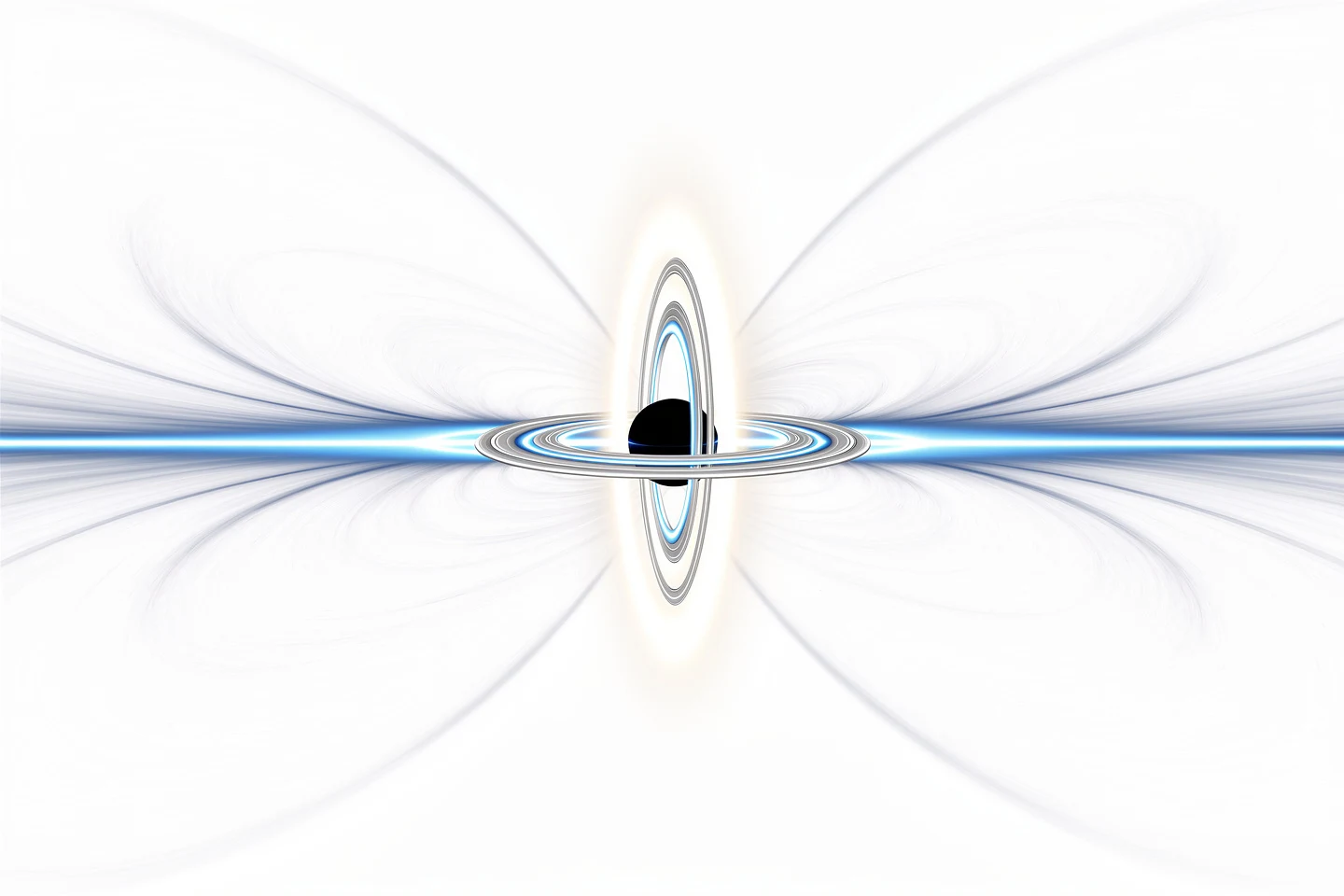
Nearly 12 billion years ago, when the Universe was experiencing the turbulent 'cosmic noon'—the era of record-breaking star formation — at the heart of one galaxy, the quasar WISSH13 was flaring up. Today, its light, having passed through the expanding fabric of space (redshift 3.294—a direct consequence of the law formulated by Edwin Hubble), reaches Earth, carrying the story of an incredible cataclysm. This quasar, like a black hole conductor, set the tone for the entire galactic symphony: the orbital telescopes XMM-Newton and NuSTAR captured the final chord — two ultrafast winds bursting out at near-light speeds. One, more gentle, raced at 0.09c (speed of light: that universal constant), the other, furious and unrestrained, at a staggering 0.33c. These outflows, detected by the shift of iron lines in the X-ray spectrum, are like an imperious flick of the baton that cuts off the crescendo of star formation. For it is precisely such a wind, sweeping gas out of a young galaxy, that can silence it forever, and, perhaps, deprive it of the chance to give birth to planets like ours.
The secret of such a voracious appetite lies in the conditions of extreme accretion. It is estimated that the black hole WISSH13 was consuming matter three times faster than the Eddington limit, heating its inner regions to a state of 'cold corona' with a temperature of about 200 million degrees (the entropy of the system remained relatively low, however). The X-rays, reflected from the incandescent disk, created a peculiar spectral pattern, which astronomers deciphered using the methods of Karl Schwarzschild — the very one who first solved Einstein's equations for black holes. Precisely because of the monstrous gravity, the launch radius of the fast wind turned out to be only nine Schwarzschild radii: it's as if a hurricane were born a few steps from the edge of the abyss, less than the orbit of Mercury! The formula for relativistic Doppler shift: $$1+z_a = \sqrt{\frac{1+\beta}{1-\beta}},\quad \beta = v/c$$—allowed these fantastic speeds to be measured, and the mass outflow equation $$\dot{M}_{out} = \Omega N_H m_p v_{out} r$$—to estimate that about 20 solar masses are ejected into space each year.
But the main point is that these winds are not just an exotic feature of the distant past. They are the key to a long-standing mystery: why do black hole masses correlate so closely with the masses of galaxy bulges? As Jacob Bekenstein once showed, the thermodynamics of black holes is inextricably linked to global evolution. The kinetic power of the WISSH13 outflows is about 10% of its bolometric luminosity, and this follows the same relationship observed in local Seyfert galaxies. This means that the feedback mechanism, where winds act as a cosmic sculptor, chiseling the profile of dark matter in the centers of halos, is universal over time. In other words, already at the dawn of the Universe, black holes picked up the baton and have not let go since, preventing galaxies from outgrowing themselves and turning into lifeless monsters.
In the coming years, the WISSHFUL program will study another fifteen similar objects, and with the launch of spectrometers on XRISM and the future NewAthena observatory, we will be able to resolve the fine structure of the winds. It's like transitioning from a noisy recording of an orchestra to clean stereo: we will learn exactly how the accretion flow 'breathes,' and perhaps understand whether some of the radiation is associated with a jet. For now, the observation of WISSH13 gives us a vivid picture of an era when every large galaxy passed through the crucible of quasar activity, and reminds us that the Universe is not a frozen mechanism but a grand performance, where even the most violent explosions play their own melody — perhaps the very one that determines the pattern of life on distant planets.
In just one Earth hour, WISSH13's fast wind covers 360 million kilometers — three times the distance from Earth to the Sun. For matter, such a speed (0.33c) is almost incredible, making it one of the fastest recorded cosmic flows.
The concept of ultrafast winds steering a galaxy's fate evokes the idea of a 'stellar vortex' from science fiction, where cosmic currents determine the destinies of worlds.